4  Wireless Link Layer


4.1 The Anchor: Shared Broadcast Medium with Location-Dependent Sensing

Every wireless link layer solves the same physical problem: multiple transmitters share a finite electromagnetic spectrum, and each must decide when to transmit without destroying the others’ signals. Two physics-level constraints anchor every design that follows. First, spectrum is scarce — the usable radio bands below 6 GHz propagate over distance and through walls, so many devices must coexist within the same frequency range. Second, a wireless transmitter cannot hear its own collision. When station A transmits, its own signal at its antenna is 40–50 dB stronger than any incoming signal — the transmitter is deaf to interference it causes at a distant receiver. Wired Ethernet solved this with collision detection (CSMA/CD), where a transmitter listens to the wire and aborts immediately upon sensing a collision. Wireless physics makes detection impossible, forcing every wireless design toward avoidance, negotiation, or centralized scheduling.

These two constraints — spectrum scarcity and half-duplex blindness — are inherited from the physical layer and cannot be engineered away. They create the binding constraint for every wireless link layer: shared broadcast medium with location-dependent sensing.

The wireless link layer must continuously answer four decision problems:

  1. When to transmit? (Should I send now, or wait?)
  2. How to detect or avoid collisions without hearing them? (My transmitter is deaf — how do I know if I collided?)
  3. Who coordinates access — distributed contention or centralized scheduling? (Is there an authority, or must devices self-organize?)
  4. How to share the medium fairly among competing devices? (When demand exceeds capacity, who gets access?)

Norman Abramson, building the first wireless packet network in 1970, framed the foundational version of these questions:

“The basic problem in any communication system involving a number of geographically distributed users is that of efficiently allocating communication channel resources among those users.” — Abramson, 1970 (Abramson 1970)

Looking back three decades later, Giuseppe Bianchi formalized the performance limits of the dominant wireless protocol (802.11 DCF) by analyzing exactly these decision problems — when each station transmits, how backoff parameters interact with station count, and where the system saturates:

“The key approximation in the model is that, at each transmission attempt, and regardless of the number of retransmissions suffered, each packet collides with constant and independent probability.” — Bianchi, 2000 (Bianchi 2000)

Bianchi’s analysis was retrospective — he formalized what the 802.11 designers had built by engineering intuition. The pioneers who created ALOHA, CSMA, and CSMA/CA had no such framework. They were solving an engineering problem from scratch, one generation at a time.


4.2 Act 1: “It’s 1970. The University of Hawaii Needs to Connect Terminals Across Islands.”

The Hawaiian Islands span 2,400 km of open ocean. In 1970, Norman Abramson at the University of Hawaii needed to connect remote terminals on neighboring islands to a central computer on Oahu. Leased telephone lines were expensive and unreliable across ocean distances. Abramson’s insight: use a shared UHF radio channel. Every terminal transmits on a single frequency (407.350 MHz); a central hub receives on that frequency and rebroadcasts acknowledgments on a second frequency (413.475 MHz). The system was called ALOHA — the first wireless packet network.

“In the ALOHA System we use a high speed random access channel for communication between a central computer and a large number of remote users.” — Abramson, 1970 (Abramson 1970)

What the pioneers saw: A handful of terminals transmitting short, bursty messages — login commands, time-sharing queries, brief data bursts. Traffic was sparse. The radio channel sat idle most of the time. The central computer on Oahu was the only destination. The problem was access, not capacity.

What remained invisible from the pioneers’ vantage point: Wireless networks would eventually serve hundreds of devices per access point, streaming video, voice, and continuous data. Traffic would shift from sparse and bursty to dense and sustained. The 18.4% utilization ceiling (Abramson 1970) that was acceptable for a dozen terminals would become catastrophic for a crowded lecture hall.

4.2.1 The Solution: Pure Random Access

Abramson’s protocol was radical in its simplicity: transmit whenever you have data. If two terminals transmit simultaneously, their signals overlap at the central receiver — a collision. The receiver detects the corruption and withholds the ACK. The sender, having received no ACK within a timeout, waits a random interval and retransmits.

Abramson applied decision placement as fully distributed — there was no coordinator, no scheduler, no shared clock. Each terminal decided independently when to transmit. This was forced by the environment: the terminals were on different islands with no shared infrastructure beyond the radio channel itself.

4.2.2 Invariant Analysis: Pure ALOHA (1970)

Invariant Pure ALOHA Answer (1970) Gap?
State None — no awareness of medium state Transmitter is blind to other activity
Time Continuous — transmit at any instant No alignment; vulnerability window = 2x packet time
Coordination None — pure random access No mechanism to prevent simultaneous transmissions
Interface Best-effort broadcast to central receiver No reservation, no priority, no fairness guarantee

The State gap is the most consequential: each terminal has zero knowledge of the medium. It transmits blindly, hoping no other terminal is active. The Time gap doubles the damage: because transmissions are unslotted, a packet is vulnerable to collision during twice its own duration — any overlap, even partial, destroys both packets. The theoretical maximum throughput is 1/(2e), approximately 18.4% of channel capacity (Abramson 1970; Roberts 1975). Above this load, the system enters collapse: more retransmissions cause more collisions, which cause more retransmissions — a positive feedback loop that drives utilization toward zero.

4.2.3 Environment → Measurement → Belief

Layer What Pure ALOHA Has What’s Missing
Environment All transmissions from all terminals, everywhere
Measurement Nothing — transmitter has no sensing capability No carrier sensing, no medium observation
Belief Assume medium is free Belief is always optimistic; diverges from reality under load

The E→M gap is physically limited — the terminals had no mechanism to sense the medium before transmitting. The radios were simplex transmitters with no receive capability during transmission. Better estimation was irrelevant; there was no signal to estimate from.

4.2.4 “The Gaps Didn’t Matter… Yet.”

Traffic was sparse and bursty. A dozen terminals sending short commands consumed a tiny fraction of the channel. At 5% utilization, collisions were rare. The 18.4% ceiling was far above actual demand. Abramson’s design worked for its environment — a cooperative academic network with modest traffic.

Roberts (1972) observed that adding a single bit of shared state — a common slot boundary — could double throughput (Roberts 1975). Slotted ALOHA synchronizes all terminals to transmit only at slot boundaries, halving the vulnerability window from 2x to 1x packet duration. Maximum throughput doubles to 1/e, approximately 36.8% (Roberts 1975; Abramson 1970). But terminals remain blind to the medium. They still transmit without sensing, still collide, still retransmit. The improvement comes entirely from time alignment, reducing the probability that two packets partially overlap.

Even 36.8% was enough for the Hawaiian terminals. But packet radio channels on the mainland were getting crowded.


4.3 Act 2: “It’s 1975. Packet Radio Channels Are Getting Crowded.”

By the mid-1970s, the U.S. military’s DARPA packet radio network and university research networks were pushing radio channel utilization well beyond what ALOHA could handle. Leonard Kleinrock and Fouad Tobagi at UCLA studied the problem systematically and identified a simple improvement: listen before you talk.

“The idea of carrier sense multiple access is to have each user listen to the channel before he transmits.” — Kleinrock and Tobagi, 1975 (Kleinrock and Tobagi 1975)

What Kleinrock and Tobagi saw: Packet radio channels where most collisions occurred because two stations transmitted simultaneously, each unaware the other was active. If a station could detect an ongoing transmission before starting its own, most collisions could be avoided. The key observation: energy detection at a radio antenna is cheap and fast — a station can sense whether the medium is busy in microseconds.

What remained invisible from the pioneers’ vantage point: Carrier sensing works only when the sensing station can actually hear the transmitter. In wireless environments, signal strength depends on distance, obstacles, and frequency. Two stations equidistant from a receiver but far from each other may be unable to hear one another — the hidden terminal problem that Tobagi and Kleinrock identified in the companion paper (Tobagi and Kleinrock 1975; Kleinrock and Tobagi 1975).

4.3.1 The Solution: Carrier Sense Multiple Access (CSMA)

CSMA adds a single measurement to ALOHA: before transmitting, sense the medium. If busy, defer. If idle, transmit. Kleinrock and Tobagi analyzed three variants:

  • 1-persistent CSMA: If busy, wait until idle, then transmit immediately. Greedy — maximizes individual throughput but causes collisions when multiple stations wait for the same transmission to end.
  • Non-persistent CSMA: If busy, wait a random interval, then sense again. Courteous — reduces collisions but wastes idle time.
  • p-persistent CSMA: If idle, transmit with probability p; with probability (1-p), defer one slot and repeat. A tunable compromise.

Kleinrock and Tobagi applied closed-loop reasoning: sense medium state (measurement) → defer if busy (decision) → attempt when idle (action). This is the first feedback loop in medium access — the system observes the environment before acting, rather than acting blindly. The improvement over ALOHA is roughly fivefold for comparable offered loads (Kleinrock and Tobagi 1975; Tobagi and Kleinrock 1975), because most collisions are avoided by deferral.

4.3.2 Invariant Analysis: CSMA (1975)

Invariant CSMA Answer (1975) Gap?
State Medium busy or idle (energy detection) Local measurement only — what one antenna hears
Time Propagation delay determines collision window Sensing is instantaneous but signal arrives late
Coordination Listen-before-talk etiquette No enforcement — stations follow convention
Interface Improved packet broadcast with deferral Still best-effort, still broadcast

The State gap is structural: carrier sensing measures energy at one point in space, but the environment is the superposition of all transmissions everywhere. A station hears only what reaches its antenna. If another station is transmitting beyond range or behind an obstacle, the sensing station measures silence — and transmits, causing a collision at the receiver.

4.3.3 Environment → Measurement → Belief

Layer What CSMA Has What’s Missing
Environment All transmissions from all stations everywhere
Measurement Local energy detection at one antenna Cannot hear transmissions beyond range or behind obstacles
Belief Medium is idle (energy below threshold) or busy Belief reflects local geometry, not global state

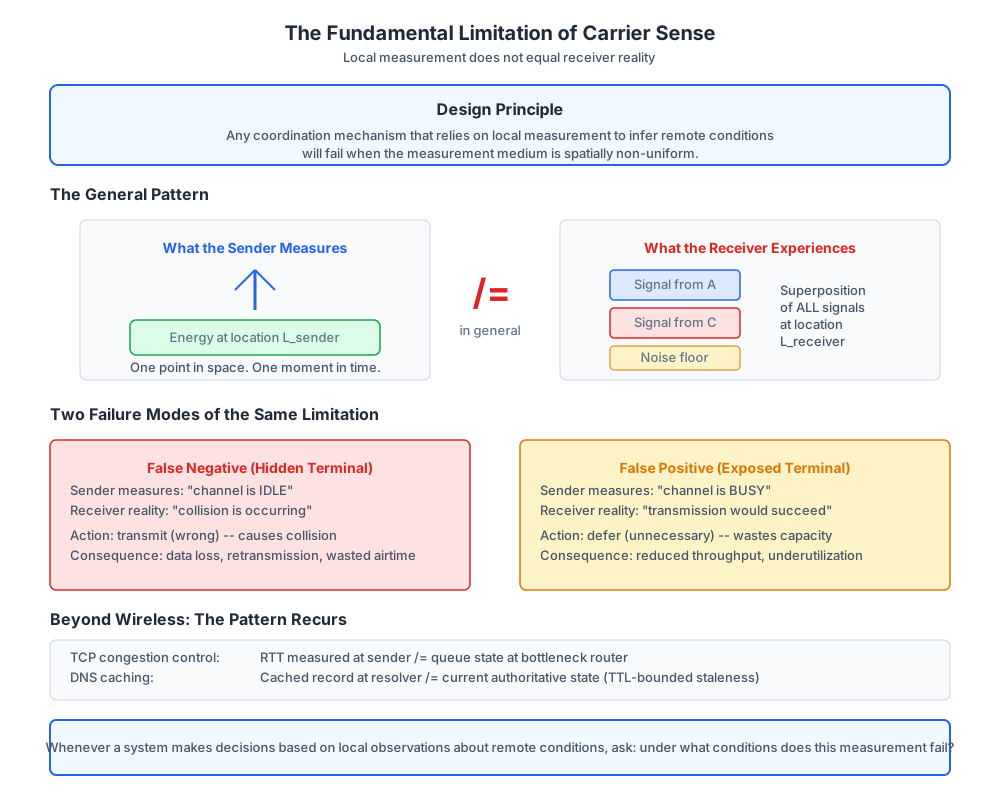
The E→M gap is structurally filtered — it is not a matter of noisy measurement or poor estimation. The gap exists because electromagnetic propagation is location-dependent. Station A, located 100 meters from station C with a concrete wall between them, receives no signal from C regardless of how sensitive A’s antenna is. The measurement is complete for A’s location but structurally incomplete for the network.

Figure 4.1: The Fundamental Limitation of Carrier Sense. Any coordination mechanism that relies on local measurement to infer remote conditions will fail when the measurement medium is spatially non-uniform. Carrier sense measures energy at one point in space; the receiver experiences the superposition of all signals at a different point. This produces two failure modes: false negatives (hidden terminals, where the sender misses an existing collision) and false positives (exposed terminals, where the sender unnecessarily defers). The same pattern recurs throughout networked systems whenever local observations drive decisions about remote conditions.

4.3.4 “The Gaps Didn’t Matter… Yet.”

Indoor environments with short range — a single room, a single building — meant most stations could hear each other. Hidden terminals (Tobagi and Kleinrock 1975) were rare when the network diameter was smaller than the radio range. CSMA provided a dramatic improvement over ALOHA for these environments (Kleinrock and Tobagi 1975).

4.3.5 Metcalfe’s Wired Solution: CSMA/CD (1976)

Robert Metcalfe, inspired by Abramson’s ALOHA, designed Ethernet for Xerox PARC in 1976 (Metcalfe and Boggs 1976). Ethernet used a shared coaxial cable — a wired broadcast medium. On a wire, propagation delay is bounded (2.5 km maximum for 10BASE5) and every station hears every transmission. Metcalfe added collision detection (CD): a transmitter monitors the wire while sending. If the observed signal differs from the transmitted signal, a collision has occurred. The transmitter aborts immediately, saving the remaining packet transmission time, and executes a binary exponential backoff.

CSMA/CD works on wire because the physical medium permits simultaneous transmission and reception — a station can send bits and listen to the wire at the same time. Wireless physics prevents this: a radio transmitter’s own signal at its antenna is 40–50 dB stronger than any incoming collision signal. The transmitter is deaf while transmitting. Collision detection is physically impossible in half-duplex wireless.

This physics constraint forced wireless toward a different strategy: collision avoidance rather than collision detection (Tobagi and Kleinrock 1975). Phil Karn (1990) proposed MACA (Multiple Access with Collision Avoidance) — a short RTS/CTS handshake before data transmission (Karn 1990). Bharghavan et al. (1994) refined this into MACAW, adding acknowledgments and fairer backoff (Bharghavan et al. 1994). These ideas became the foundation of 802.11’s Distributed Coordination Function.


4.4 Act 3: “It’s 1997. WiFi Ships. 802.11 DCF Codifies CSMA/CA.”

The IEEE 802.11 standard, ratified in 1997 (IEEE 1997), codified collision avoidance for wireless LANs. The Distributed Coordination Function (DCF) combined carrier sensing, random backoff, virtual carrier sensing (NAV), and optional RTS/CTS into a single protocol. Giuseppe Bianchi’s analytical model (2000) later revealed both the protocol’s elegance and its limits.

“The key approximation in the model is that, at each transmission attempt, and regardless of the number of retransmissions suffered, each packet collides with constant and independent probability.” — Bianchi, 2000 (Bianchi 2000)

What the 802.11 designers saw: Small wireless LANs — a home with one laptop, a small office with five desktops, a conference room with ten devices. The access point served as a bridge to the wired network. Traffic was modest: email, web browsing, file transfers. The medium was lightly loaded.

What remained invisible from the designers’ vantage point: Smartphones, tablets, IoT devices, and video streaming would push device counts to 100+ per access point in stadiums, airports, and lecture halls. At these densities, CSMA/CA’s collision probability would overwhelm its backoff mechanism, and throughput would collapse.

4.4.1 The Solution: CSMA/CA with Binary Exponential Backoff

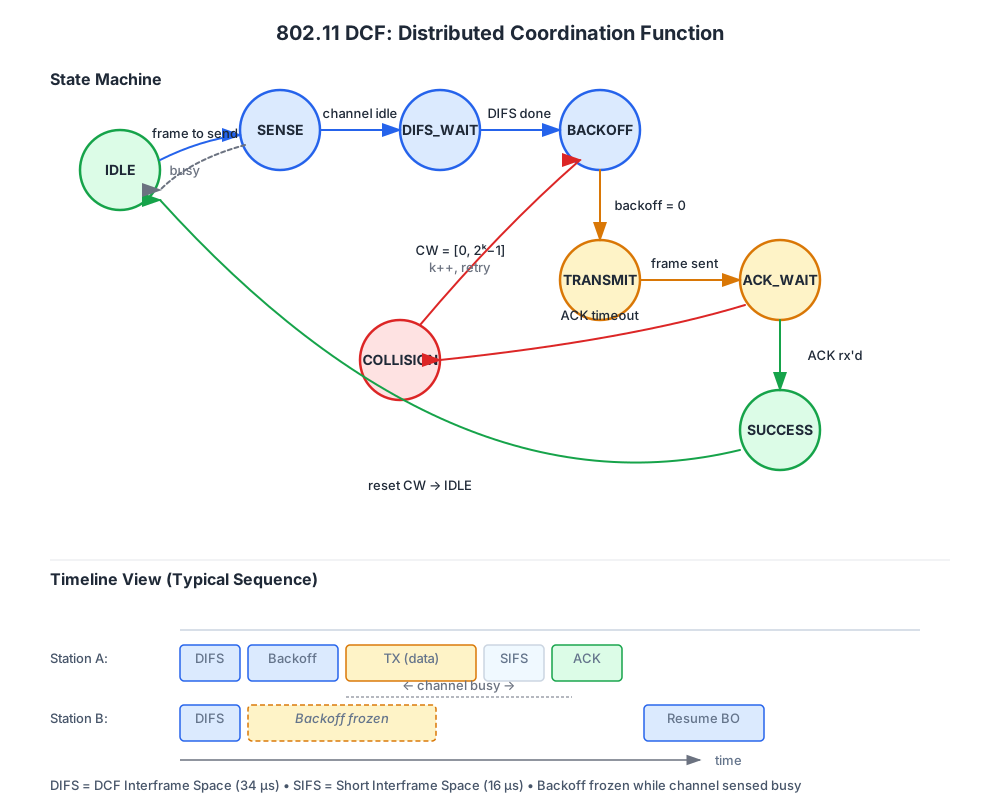
The DCF protocol (IEEE 1997): before transmitting, sense the medium. If idle for DIFS (34 microseconds)1, draw a random backoff from [0, CW] where CW starts at 31 slots. Count down one slot (20 microseconds)2 each time the medium is idle; pause when busy. When the counter reaches zero, transmit. If the receiver sends an ACK within SIFS (16 microseconds), the transmission succeeded — reset CW to 31. If no ACK arrives within 50 milliseconds, assume collision — double CW (up to 1023)3 and retry (IEEE 1997; Bianchi 2000).

The protocol applied disaggregation by separating physical carrier sensing (energy detection at the antenna) from virtual carrier sensing (NAV — Network Allocation Vector). When a station overhears any frame, it reads the Duration field and sets its NAV4 timer, deferring until the announced reservation expires (IEEE 1997). Physical sensing detects nearby activity5; virtual sensing extends awareness to announced-but-not-yet-started transmissions. Two independent sensing mechanisms, each covering a different failure mode.

The protocol applied closed-loop reasoning through the backoff mechanism: collision (inferred from ACK timeout) → increase CW → reduce transmission probability → fewer collisions. This negative feedback loop stabilizes the system under moderate load. The exponential growth of CW means each successive collision halves the attempt rate, preventing medium saturation.

Figure 4.2: The Distributed Coordination Function (DCF) coordinates medium access through a decentralized state machine where each station independently monitors channel idleness and applies random backoff. The protocol implements a closed-loop collision-avoidance mechanism: when the medium is idle for DIFS (34 microseconds), a station decrements its backoff counter once per slot (20 microseconds). If the medium becomes busy, decrementing pauses until the channel is idle again. When the backoff counter reaches zero, the station transmits its frame. Upon successful transmission, the receiver acknowledges within SIFS (16 microseconds); the station resets its contention window (CW) to the minimum (31 slots) and begins a new attempt cycle. If no ACK arrives within a timeout (typically 50 milliseconds), the station assumes collision, doubles the CW (up to 1023 slots), and applies a new random backoff. This exponential backoff creates negative feedback: collisions increase contention, reducing the attempt rate, which reduces future collisions. The binary exponential backoff timeline—CW doubling from 31 to 1023 over successive collisions—can stretch retransmission delays to tens of seconds, preventing medium saturation during overload.

4.4.2 Invariant Analysis: 802.11 DCF (1997)

Invariant 802.11 DCF Answer (1997) Gap?
State Backoff counter + CW + NAV timer Hidden stations invisible to NAV
Time Slotted (9–20 microsecond slots, SIFS/DIFS gaps) ACK timeout = 50 ms — slow feedback
Coordination Fully distributed BEB (binary exponential backoff) Throughput collapses above ~30 stations
Interface Asynchronous best-effort frames with Duration field No QoS differentiation, no priority

The Coordination gap is the most consequential for the chapter’s arc. Bianchi’s analysis (Bianchi 2000) proved that collision probability grows with station count: with CW_min = 31 (IEEE 1997) and 30 stations, approximately 40% of transmission attempts result in collisions (Bianchi 2000). At 50 stations, collision probability exceeds 50%, and useful throughput drops below 30% of channel capacity (Bianchi 2000). The backoff mechanism provides negative feedback, but its gain is insufficient to compensate for the exponential growth in collision probability.

4.4.3 Environment → Measurement → Belief

Layer What 802.11 DCF Has What’s Missing
Environment All transmissions + spatial geometry of all stations
Measurement Local energy detection + NAV from overheard frames Hidden nodes invisible; no measurement of distant stations
Belief Medium available when NAV=0 and energy below threshold Belief accurate for nearby stations; blind to distant ones

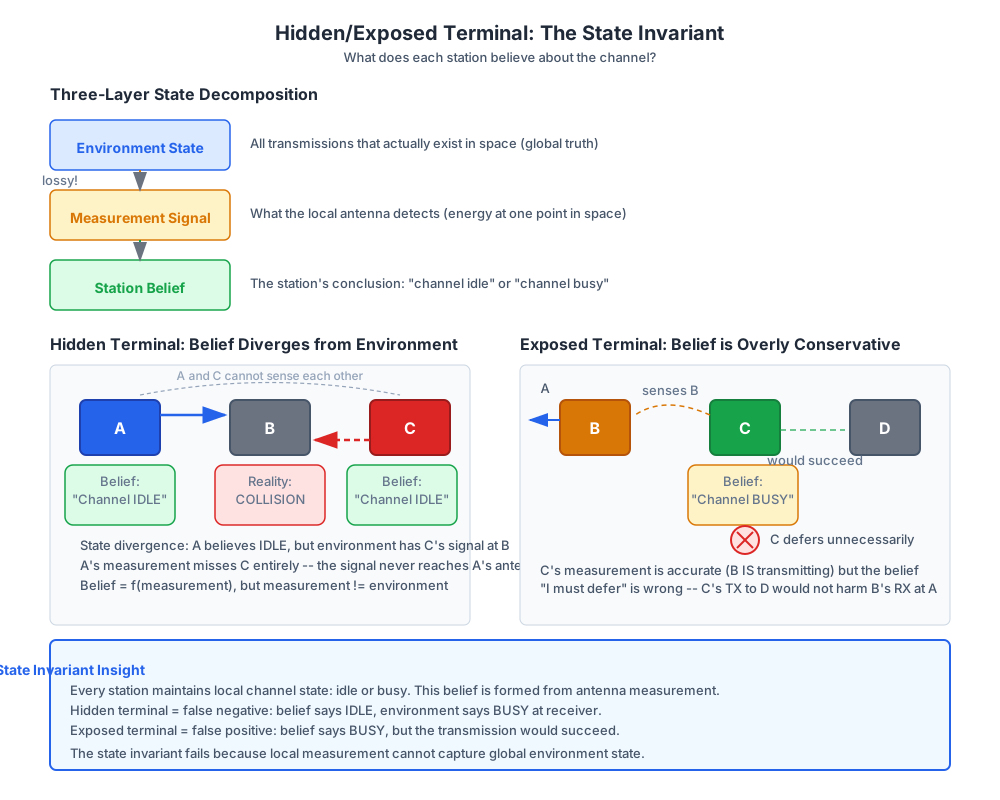
The E→M gap remains structurally filtered — hidden terminals persist because location-dependent sensing is fundamental to wireless physics. RTS/CTS mitigates the gap by extending reservation visibility (Karn 1990; Bharghavan et al. 1994) (a station that hears the CTS defers even if it cannot hear the data sender), but stations completely out of range of both sender and receiver remain invisible.

Figure 4.3: Figure 2.3a — State Invariant. Each station maintains local channel state (idle or busy) derived from antenna measurement. The hidden terminal is a false negative: A believes the channel is idle while C’s signal collides at B. The exposed terminal is a false positive: C believes the channel is busy when its transmission to D would succeed. Both failures arise because local measurement cannot capture the global environment state.

4.4.4 Interactive: CSMA/CA Throughput vs. Station Count

TipInteractive: CSMA/CA Throughput vs. Station Count

Use the slider below to vary the number of competing stations and observe how throughput collapses as contention increases. The simulation models Bianchi’s analytical approximation (Bianchi 2000) of the binary exponential backoff dynamics (IEEE 1997).

(a)
(b)
(c)
Figure 4.4: CSMA/CA throughput as a function of competing stations. As station count grows beyond ~10, collision probability rises faster than backoff can compensate, and throughput collapses toward zero.

4.4.5 “The Gaps Didn’t Matter… Yet.”

Early WiFi deployments were sparse. A home had one laptop and one AP. A small office had five devices. Conference rooms rarely exceeded ten. At these densities, collision probability stayed below 10%, and throughput remained close to the single-station maximum. Hidden terminals were uncommon in single-room deployments where every station was within range of every other.

Then density increased. Stadiums with 70,000 spectators, each carrying a smartphone. Airport terminals with hundreds of travelers streaming video. University lecture halls with 200 students on laptops. At 100+ devices per AP, CSMA/CA’s contention overhead dominates: more than half of all transmission attempts collide, backoff windows saturate at CW_max, and useful throughput drops below 20% of channel capacity.


4.5 Act 4: “It’s 2021. WiFi Adopts Cellular-Style Scheduling. 802.11ax Ships.”

4.5.1 Which Invariant Broke?

Invariant What Broke Concrete Consequence
Coordination Distributed contention scales poorly with station count At 100 stations, >50% of attempts collide; throughput per user drops below 1 Mbps
State Single NAV timer conflates overlapping BSSs Neighboring APs’ traffic triggers unnecessary deferral, wasting 30–40% of airtime
Time Fixed slot timing wastes outdoor subcarrier efficiency OFDM symbol duration mismatched to diverse deployment distances

Bianchi’s analysis (Bianchi 2000) proved the Coordination failure formally: collision probability p grows as 1 - (1 - tau)^(n-1), where tau is per-station transmission probability and n is station count. With CW_min = 31 (IEEE 1997), the protocol provides adequate negative feedback for n < 20 but insufficient gain for n > 50 (Bianchi 2000). The collision rate grows exponentially with station count while the backoff mechanism grows only linearly (doubling CW on each collision). Dense deployments broke the equilibrium that CSMA/CA assumed.

4.5.2 802.11ax: The AP Becomes a Scheduler

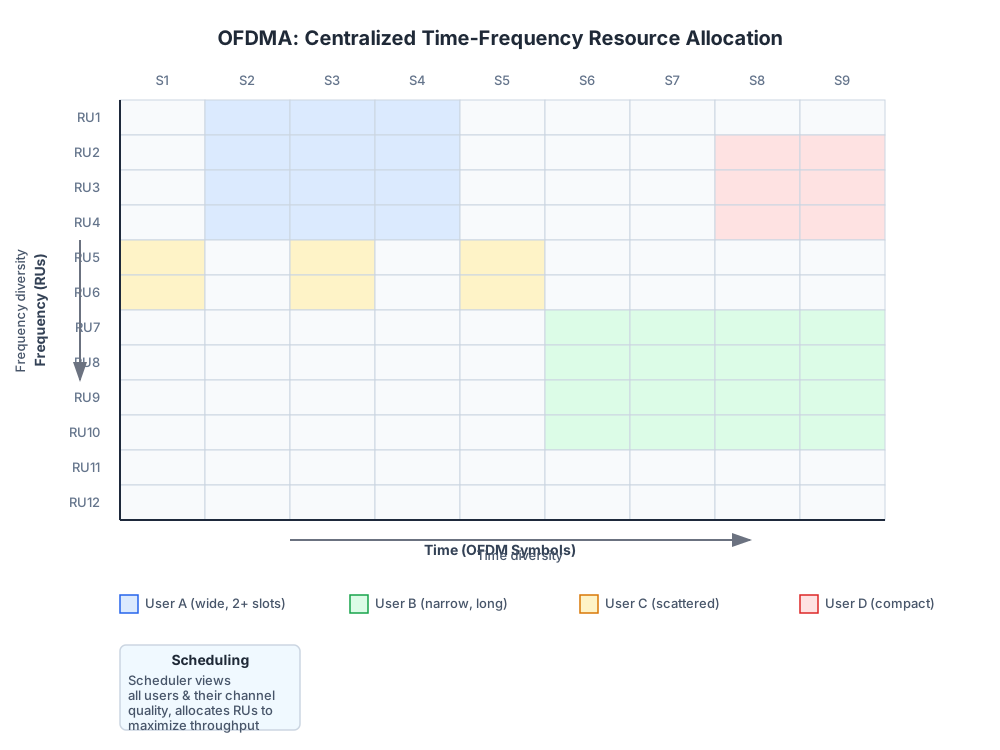
The IEEE 802.11ax standard (WiFi 6, ratified 2021) (IEEE 2021) responded by borrowing the coordination model that cellular networks had used since inception: OFDMA — Orthogonal Frequency Division Multiple Access (Khorov et al. 2019). The AP divides the channel into fine-grained resource units (RUs) in both frequency and time, and explicitly schedules each station’s transmission.

The standard applied decision placement by shifting from fully distributed (each station decides independently) to centralized at the AP (the AP decides who transmits when and where). This is the most dramatic coordination shift in WiFi’s history — the same shift that cellular made at inception, now forced upon WiFi by density pressure.

The standard applied disaggregation by partitioning the channel into resource units (IEEE 2021; Khorov et al. 2019). A 20 MHz channel divides into up to 9 RUs6; an 80 MHz channel into 37 RUs (Khorov et al. 2019). Each RU is independently allocated to a different station. Collisions become impossible by construction — RUs are non-overlapping. The binary decision of CSMA/CA (“transmit or defer on the entire channel”) is replaced by fine-grained allocation (“transmit on RU 7 during this trigger frame”).

The standard applied closed-loop reasoning through CQI (Channel Quality Indicator) feedback: each station reports its channel quality per RU to the AP, which uses this information to allocate RUs optimally. The feedback loop operates on a 1–5 millisecond cycle — 10x faster than CSMA/CA’s 50 ms ACK timeout.

Additional mechanisms (IEEE 2021): BSS Coloring tags each BSS (Basic Service Set — the set of stations associated with a single AP) with a 6-bit color. Stations can distinguish frames from their own BSS versus neighboring BSSs, enabling spatial reuse — two APs using the same channel but different colors can transmit simultaneously if their stations are sufficiently separated. Target Wake Time (TWT) schedules IoT devices to wake at predetermined intervals, reducing contention from low-duty-cycle devices (IEEE 2021; Khorov et al. 2019).

Figure 4.5: OFDMA (Orthogonal Frequency Division Multiple Access) disaggregates the spectrum into discrete, non-overlapping resource elements—time-frequency blocks that can be allocated independently to different users. The base station scheduler partitions a 20 MHz channel into 100 physical resource blocks (PRBs), each 180 kHz wide and 1 millisecond deep (in LTE), creating a two-dimensional resource grid. This grid eliminates the binary decision (“transmit or defer”) that CSMA/CA faces on an undefined medium. Instead, the scheduler makes explicit allocation decisions: “User A gets PRBs 1–5 in TTI 10; User B gets PRBs 6–12 in TTI 10; User C gets PRBs 13–25 in TTI 10.” Collisions are impossible by construction because resource elements are strictly partitioned. In contrast to WiFi’s distributed contention where each station independently listens and backs off, OFDMA centralizes allocation at the base station. Every 1 millisecond (one transmission time interval or TTI), the scheduler observes channel quality reports (CQI) from all connected devices, computes the allocation that maximizes throughput subject to fairness constraints, and broadcasts a trigger frame specifying which PRBs each user can access. This centralized control enables utilization >70%—far exceeding the ~30% ceiling of CSMA/CA—because the scheduler prevents collisions through coordination rather than hoping devices will avoid them. The cost is infrastructure dependency (an access point is mandatory, ad hoc operation is not possible) and measurement overhead (users must report CQI every 5–40 milliseconds), but the throughput gains justify the tradeoff in licensed spectrum deployments.

4.5.3 Before/After Comparison

What Changed CSMA/CA (Before) 802.11ax OFDMA (After)
Coordination Distributed — each station contends Centralized — AP schedules via trigger frames
State Local backoff counter + single NAV BSS Color + dual NAVs (intra/inter-BSS) + BSR
Time 20 microsecond slots, 50 ms ACK timeout 12.8 microsecond OFDM symbols, 1–5 ms scheduling cycle
Interface Contend for entire channel Allocated specific RU within channel
Collision rate >50% at 100 stations ~0% (collisions eliminated by design)
Throughput/station <1 Mbps at 100 stations 5–10 Mbps at 100 stations

4.5.4 Invariant Analysis: 802.11ax (2021)

Invariant 802.11ax Answer (2021) Gap?
State BSS Color + dual NAVs + Buffer Status Reports Inter-BSS coordination still missing
Time 12.8 microsecond OFDM symbols + TWT scheduling Trigger frame overhead reduces efficiency
Coordination AP scheduler with trigger frames (hybrid LBT + scheduled) AP-to-AP coordination absent — overlapping BSSs still interfere
Interface Sub-channelized RU grid per station Requires AP infrastructure — ad hoc mode abandoned

The remaining gap is inter-BSS interference. Each AP schedules its own stations, but neighboring APs on the same channel have no coordination mechanism. BSS Coloring enables spatial reuse detection but provides no joint scheduling. In dense apartment buildings with dozens of overlapping BSSs, inter-AP interference remains the dominant throughput limiter.

4.5.5 Environment → Measurement → Belief After the Fix

Layer DCF (Before) 802.11ax (After) Gap Closed?
Environment All transmissions + spatial geometry Same + multi-BSS interference patterns
Measurement Local energy + NAV from overheard frames CQI per RU + BSS Color detection + BSR Intra-BSS: yes
Belief Medium free when NAV=0 and energy low Per-RU allocation table at AP Intra-BSS: yes; Inter-BSS: no

4.6 Act 5: “The Cellular Alternative: Centralized from Day One”

WiFi started distributed and was forced toward centralization by density. Cellular networks took the opposite path: centralized from inception (MacDonald 1979). The binding constraint is different — licensed spectrum exclusivity. A carrier owns a frequency band by regulatory grant. This ownership justifies infrastructure investment (base stations, backhaul, spectrum licenses) and eliminates the need for distributed contention. There are no competing unlicensed devices; the carrier has exclusive access.

The cellular evolution is a progression in allocation granularity and feedback speed, driven by the same three design principles.

4.6.1 FDMA (1G, 1980s): Static Frequency Channels

Divide spectrum into fixed frequency channels (30 kHz each) (MacDonald 1979). Assign one channel per active call for the call’s duration. The base station tracks which channels are in use. Capacity: approximately 200 users per cell (MacDonald 1979). Gap: a channel is held even during silence — a phone conversation has 60% silence, wasting 60% of the allocated spectrum. Decision placement is centralized. No feedback loop exists — allocation is static for the call’s duration.

4.6.2 TDMA (2G/GSM, 1990s): Time Slots Within Frequency Channels

Further divide each frequency channel into time slots (GSM: 8 slots per 4.615 ms frame) (Dahlman et al. 2020). Assign users a (frequency, slot) pair. Capacity increases 8x over FDMA. Gap: rigid slot structure requires tight synchronization across base stations; handoff between cells demands frame timing alignment. The standard applied disaggregation by separating frequency division from time division — two independent allocation dimensions. Feedback remains coarse: power control updates every 60 ms.

4.6.3 CDMA (3G, 1991): All Users on the Same Frequency

Klein Gilhousen and Qualcomm’s team demonstrated that all users could share the same wideband frequency, separated by orthogonal spreading codes (Gilhousen et al. 1991; Viterbi 1995). User A’s data is multiplied by a unique high-frequency code; user B uses a different code. Both transmit simultaneously on the same frequency. The receiver decodes by correlating the received signal with the target code, recovering only the intended data.

CDMA represents a fundamentally different philosophy: there are no collisions, no slots, no frequency partitions. All users transmit all the time on all frequencies. The medium is interference-limited rather than collision-limited. Capacity depends on how many simultaneous users the receiver can decode before interference overwhelms the signal.

The critical challenge is the near-far problem (Gilhousen et al. 1991): a mobile 100 meters from the base station arrives 20 dB stronger than a mobile 1 km away. The strong signal drowns the weak one. Gilhousen applied closed-loop reasoning through fast power control: the base station measures each mobile’s received power and sends power-up or power-down commands every 1.25 ms (Gilhousen et al. 1991; Viterbi 1995). Each mobile adjusts its transmit power so that all signals arrive at the base station at approximately equal strength. This 800 Hz feedback loop is the fastest closed loop in cellular history up to that point.

4.6.4 OFDMA (4G/LTE, 2009): Fine-Grained Resource Blocks

LTE (3GPP 2009) divides spectrum into small subcarriers (15 kHz spacing) and 1 ms time slots. A resource block (RB) is one subcarrier group in one slot (3GPP 2009). The scheduler allocates RBs to users every 1 ms based on CQI feedback. Capacity: highest utilization of any generation. The standard applied disaggregation further — frequency, time, and spatial dimensions are all independently allocatable. The standard applied closed-loop reasoning with a 1 ms CQI feedback loop — 1000x faster than FDMA’s static allocation.

4.6.5 Massive MIMO (Multiple-Input Multiple-Output) (5G, 2010): Spatial Multiplexing

Thomas Marzetta proposed that a base station with many more antennas than active users (e.g., 64 or 128 antennas serving 16 users) could form independent spatial beams to each user simultaneously (Marzetta 2010), building on the MIMO capacity results of Foschini (Foschini 1996) and Telatar (Telatar 1999). Medium access becomes a beamforming problem (Marzetta 2010) — the base station points distinct energy beams at distinct users, and interference between beams approaches zero as antenna count grows. The standard applied disaggregation to the spatial dimension: each beam is an independent channel, and the number of independent channels scales with antenna count. The scheduling problem shifts from “which time-frequency block for which user” to “which spatial beam for which user” — a fundamentally higher-dimensional allocation space.


4.7 Act 6: “WiFi-Cellular Convergence”

The two evolutionary paths — WiFi starting distributed, cellular starting centralized — are converging. The mechanism is mutual borrowing.

WiFi borrowed OFDMA from cellular. The 802.11ax standard (IEEE 2021) adopted OFDMA resource allocation, trigger-based scheduling, and CQI feedback — all mechanisms pioneered in LTE (3GPP 2009). The AP became a scheduler, mirroring the base station’s role. The conceptual distance between a WiFi 6 AP and an LTE small cell has narrowed dramatically.

Cellular borrowed listen-before-talk from WiFi. When LTE moved into unlicensed spectrum (LTE-LAA, 3GPP Release 13, 2016) (3GPP 2016) and 5G NR-U (3GPP 2022) followed, cellular devices had to coexist with WiFi on shared channels. Regulatory requirements in the 5 GHz band mandate listen-before-talk — the same carrier sensing that Kleinrock and Tobagi introduced in 1975. A cellular base station, designed for exclusive licensed spectrum, now senses the medium and defers to WiFi traffic before transmitting (Kleinrock and Tobagi 1975).

The institutional barrier is eroding. Licensed and unlicensed spectrum regimes historically kept WiFi and cellular in separate worlds. Three developments are blurring this boundary: the 6 GHz band (Wi-Fi 6E and 5G NR-U both target the same greenfield spectrum), CBRS (Citizens Broadband Radio Service — a shared-access spectrum model in 3.5 GHz where priority tiers replace exclusive licensing), and private 5G networks that operate more like enterprise WiFi than carrier cellular.

The convergence point: when the spectrum regime aligns (shared access, no exclusive license), WiFi and cellular designs face identical constraints — and produce increasingly similar solutions. OFDMA scheduling, CQI feedback, spatial multiplexing, and listen-before-talk appear in both. The remaining differences are institutional (who manages the infrastructure) rather than technical (how the medium is accessed).


4.8 The Grand Arc: From ALOHA to Massive MIMO

4.8.1 The Evolving Anchor

Era System Binding Constraint STATE TIME COORDINATION INTERFACE
1970 ALOHA No sensing mechanism Zero — blind Continuous, unaligned None — random access Best-effort broadcast
1975 CSMA Location-dependent sensing Medium busy/idle Propagation delay matters Listen-before-talk Improved broadcast
1976 Ethernet CSMA/CD Bounded wired propagation Medium + collision signal Slot = 2x max propagation Detect and abort Wired bus frames
1997 802.11 DCF Half-duplex wireless Backoff + CW + NAV Slotted (9–20 microseconds) Distributed BEB Async best-effort frames
1991 CDMA IS-95 Near-far interference Per-user code + power level 1.25 ms power control Centralized + power control Spread-spectrum codes
2009 LTE OFDMA Channel variation per user CQI per resource block 1 ms TTI scheduling Centralized scheduler Resource block grid
2021 802.11ax Dense contention BSS Color + dual NAV + BSR 12.8 microsecond OFDM symbols Hybrid LBT + AP scheduler Sub-channelized RU grid
2020 5G Massive MIMO Spatial multiplexing capacity Per-beam CSI Flexible numerology Centralized beamforming Spatial beam allocation

4.8.2 Three Design Principles Applied Across the Arc

Disaggregation. The shared medium was progressively decomposed into independent dimensions. ALOHA treated the channel as a single indivisible resource. FDMA separated frequency. TDMA separated time within frequency. CDMA separated users by code within the same time and frequency. OFDMA combined frequency and time into a fine-grained grid. Massive MIMO added spatial separation. Each decomposition created a new allocation dimension and a new interface — and each interface enabled independent evolution of the separated components.

Closed-loop reasoning. The feedback loop tightened across generations. ALOHA had no feedback before transmission (blind access) (Abramson 1970). CSMA added pre-transmission sensing (carrier detect) (Kleinrock and Tobagi 1975). CSMA/CA added post-transmission inference (ACK timeout at 50 ms) (IEEE 1997). CDMA added fast power control (1.25 ms loop) (Gilhousen et al. 1991). OFDMA added per-user CQI reporting (1 ms loop) (3GPP 2009). Massive MIMO adds per-beam CSI (channel state information) estimation. Each tighter loop enables finer-grained adaptation — from “is anyone transmitting?” to “what is this user’s channel quality on this subcarrier in this direction?”

Decision placement. The WiFi lineage moved from fully distributed (ALOHA, CSMA, CSMA/CA) toward centralized (802.11ax AP scheduler). The cellular lineage was centralized from inception (base station scheduler in every generation). The convergence of both paths toward centralized scheduling confirms that density pressure, regardless of starting point, forces centralization — distributed contention scales linearly while centralized scheduling scales with the number of allocatable resource units.

4.8.3 The Dependency Chain

flowchart TD
    A[Shared medium<br/>finite spectrum] --> B[No coordination:<br/>ALOHA 18.4%]
    B --> C{Environment changed:<br/>more users}
    C --> D[Carrier sensing:<br/>CSMA 5x improvement]
    D --> E{Physics constraint:<br/>wireless half-duplex}
    E --> F[Collision avoidance:<br/>802.11 CSMA/CA]
    F --> G{Density increased:<br/>100+ devices/AP}
    G --> H[Centralized scheduling:<br/>802.11ax OFDMA]

    A --> I[Licensed spectrum:<br/>exclusive ownership]
    I --> J[Centralized scheduling:<br/>FDMA → TDMA → CDMA]
    J --> K[Fine-grained OFDMA:<br/>1ms feedback loop]
    K --> L[Spatial multiplexing:<br/>Massive MIMO]

    H --> M[Convergence:<br/>WiFi and cellular<br/>meet at OFDMA]
    K --> M

    style A fill:#e3f2fd
    style B fill:#ffcdd2
    style D fill:#c8e6c9
    style F fill:#c8e6c9
    style H fill:#c8e6c9
    style I fill:#e3f2fd
    style J fill:#c8e6c9
    style K fill:#c8e6c9
    style L fill:#c8e6c9
    style M fill:#fff9c4

4.8.4 Pioneer Diagnosis Table

Year Pioneer Invariant Diagnosis Contribution
1970 Abramson — (first design) Shared medium needs access protocol Pure ALOHA — random access, 18.4% ceiling (Abramson 1970)
1972 Roberts Time Unslotted access doubles vulnerability window Slotted ALOHA — 36.8% ceiling (Roberts 1975)
1975 Kleinrock/Tobagi State Blind transmission wastes capacity CSMA — carrier sensing before transmission (Kleinrock and Tobagi 1975)
1975 Tobagi State (measurement) Local sensing misses hidden transmitters Hidden terminal problem identified (Tobagi and Kleinrock 1975)
1976 Metcalfe Coordination Collisions waste transmission time on wire CSMA/CD — detect and abort on Ethernet (Metcalfe and Boggs 1976)
1990 Karn Coordination Wireless half-duplex prevents detection MACA — RTS/CTS handshake for avoidance (Karn 1990)
1997 IEEE 802.11 Coordination Standardized wireless LAN access DCF: CSMA/CA + BEB + NAV (IEEE 1997)
2000 Bianchi Coordination Collision probability grows exponentially Analytical model proving DCF saturation limits (Bianchi 2000)
1991 Gilhousen State (measurement) Near-far problem requires power equalization CDMA with fast power control (Gilhousen et al. 1991)
2010 Marzetta Interface Time-frequency scheduling has capacity ceiling Massive MIMO — spatial multiplexing as access (Marzetta 2010)
2021 IEEE 802.11ax Coordination Distributed contention fails under density OFDMA + trigger-based scheduling for WiFi (IEEE 2021)

4.8.5 Innovation Timeline

flowchart TD
    subgraph sg1["Random Access"]
        A1["1970 — Abramson: Pure ALOHA"]
        A2["1972 — Roberts: Slotted ALOHA"]
        A1 --> A2
    end
    subgraph sg2["Carrier Sensing"]
        B1["1975 — Kleinrock/Tobagi: CSMA"]
        B2["1975 — Tobagi: Hidden Terminal"]
        B3["1976 — Metcalfe: Ethernet CSMA/CD"]
        B1 --> B2 --> B3
    end
    subgraph sg3["WiFi"]
        C1["1990 — Karn: MACA (RTS/CTS)"]
        C2["1997 — IEEE 802.11: CSMA/CA DCF"]
        C3["2000 — Bianchi: DCF Analysis"]
        C4["2009 — 802.11n: MIMO"]
        C1 --> C2 --> C3 --> C4
    end
    subgraph sg4["Cellular"]
        D1["1991 — Gilhousen: CDMA"]
        D2["2009 — LTE: OFDMA"]
        D3["2010 — Marzetta: Massive MIMO"]
        D1 --> D2 --> D3
    end
    subgraph sg5["Convergence"]
        E1["2020 — 5G NR: Flexible Numerology"]
        E2["2021 — 802.11ax: WiFi OFDMA"]
        E1 --> E2
    end
    sg1 --> sg2 --> sg3 --> sg4 --> sg5

Medium Access Innovation Timeline


4.9 Generative Exercises

TipExercise 1: Satellite Medium Access

A low-earth-orbit satellite constellation serves ground terminals with a 25 ms round-trip time (LEO) or 600 ms round-trip time (GEO). Using the four invariants, predict which coordination model each orbit altitude demands. Where does CSMA/CA break? Where does centralized scheduling break? What is the binding constraint for each, and how does it force the invariant answers?

TipExercise 2: WiFi at Scale

A university deploys WiFi in a 500-seat lecture hall. Each student has a laptop and a smartphone — 1,000 devices competing for a single AP. Using Bianchi’s model (Bianchi 2000), predict which invariant breaks first. Then propose a redesign: which invariant answer must change, and what is the minimum mechanism required? Would 802.11ax solve this, or does the inter-BSS gap remain?

TipExercise 3: Vehicle-to-Everything (V2X) Medium Access

Self-driving cars must exchange safety messages (position, speed, braking) with sub-10 ms latency and 99.99% reliability within a 300-meter radius. Using the framework, identify the binding constraint. Is it spectrum scarcity, latency, reliability, or something else? Predict whether the coordination model should be distributed (like CSMA/CA), centralized (like LTE), or something new. What measurement signal would the closed loop use?


4.10 References

3GPP. 2009. E-UTRA; Physical Layer; General Description. TS 36.201. 3rd Generation Partnership Project.
3GPP. 2016. E-UTRA and E-UTRAN; Overall Description; Stage 2 (Release 13). TS 36.300 v13. 3rd Generation Partnership Project.
3GPP. 2022a. E-UTRA and E-UTRAN Overall Description; Stage 2. TS 36.300. 3rd Generation Partnership Project.
3GPP. 2022b. NR; NR and NG-RAN Overall Description; Stage 2. TS 38.300. 3rd Generation Partnership Project.
3GPP. 2022c. Radio Interface Protocol Architecture. TS 25.301. 3rd Generation Partnership Project.
3GPP. 2022d. System Architecture for the 5G System (5GS); Stage 2. TS 23.501. 3rd Generation Partnership Project.
Abramson, Norman. 1970. “The ALOHA System: Another Alternative for Computer Communications.” Proceedings of the Fall Joint Computer Conference, 281–85.
Al-Fares, Mohammad, Alexander Loukissas, and Amin Vahdat. 2008. “A Scalable, Commodity Data Center Network Architecture.” Proceedings of the ACM SIGCOMM Conference, 63–74.
Alizadeh, Mohammad, Albert Greenberg, David A. Maltz, et al. 2010. “Data Center TCP (DCTCP).” Proceedings of the ACM SIGCOMM Conference, 63–74.
Alvestrand, Harald. 2021. Overview: Real-Time Protocols for Browser-Based Applications. RFC No. 8825. IETF.
Andrews, Jeffrey G., Stefano Buzzi, Wan Choi, et al. 2014. “What Will 5G Be?” IEEE Journal on Selected Areas in Communications 32 (6): 1065–82.
Anthropic. 2024. Introducing the Model Context Protocol. Https://www.anthropic.com/news/model-context-protocol.
Arends, Roy, Rob Austein, Matt Larson, Dan Massey, and Scott Rose. 2005. DNS Security Introduction and Requirements. RFC No. 4033. IETF.
Arnold, Todd, Matt Calder, Italo Cunha, et al. 2019. “Beating BGP Is Harder Than We Thought.” Proc. ACM HotNets, 1–8.
Bai, Yuntao, Saurav Kadavath, Sandipan Kundu, et al. 2022. “Constitutional AI: Harmlessness from AI Feedback.” arXiv Preprint arXiv:2212.08073.
Baker, Fred, and Gorry Fairhurst. 2015. IETF Recommendations Regarding Active Queue Management. RFC No. 7567. IETF.
Baran, Paul. 1964. “On Distributed Communications Networks.” IEEE Transactions on Communications Systems 12 (1): 1–9.
Baset, Salman A., and Henning Schulzrinne. 2006. “An Analysis of the Skype Peer-to-Peer Internet Telephony Protocol.” Proc. IEEE INFOCOM.
Bellman, Richard. 1958. “On a Routing Problem.” Quarterly of Applied Mathematics 16 (1): 87–90.
Belshe, Mike. 2010. More Bandwidth Doesn’t Matter (Much).
Belshe, Mike, and Roberto Peon. 2012. SPDY Protocol.
Belshe, Mike, Roberto Peon, and Martin Thomson. 2015. Hypertext Transfer Protocol Version 2 (HTTP/2). RFC No. 7540. IETF.
Berners-Lee, Tim. 1991. The Original HTTP as Defined in 1991.
Berners-Lee, Tim, Roy Fielding, and Henrik Frystyk. 1996. Hypertext Transfer Protocol — HTTP/1.0. RFC No. 1945. IETF.
Bharghavan, Vaduvur, Alan Demers, Scott Shenker, and Lixia Zhang. 1994. MACAW: A Media Access Protocol for Wireless LANs.” Proceedings of the ACM SIGCOMM Conference, 212–25.
Bianchi, Giuseppe. 2000. “Performance Analysis of the IEEE 802.11 Distributed Coordination Function.” IEEE Journal on Selected Areas in Communications 18 (3): 535–47.
Bishop, Mike. 2022. HTTP/3. RFC No. 9114. IETF.
Bonati, Leonardo, Michele Polese, Salvatore D’Oro, Stefano Basagni, and Tommaso Melodia. 2020. “Open, Programmable, and Virtualized 5G Networks: State-of-the-Art and the Road Ahead.” Computer Networks 182: 107516.
Bosshart, Pat, Dan Daly, Glen Gibb, et al. 2014. P4: Programming Protocol-Independent Packet Processors.” ACM SIGCOMM Computer Communication Review 44: 87–95.
Böttger, Timm, Felix Cuadrado, Gareth Tyson, Ignacio Castro, and Steve Uhlig. 2018. “Open Connect Everywhere: A Glimpse at the Internet Ecosystem Through the Lens of the Netflix CDN.” ACM SIGCOMM Computer Communication Review 48: 28–34.
Braden, Bob, David Clark, Jon Crowcroft, et al. 1998. Recommendations on Queue Management and Congestion Avoidance in the Internet. RFC No. 2309. IETF.
Braden, Robert. 1989. Requirements for Internet Hosts — Communication Layers. RFC No. 1122. IETF.
Brakmo, Lawrence S., Sean W. O’Malley, and Larry L. Peterson. 1994. TCP Vegas: New Techniques for Congestion Detection and Avoidance.” Proceedings of the ACM SIGCOMM Conference.
Briscoe, Bob, Koen De Schepper, Marcelo Bagnulo, and Toerless Eckert. 2023. Low Latency, Low Loss, and Scalable Throughput (L4S) Internet Service: Architecture. RFC No. 9330. IETF.
Briscoe, Bob, Koen De Schepper, Olga Bondarenko, and Ing Jyh Tsang. 2023. Accurate ECN Feedback in TCP. RFC No. 9341. IETF.
Brown, Tom B., Benjamin Mann, Nick Ryder, et al. 2020. “Language Models Are Few-Shot Learners.” Advances in Neural Information Processing Systems (NeurIPS).
CableLabs. 1997. Data-over-Cable Service Interface Specifications: Radio Frequency Interface Specification. DOCSIS 1.0.
CableLabs. 2013. Data-over-Cable Service Interface Specifications: DOCSIS 3.1 Physical Layer Specification. DOCSIS 3.1.
Cardwell, Neal, Yuchung Cheng, C. Stephen Gunn, Soheil Hassas Yeganeh, and Van Jacobson. 2017. BBR: Congestion-Based Congestion Control.” ACM Queue 14 (5): 20–53.
Casado, Martin, Michael J. Freedman, Justin Pettit, Jianying Luo, Nick McKeown, and Scott Shenker. 2007. “Ethane: Taking Control of the Enterprise.” Proceedings of the ACM SIGCOMM Conference, 1–12.
Cerf, Vinton G., and Robert E. Kahn. 1974. “A Protocol for Packet Network Intercommunication.” IEEE Transactions on Communications COM-22 (5): 637–48.
Checko, Aleksandra, Henrik L. Christiansen, Ying Yan, et al. 2015. “Cloud RAN for Mobile Networks — a Technology Overview.” IEEE Communications Surveys & Tutorials 17 (1): 405–26.
Chen, Yue, Debargha Murherjee, Jingning Han, et al. 2018. “An Overview of Core Coding Tools in the AV1 Video Codec.” IEEE Intl. Conf. On Image Processing (ICIP), 41–45.
Cheng, Yuchung, Jerry Chu, Sivasankar Radhakrishnan, and Arvind Jain. 2014. TCP Fast Open. RFC No. 7413. IETF.
China Mobile Research Institute. 2011. C-RAN: The Road Towards Green RAN. China Mobile.
Chiu, Dah-Ming, and Raj Jain. 1989. “Analysis of the Increase and Decrease Algorithms for Congestion Avoidance in Computer Networks.” Computer Networks and ISDN Systems 17 (1): 1–14.
Claise, B., B. Trammell, and P. Aitken. 2013. Specification of the IP Flow Information Export (IPFIX) Protocol. RFC No. 7011. IETF.
Clark, David D. 1988. “The Design Philosophy of the DARPA Internet Protocols.” ACM SIGCOMM Computer Communication Review 18 (4): 106–14.
Clark, David D., and David L. Tennenhouse. 1990. “Architectural Considerations for a New Generation of Protocols.” Proceedings of the ACM SIGCOMM Conference, 200–208.
Clark, David D., John Wroclawski, Karen R. Sollins, and Robert Braden. 2005. “Tussle in Cyberspace: Defining Tomorrow’s Internet.” IEEE/ACM Transactions on Networking 13: 462–75.
Dahlman, Erik, Stefan Parkvall, and Johan Sköld. 2020. 5G NR: The Next Generation Wireless Access Technology. 2nd ed. Academic Press.
De Schepper, Koen, and Bob Briscoe. 2023a. Low Latency, Low Loss, and Scalable Throughput (L4S) Internet Service: Architecture. RFC No. 9330. IETF.
De Schepper, Koen, and Bob Briscoe. 2023b. Low Latency, Low Loss, and Scalable Throughput (L4S) Internet Service: Architecture. RFC No. 9332. IETF.
De Schepper, Koen, and Bob Briscoe. 2023c. The Dual-Queue Coupled AQM for L4S. RFC No. 9331. IETF.
DeepSeek AI. 2025. DeepSeek-R1: Incentivizing Reasoning Capability in LLMs via Reinforcement Learning. Technical report.
Deering, Stephen E., and Robert M. Hinden. 1998. Internet Protocol, Version 6 (IPv6) Specification. RFC No. 2460. IETF.
Deering, Steve. 1998. Watching the Waist of the Protocol Hourglass. Keynote, IETF 43.
Demers, Alan, Srinivasan Keshav, and Scott Shenker. 1989. “Analysis and Simulation of a Fair Queueing Algorithm.” Proceedings of the ACM SIGCOMM Conference, 1–12.
Dijkstra, Edsger W. 1959. “A Note on Two Problems in Connexion with Graphs.” Numerische Mathematik 1: 269–71.
Dilley, John, Bruce Maggs, Jay Parikh, Harald Prokop, Ramesh Sitaraman, and Bill Weihl. 2002. “Globally Distributed Content Delivery.” IEEE Internet Computing 6: 50–58.
Dobrian, Florin, Vyas Sekar, Asad Awan, et al. 2011. “Understanding the Impact of Video Quality on User Engagement.” Proceedings of the ACM SIGCOMM Conference, 362–73.
Droms, Ralph. 1997. Dynamic Host Configuration Protocol. RFC No. 2131. IETF.
Enns, R., M. Bjorklund, J. Schoenwaelder, and A. Bierman. 2011. Network Configuration Protocol (NETCONF). RFC No. 6241. IETF.
Feamster, Nick, Hari Balakrishnan, Jennifer Rexford, Aman Shaikh, and Kobus van der Merwe. 2004. “The Case for Separating Routing from Routers.” Proceedings of the ACM SIGCOMM Workshop on Future Directions in Network Architecture (FDNA), 5–12.
Fielding, Roy Thomas. 2000. “Architectural Styles and the Design of Network-Based Software Architectures.” PhD thesis, University of California, Irvine.
Fielding, Roy, James Gettys, Jeffrey Mogul, et al. 1999. Hypertext Transfer Protocol — HTTP/1.1. RFC No. 2616. IETF.
Filsfils, Clarence, Nagendra Kumar Nainar, Carlos Pignataro, Juan Camilo Cardona, and Pierre Francois. 2015. “The Segment Routing Architecture.” Proc. IEEE GLOBECOM, 1–6.
Firestone, Daniel, Andrew Putnam, Sambhrama Mundkur, et al. 2018. “Azure Accelerated Networking: SmartNICs in the Public Cloud.” Proceedings of USENIX NSDI, 51–66.
Fischer, Michael J., Nancy A. Lynch, and Michael S. Paterson. 1985. “Impossibility of Distributed Consensus with One Faulty Process.” Journal of the ACM 32 (2): 374–82.
Flach, Tobias, Pavlos Papageorge, Andreas Terzis, et al. 2016. “An Internet-Wide Analysis of Traffic Policing.” Proceedings of the ACM SIGCOMM Conference, 468–82.
Floyd, Sally, and Van Jacobson. 1993. “Random Early Detection Gateways for Congestion Avoidance.” IEEE/ACM Transactions on Networking 1 (4): 397–413.
Fogel, Ari, Stanley Fung, Luis Pedrosa, et al. 2015. “A General Approach to Network Configuration Analysis.” Proceedings of USENIX NSDI, 469–83.
Ford, Alan, Costin Raiciu, Mark Handley, and Olivier Bonaventure. 2013. TCP Extensions for Multipath Operation with Multiple Addresses. RFC No. 6824. IETF.
Fortz, Bernard, and Mikkel Thorup. 2000. “Internet Traffic Engineering by Optimizing OSPF Weights.” Proceedings of IEEE INFOCOM, 519–28.
Foschini, Gerard J. 1996. “Layered Space-Time Architecture for Wireless Communication in a Fading Environment When Using Multi-Element Antennas.” Bell Labs Technical Journal 1 (2): 41–59.
Foukas, Xenofon, Georgios Patounas, Ahmed Elmokashfi, and Mahesh K. Marina. 2017. “Network Slicing in 5G: Survey and Challenges.” IEEE Communications Magazine 55 (5): 94–100.
Fuller, Vince, Tony Li, Jessica Yu, and Kannan Varadhan. 1993. Classless Inter-Domain Routing (CIDR): An Address Assignment and Aggregation Strategy. RFC No. 1519. IETF.
Gao, Lixin, and Jennifer Rexford. 2001. “Stable Internet Routing Without Global Coordination.” IEEE/ACM Transactions on Networking 9: 681–92.
Gettys, Jim, and Kathleen Nichols. 2012. “Bufferbloat: Dark Buffers in the Internet.” Communications of the ACM 55 (1): 57–65.
Gigabit-Capable Passive Optical Networks (GPON): General Characteristics, Pub. L. No. G.984.1 (2003).
Gilhousen, Klein S., Irwin M. Jacobs, Roberto Padovani, Andrew J. Viterbi, Lindsay A. Weaver, and Charles E. Wheatley. 1991. “On the Capacity of a Cellular CDMA System.” IEEE Transactions on Vehicular Technology 40 (2): 303–12.
Griffin, Timothy G., F. Bruce Shepherd, and Gordon Wilfong. 2002. “The Stable Paths Problem and Interdomain Routing.” IEEE/ACM Transactions on Networking 10: 232–43.
Gupta, Arpit, Rob Harrison, Marco Canini, Nick Feamster, Jennifer Rexford, and Walter Willinger. 2018. “Sonata: Query-Driven Streaming Network Telemetry.” Proceedings of the ACM SIGCOMM Conference, 357–71.
Gupta, Arpit, Laurent Vanbever, Muhammad Shahbaz, et al. 2014. SDX: A Software Defined Internet Exchange.” Proc. ACM SIGCOMM, 551–62.
Ha, Sangtae, Injong Rhee, and Lisong Xu. 2008. CUBIC: A New TCP-Friendly High-Speed TCP Variant.” ACM SIGOPS Operating Systems Review 42: 64–74.
Hamadanian, Pouya, Mahdi Karimi, Mohammad Alizadeh, Hari Balakrishnan, et al. 2025. Glia: Multi-Agent LLM for Systems Design Optimization.” arXiv Preprint arXiv:2510.27176.
Handigol, Nikhil, Brandon Heller, Vimalkumar Jeyakumar, David Mazieres, and Nick McKeown. 2014. I Know What Your Packet Did Last Hop: Using Packet Histories to Troubleshoot Networks.” Proceedings of USENIX NSDI, 71–85.
Harrington, D., R. Presuhn, and B. Wijnen. 2002. An Architecture for Describing SNMP Management Frameworks. RFC No. 3411. IETF.
Heart, Frank E., Robert E. Kahn, Severo M. Ornstein, William R. Crowther, and David C. Walden. 1970. The Interface Message Processor for the ARPA Computer Network. BBN Report No. 1822. Bolt Beranek; Newman.
Hedrick, Charles L. 1988. Routing Information Protocol. RFC No. 1058. IETF.
Hoeiland-Joergensen, Toke, Paul McKenney, Dave Taht, Jim Gettys, and Eric Dumazet. 2018. The Flow Queue CoDel Packet Scheduler and Active Queue Management Algorithm. RFC No. 8290. IETF.
Hoffman, Paul, and Patrick McManus. 2018. DNS Queries over HTTPS (DoH). RFC No. 8484. IETF.
Honda, Michio, Yoshifumi Nishida, Costin Raiciu, Adam Greenhalgh, Mark Handley, and Hideyuki Tokuda. 2011. “Is It Still Possible to Extend TCP?” Proceedings of ACM IMC, 181–94.
Hong, Sirui, Mingchen Zhuge, Jonathan Chen, et al. 2024. MetaGPT: Meta Programming for a Multi-Agent Collaborative Framework.” International Conference on Learning Representations (ICLR).
Hu, Zi, Liang Zhu, John Heidemann, Allison Mankin, Duane Wessels, and Paul Hoffman. 2016. Specification for DNS over Transport Layer Security (TLS). RFC No. 7858. IETF.
Huang, Te-Yuan, Ramesh Johari, Nick McKeown, Matthew Trunnell, and Mark Watson. 2014. “A Buffer-Based Approach to Rate Adaptation: Evidence from a Large Video Streaming Service.” Proc. ACM SIGCOMM.
IEEE. 1997. IEEE 802.11: Wireless LAN Medium Access Control (MAC) and Physical Layer (PHY) Specifications. IEEE Standards Association.
IEEE. 2021. IEEE 802.11ax: Enhancements for High Efficiency WLAN. IEEE Standards Association.
IEEE Standard for 10 Gbit/s Ethernet, Pub. L. Nos. IEEE 802.3ae (2002).
IEEE Standard for 100 Mbit/s Ethernet (Fast Ethernet), Pub. L. Nos. IEEE 802.3u (1995).
IEEE Standard for 1000 Mbit/s Ethernet (Gigabit Ethernet), Pub. L. Nos. IEEE 802.3z (1999).
IEEE Standard for Ethernet, Pub. L. Nos. IEEE 802.3 (1985).
IEEE Standard for Local and Metropolitan Area Networks — Bridges and Bridged Networks, Pub. L. Nos. IEEE 802.1Q (1998).
IEEE Standard for Local and Metropolitan Area Networks: Rapid Spanning Tree Protocol, Pub. L. Nos. IEEE 802.1w (2001).
IEEE Standard for Local and Metropolitan Area Networks: Shortest Path Bridging, Pub. L. Nos. IEEE 802.1aq (2012).
IEEE Standard for Local and Metropolitan Area Networks: Specification for 802.3 Full Duplex Operation, Pub. L. Nos. IEEE 802.3x (1997).
ISO/IEC. 2018. Information Technology — Multimedia Application Format (MPEG-A) — Part 19: Common Media Application Format (CMAF) for Segmented Media. Nos. 23000-19. ISO/IEC.
ISO/IEC. 2019. Information Technology — Dynamic Adaptive Streaming over HTTP (DASH) — Part 1: Media Presentation Description and Segment Formats. Nos. 23009-1. 4th ed. ISO/IEC.
Iyengar, Jana, and Martin Thomson. 2021. QUIC: A UDP-Based Multiplexed and Secure Transport. RFC No. 9000. IETF.
Jacobson, Van. 1988. “Congestion Avoidance and Control.” ACM SIGCOMM Computer Communication Review 18 (4): 314–29.
Jain, Sushant, Alok Kumar, Subhasree Mandal, et al. 2013. B4: Experience with a Globally-Deployed Software Defined WAN.” Proceedings of the ACM SIGCOMM Conference, 3–14.
Jimenez, Carlos E., John Yang, Alexander Wettig, et al. 2024. SWE-bench: Can Language Models Resolve Real-World GitHub Issues?” International Conference on Learning Representations (ICLR).
Jin, Xin, Xiaozhou Li, Haoyu Zhang, et al. 2017. NetCache: Balancing Key-Value Stores with Fast in-Network Caching.” Proceedings of ACM SOSP, 121–36.
Kaminsky, Dan. 2008. “Black Ops 2008: It’s the End of the Cache as We Know It.” Black Hat USA.
Karn, Phil. 1990. MACA — a New Channel Access Method for Packet Radio.” Proceedings of the ARRL/CRRL Amateur Radio Computer Networking Conference, 134–40.
Karn, Phil, and Craig Partridge. 1987. “Improving Round-Trip Time Estimates in Reliable Transport Protocols.” Proceedings of the ACM SIGCOMM Conference.
Kazemian, Peyman, George Varghese, and Nick McKeown. 2012. “Header Space Analysis: Static Checking for Networks.” Proceedings of USENIX NSDI, 113–26.
Keranen, Ari, Christer Holmberg, and Jonathan Rosenberg. 2018. Interactive Connectivity Establishment (ICE). RFC No. 8445. IETF.
Khorov, Evgeny, Anton Kiryanov, Andrey Lyakhov, and Giuseppe Bianchi. 2019. “A Tutorial on IEEE 802.11ax High Efficiency WLANs.” IEEE Communications Surveys & Tutorials 21 (1): 197–216.
Khurshid, Ahmed, Xuan Zou, Wenxuan Zhou, Matthew Caesar, and P. Brighten Godfrey. 2013. VeriFlow: Verifying Network-Wide Invariants in Real Time.” Proceedings of USENIX NSDI, 15–27.
Kim, Changhoon, Anirudh Sivaraman, Naga Katta, Antonin Bas, Advait Dixit, and Lawrence J. Wobker. 2015. In-Band Network Telemetry via Programmable Dataplanes. SIGCOMM Industrial Demo; P4 Consortium Specification.
Kleinrock, Leonard, and Fouad A. Tobagi. 1975. “Packet Switching in Radio Channels: Part I — Carrier Sense Multiple-Access Modes and Their Throughput-Delay Characteristics.” IEEE Transactions on Communications COM-23 (12): 1400–1416.
Kojima, Takeshi, Shixiang Shane Gu, Machel Reid, Yutaka Matsuo, and Yusuke Iwasawa. 2022. “Large Language Models Are Zero-Shot Reasoners.” Advances in Neural Information Processing Systems (NeurIPS).
Koponen, Teemu, Martin Casado, Natasha Gude, et al. 2010. “Onix: A Distributed Control Platform for Large-Scale Production Networks.” Proceedings of USENIX OSDI, 351–64.
Kumar, Gautam, Nandita Dukkipati, Keon Jang, et al. 2020. Swift: Delay Is Simple and Effective for Congestion Control in the Datacenter.” Proceedings of the ACM SIGCOMM Conference, 514–28.
Labovitz, Craig, Abha Ahuja, Abhijit Bose, and Farnam Jahanian. 2000. “Delayed Internet Routing Convergence.” Proceedings of the ACM SIGCOMM Conference, 175–87.
Lamport, Leslie. 1978. “Time, Clocks, and the Ordering of Events in a Distributed System.” Communications of the ACM 21 (7): 558–65.
Langley, Adam, Alistair Riddoch, Alyssa Wilk, et al. 2017. “The QUIC Transport Protocol: Design and Internet-Scale Deployment.” Proceedings of the ACM SIGCOMM Conference, 183–96.
Lepinski, Matt, and Stephen Kent. 2012. An Infrastructure to Support Secure Internet Routing. RFC No. 6480. IETF.
Li, Yuliang, Rui Miao, Hongqiang Harry Liu, et al. 2019. HPCC: High Precision Congestion Control.” Proceedings of the ACM SIGCOMM Conference, 44–58.
Lu, Chris, Cong Lu, Robert Tjarko Lange, Jakob Foerster, Jeff Clune, and David Ha. 2024. “The AI Scientist: Towards Fully Automated Open-Ended Scientific Discovery.” arXiv Preprint arXiv:2408.06292.
MacDonald, V. H. 1979. “The Cellular Concept.” The Bell System Technical Journal 58 (1): 15–41.
Mahalingam, M., D. Dutt, K. Duda, et al. 2014. Virtual eXtensible Local Area Network (VXLAN): A Framework for Overlaying Virtualized Layer 2 Networks over Layer 3 Networks. RFC No. 7348. IETF.
Mahy, Rohan, Philip Matthews, and Jonathan Rosenberg. 2010. Traversal Using Relays Around NAT (TURN). RFC No. 5766. IETF.
Mao, Hongzi, Ravi Netravali, and Mohammad Alizadeh. 2017. “Neural Adaptive Video Streaming with Pensieve.” Proc. ACM SIGCOMM.
Mao, Zhuoqing Morley, Ramesh Govindan, George Varghese, and Randy H. Katz. 2002. “Route Flap Damping Exacerbates Internet Routing Convergence.” Proceedings of the ACM SIGCOMM Conference, 221–33.
Marzetta, Thomas L. 2010. “Noncooperative Cellular Wireless with Unlimited Numbers of Base Station Antennas.” IEEE Transactions on Wireless Communications 9 (11): 3590–600.
McCanne, Steven, and Van Jacobson. 1993. “The BSD Packet Filter: A New Architecture for User-Level Packet Capture.” Proceedings of USENIX Winter Conference, 259–69.
McKeown, Nick, Tom Anderson, Hari Balakrishnan, et al. 2008. OpenFlow: Enabling Innovation in Campus Networks.” ACM SIGCOMM Computer Communication Review 38 (2): 69–74.
McQuillan, John M., Ira Richer, and Eric C. Rosen. 1980. “The New Routing Algorithm for the ARPANET.” IEEE Transactions on Communications COM-28 (5): 711–19.
Metcalfe, Robert M., and David R. Boggs. 1976. “Ethernet: Distributed Packet Switching for Local Computer Networks.” Communications of the ACM 19 (7): 395–404.
Mittal, Radhika, Vinh The Lam, Nandita Dukkipati, et al. 2015. TIMELY: RTT-Based Congestion Control for the Datacenter.” Proceedings of the ACM SIGCOMM Conference, 537–50.
Mockapetris, Paul. 1987a. Domain Names — Concepts and Facilities. RFC No. 1034. IETF.
Mockapetris, Paul. 1987b. Domain Names — Implementation and Specification. RFC No. 1035. IETF.
Moy, John. 1998. OSPF Version 2. RFC No. 2328. IETF.
Nagle, John. 1984. Congestion Control in IP/TCP Internetworks. RFC No. 896. IETF.
Narayana, Srinivas, Anirudh Sivaraman, Vikram Nathan, et al. 2017. “Language-Directed Hardware Design for Network Performance Monitoring.” Proceedings of ACM SIGCOMM, 85–98.
Narten, Thomas, Erik Nordmark, William Simpson, and Hesham Soliman. 2007. Neighbor Discovery for IP Version 6 (IPv6). RFC No. 4861. IETF.
NGMN Alliance. 2015. 5G White Paper. Next Generation Mobile Networks Alliance.
Nichols, Kathleen, and Van Jacobson. 2012. “Controlling Queue Delay.” ACM Queue 10 (5): 20–34.
Nygren, Erik, Ramesh K. Sitaraman, and Jennifer Sun. 2010. “The Akamai Network: A Platform for High-Performance Internet Applications.” ACM SIGOPS Operating Systems Review 44 (3): 2–19.
OpenAI. 2024. Learning to Reason with LLMs. Https://openai.com/index/learning-to-reason-with-llms/.
OpenConfig Working Group. 2016. gNMI: gRPC Network Management Interface. OpenConfig specification.
O-RAN Alliance. 2022. O-RAN Architecture Description v07.00. O-RAN.WG1.O-RAN-Architecture-Description-v07.00. O-RAN Alliance.
Packer, Charles, Sarah Wooders, Kevin Lin, et al. 2023. MemGPT: Towards LLMs as Operating Systems.” arXiv Preprint arXiv:2310.08560.
Pantos, Roger. 2019. Low-Latency HLS Preliminary Specification.
Pantos, Roger, and William May. 2017. HTTP Live Streaming. RFC No. 8216. IETF.
Parekh, Abhay K., and Robert G. Gallager. 1993. “A Generalized Processor Sharing Approach to Flow Control in Integrated Services Networks: The Single-Node Case.” IEEE/ACM Transactions on Networking 1: 344–57.
Paxson, Vern. 1999. “End-to-End Internet Packet Dynamics.” IEEE/ACM Transactions on Networking 7 (3): 277–92.
Paxson, Vern, Mark Allman, Jerry Chu, and Matt Sargent. 2011. Computing TCP’s Retransmission Timer. RFC No. 6298. IETF.
Perlman, Radia. 1985. “An Algorithm for Distributed Computation of a Spanning Tree in an Extended LAN.” Proceedings of the ACM SIGCOMM Conference, 44–53.
Perlman, R., D. Eastlake, D. Dutt, S. Gai, and A. Ghanwani. 2011. Routing Bridges (RBridges): Base Protocol Specification (TRILL). RFC No. 6325. IETF.
Plummer, David C. 1982. An Ethernet Address Resolution Protocol. RFC No. 826. IETF.
Polese, Michele, Leonardo Bonati, Salvatore D’Oro, Stefano Basagni, and Tommaso Melodia. 2023. “Understanding O-RAN: Architecture, Interfaces, Algorithms, Security, and Research Challenges.” IEEE Communications Surveys & Tutorials 25 (2): 1376–411.
Postel, Jon. 1981a. Internet Protocol. RFC No. 791. IETF.
Postel, Jon. 1981b. Transmission Control Protocol. RFC No. 793. IETF.
Ramakrishnan, K. K., Sally Floyd, and David Black. 2001. The Addition of Explicit Congestion Notification (ECN) to IP. RFC No. 3168. IETF.
Rekhter, Yakov, Tony Li, and Susan Hares. 2006. A Border Gateway Protocol 4 (BGP-4). RFC No. 4271. IETF.
Rekhter, Yakov, Robert G. Moskowitz, Daniel Karrenberg, Geert Jan de Groot, and Eliot Lear. 1996. Address Allocation for Private Internets. RFC No. 1918. IETF.
Roberts, Lawrence G. 1975. ALOHA Packet System with and Without Slots and Capture.” ACM SIGCOMM Computer Communication Review 5: 28–42.
Rosen, Eric, Arun Viswanathan, and Ross Callon. 2001. Multiprotocol Label Switching Architecture. RFC No. 3031. IETF.
Rosenberg, Jonathan, Rohan Mahy, Philip Matthews, and Dan Wing. 2008. Session Traversal Utilities for NAT (STUN). RFC No. 5389. IETF.
Rost, Peter, Carlos J. Bernardos, Antonio De Domenico, et al. 2014. “Cloud Technologies for Flexible 5G Radio Access Networks.” IEEE Communications Magazine 52 (5): 68–76.
Sajassi, A., R. Aggarwal, N. Bitar, et al. 2015. BGP MPLS-Based Ethernet VPN. RFC No. 7432. IETF.
Saltzer, Jerome H. 1993. On the Naming and Binding of Network Destinations. RFC No. 1498. IETF.
Saltzer, Jerome H., David P. Reed, and David D. Clark. 1984. “End-to-End Arguments in System Design.” ACM Transactions on Computer Systems 2 (4): 277–88.
Sapio, Amedeo, Marco Canini, Chen-Yu Ho, et al. 2021. “Scaling Distributed Machine Learning with in-Network Aggregation.” Proceedings of USENIX NSDI, 785–808.
Schick, Timo, Jane Dwivedi-Yu, Roberto Dessı̀, et al. 2023. Toolformer: Language Models Can Teach Themselves to Use Tools.” Advances in Neural Information Processing Systems (NeurIPS).
Schinazi, David, and Tommy Pauly. 2017. Happy Eyeballs Version 2: Better Connectivity Using Concurrency. RFC No. 8305. IETF.
Schlinker, Brandon, Hyojeong Kim, Timothy Cui, et al. 2017. “Engineering Egress with Edge Fabric: Steering Oceans of Content to the World.” Proc. ACM SIGCOMM, 418–31.
Schmidgall, Samuel, Yusheng Su, Ze Wang, et al. 2025. “Agent Laboratory: Using LLM Agents as Research Assistants.” arXiv Preprint arXiv:2501.04227.
Schulzrinne, Henning, Stephen Casner, Ron Frederick, and Van Jacobson. 2003. RTP: A Transport Protocol for Real-Time Applications. RFC No. 3550. IETF.
Schwarz, Heiko, Detlev Marpe, and Thomas Wiegand. 2007. “Overview of the Scalable Video Coding Extension of the H.264/AVC Standard.” IEEE Trans. Circuits Syst. Video Technol. 17 (9): 1103–20.
Shannon, Claude E. 1948. “A Mathematical Theory of Communication.” Bell System Technical Journal 27: 379–423, 623–56.
Shinn, Noah, Federico Cassano, Edward Berman, Ashwin Gopinath, Karthik Narasimhan, and Shunyu Yao. 2023. Reflexion: Language Agents with Verbal Reinforcement Learning.” Advances in Neural Information Processing Systems (NeurIPS).
Shreedhar, Madhavapeddi, and George Varghese. 1996. “Efficient Fair Queuing Using Deficit Round-Robin.” IEEE/ACM Transactions on Networking 4: 375–85.
Sodagar, Iraj. 2011. “The MPEG-DASH Standard for Multimedia Streaming over the Internet.” IEEE MultiMedia 18 (4): 62–67.
Srisuresh, Pyda, and Kjeld Egevang. 2001. Traditional IP Network Address Translator (Traditional NAT). RFC No. 3022. IETF.
Sundaresan, Srikanth, Walter de Donato, Nick Feamster, Renata Teixeira, Sam Crawford, and Antonio Pescapè. 2011. “Broadband Internet Performance: A View from the Gateway.” Proceedings of the ACM SIGCOMM Conference, 134–45.
Telatar, İ. Emre. 1999. “Capacity of Multi-Antenna Gaussian Channels.” European Transactions on Telecommunications 10 (6): 585–95.
Thomson, Susan, Thomas Narten, and Tatuya Jinmei. 2007. IPv6 Stateless Address Autoconfiguration. RFC No. 4862. IETF.
Tobagi, Fouad A., and Leonard Kleinrock. 1975. “Packet Switching in Radio Channels: Part II — the Hidden Terminal Problem in Carrier Sense Multiple-Access and the Busy-Tone Solution.” IEEE Transactions on Communications COM-23 (12): 1417–33.
Viterbi, Andrew J. 1995. CDMA: Principles of Spread Spectrum Communication. Prentice Hall.
Wang, Changjie, Mariano Scazzariello, Alireza Farshin, Simone Ferlin, Dejan Kostić, and Marco Chiesa. 2024. NetConfEval: Can LLMs Facilitate Network Configuration?” Proceedings of ACM CoNEXT.
Wang, Xuezhi, Jason Wei, Dale Schuurmans, et al. 2023. “Self-Consistency Improves Chain of Thought Reasoning in Language Models.” International Conference on Learning Representations (ICLR).
Wei, Jason, Xuezhi Wang, Dale Schuurmans, et al. 2022. “Chain-of-Thought Prompting Elicits Reasoning in Large Language Models.” Advances in Neural Information Processing Systems (NeurIPS).
Wiegand, Thomas, Gary J. Sullivan, Gisle Bjontegaard, and Ajay Luthra. 2003. “Overview of the H.264/AVC Video Coding Standard.” IEEE Trans. Circuits Syst. Video Technol. 13 (7): 560–76.
Wiener, Norbert. 1948. Cybernetics: Or Control and Communication in the Animal and the Machine. MIT Press.
Wu, Qingyun, Gagan Bansal, Jieyu Zhang, et al. 2023. AutoGen: Enabling Next-Gen LLM Applications via Multi-Agent Conversation.” arXiv Preprint arXiv:2308.08155.
Xie, Tianbao, Danyang Zhang, Jixuan Chen, et al. 2024. OSWorld: Benchmarking Multimodal Agents for Open-Ended Tasks in Real Computer Environments.” Advances in Neural Information Processing Systems (NeurIPS).
Yang, John, Carlos E. Jimenez, Alexander Wettig, et al. 2024. SWE-agent: Agent-Computer Interfaces Enable Automated Software Engineering.” Advances in Neural Information Processing Systems (NeurIPS).
Yao, Shunyu, Noah Shinn, Pedram Razavi, and Karthik Narasimhan. 2024. τ-bench: A Benchmark for Tool-Agent-User Interaction in Real-World Domains.” arXiv Preprint arXiv:2406.12045.
Yao, Shunyu, Dian Yu, Jeffrey Zhao, et al. 2023. “Tree of Thoughts: Deliberate Problem Solving with Large Language Models.” Advances in Neural Information Processing Systems (NeurIPS).
Yao, Shunyu, Jeffrey Zhao, Dian Yu, et al. 2023. ReAct: Synergizing Reasoning and Acting in Language Models.” International Conference on Learning Representations (ICLR).
Yap, Kok-Kiong, Murtaza Motiwala, Jeremy Rahe, et al. 2017. “Taking the Edge Off with Espresso: Scale, Reliability and Programmability for Global Internet Peering.” Proc. ACM SIGCOMM, 432–45.
Yin, Xiaoqi, Abhishek Jindal, Vyas Sekar, and Bruno Sinopoli. 2015. “A Control-Theoretic Approach for Dynamic Adaptive Video Streaming over HTTP.” Proc. ACM SIGCOMM.
Zhang, Lixia. 1986. “Why TCP Timers Don’t Work Well.” Proceedings of the ACM SIGCOMM Conference.
Zhou, Shuyan, Frank F. Xu, Hao Zhu, et al. 2024. WebArena: A Realistic Web Environment for Building Autonomous Agents.” International Conference on Learning Representations (ICLR).
Zhu, Yibo, Nanxi Kang, Jiaxin Cao, et al. 2015. “Packet-Level Telemetry in Large Datacenter Networks.” Proceedings of ACM SIGCOMM, 479–91.
This chapter is part of “A First-Principles Approach to Networked Systems” by Arpit Gupta, UC Santa Barbara. Licensed under CC BY-NC-SA 4.0.


  1. SIFS = 16 µs is the minimum interframe space, determined by the time needed for the receiver to decode the frame and prepare an ACK. DIFS = SIFS + 2 x slot time = 16 + 2 x 9 = 34 µs for 802.11a/g. The 2-slot-time gap ensures that any station waiting for DIFS detects a SIFS-spaced ACK before attempting to transmit.↩︎

  2. The 802.11a/g slot time of 9 µs reflects the shorter OFDM (Orthogonal Frequency Division Multiplexing) symbol turnaround time. The 802.11b slot time of 20 µs reflects the longer DSSS (Direct Sequence Spread Spectrum) processing. Slot time = air propagation delay + CCA (Clear Channel Assessment) detection time + transceiver turnaround.↩︎

  3. CW_min = 31 (2^5 - 1) was chosen as a compromise between collision probability at low contention (smaller CW = more collisions) and wasted airtime at light load (larger CW = more idle slots). CW_max = 1023 (2^10 - 1) limits the maximum backoff to approximately 9 ms at 9 µs/slot.↩︎

  4. NAV (Network Allocation Vector) is a per-station timer. When a station overhears any frame, it reads the Duration/ID field in the MAC header and sets NAV to that value. The station defers transmission until NAV counts down to zero, even if the physical medium appears idle. NAV is “virtual carrier sensing” — the station trusts the overheard duration announcement.↩︎

  5. -82 dBm is the preamble detection threshold mandated by 802.11a/g. A station considers the medium busy if received energy exceeds -82 dBm (preamble detected) or -62 dBm (energy detected without preamble). The 20 dB gap means a station can detect a valid 802.11 preamble at much weaker signal levels than raw energy.↩︎

  6. A Resource Unit (RU) is a group of OFDM subcarriers assigned to one user. In a 20 MHz channel with 256 subcarriers, the smallest RU is 26 tones (~2 MHz), supporting up to 9 simultaneous users. Larger RUs (52, 106, 242 tones) serve fewer users at higher per-user throughput.↩︎