flowchart TD
  A[Perceptual deadline <150ms] -->|forces| B[Cannot retransmit]
  B -->|forces| C[Loss detection + concealment at endpoint]
  C -->|1996: RTP| D[Sequence + timestamp over UDP]
  D -->|NAT/firewall break UDP reachability| E[Must move to HTTP]
  E -->|2009: HLS| F[Chunks over HTTP + client-driven ABR]
  F -->|throughput signal is gamed by controller| G[Need honest sensor]
  G -->|2014: BBA| H[Buffer-based ABR]
  F -->|myopic decisions waste quality| I[Need horizon]
  I -->|2015: MPC| J[Model predictive control]
  F -->|chunk cadence floors live latency| K[Need sub-chunk delivery]
  K -->|2019: LL-HLS| L[Partial segments + HTTP/2 push]
  D -->|browsers need plugin-free RTC| M[Browser-native stack]
  M -->|2021: WebRTC| N[ICE + GCC + SFU]

  classDef constraint fill:#e3f2fd,stroke:#1565c0;
  classDef failure fill:#ffebee,stroke:#c62828;
  classDef fix fill:#e8f5e9,stroke:#2e7d32;
  class A,B,C,E,G,I,K,M constraint;
  class D,F,H,J,L,N fix;
12 Multimedia Applications
12.1 The Anchor: Human Perception as System Constraint
Multimedia applications sit at an unusual place in the stack. Every other application negotiates with time — file transfer tolerates seconds of variance, email tolerates minutes, web browsing tolerates hundreds of milliseconds of jitter so long as the page eventually arrives. Multimedia is bound by biology, with no room to negotiate. The human ear detects voice gaps shorter than 50 milliseconds. The eye perceives a video freeze lasting a quarter-second. At 150 milliseconds of one-way conversational latency, talkers start interrupting each other; beyond 400 milliseconds, conversation collapses (Schulzrinne et al. 2003). These are not engineering targets. They are biological facts, inherited from human perception, that cascade through every layer of the design.
The binding constraint is therefore human perceptual requirements meeting a best-effort network. The application inherits two fixed realities: (1) perceptual deadlines set by biology, and (2) variable bandwidth, jitter, and loss from the IP substrate below. Reliability trades against latency (a retransmitted voice packet arriving 200ms late is worse than silence). Latency trades against quality below the perceptual floor (a crystal-clear video that rebuffers every ten seconds is unwatchable). The application must adapt — continuously, in real time — to whatever the network delivers, while staying inside a deadline the user imposes.
“Real-time services have requirements that are different from traditional data traffic… end-to-end delay and delay jitter are the primary concerns, not throughput or reliable delivery.” — Schulzrinne et al., 1996 (Schulzrinne et al. 2003)
The four decision problems every multimedia system must continuously answer:
- What bitrate to choose for the next chunk or frame — higher means better quality but longer downloads, risking stalls.
- How to estimate network conditions from delivery signals — chunk download time, RTT, loss rate, jitter.
- How to handle packet loss under a real-time deadline — retransmit, conceal, or encode redundantly.
- Where to place the decision — client, server, or network.
Yin et al. (Yin et al. 2015) retrospectively framed the ABR version of this as an optimization: maximize quality minus rebuffering time minus switch magnitude, over a planning horizon. That framing came later; the pioneers each saw only the local piece they could name.
12.2 Act 1: “It’s 1996. Voice and Video Over the MBone.”
It’s 1996. The Mbone is carrying IETF meeting audio live across the internet. Researchers are stringing together UDP-based tools — vat, vic, sdr — each reinventing the primitives needed to turn a UDP flow into a timed media stream. Henning Schulzrinne, Stephen Casner, Ron Frederick, and Van Jacobson consolidate those primitives into a standard.
“RTP does not provide any mechanism to ensure timely delivery or provide other quality-of-service guarantees, but relies on lower-layer services to do so. It does not guarantee delivery or prevent out-of-order delivery.” — Schulzrinne et al., 1996 (Schulzrinne et al. 2003)
What the pioneers saw: Endpoints with global IP addresses, willing to cooperate, speaking UDP. Bandwidth was scarce but honest — you got what you got. The job was to package media so the receiver could detect loss, reconstruct timing, and identify the codec — without adding the latency that TCP’s retransmission would impose.
What remained invisible: NATs would proliferate within five years, breaking the assumption of reachable endpoints. Firewalls would block UDP at the enterprise edge, pushing real-time media onto TCP and HTTP. Scale would demand that content be cacheable by the network — a capability RTP’s per-session model lacked.
RTP embodies an “application-level framing” design philosophy: rather than providing a complete, rigid protocol, it offers a thin framework on UDP that lets each application define its own payload format, packetization, and error-recovery strategy. This deliberate thinness is the Interface invariant answer — the protocol specifies only what information applications must carry, leaving everything else to the application.
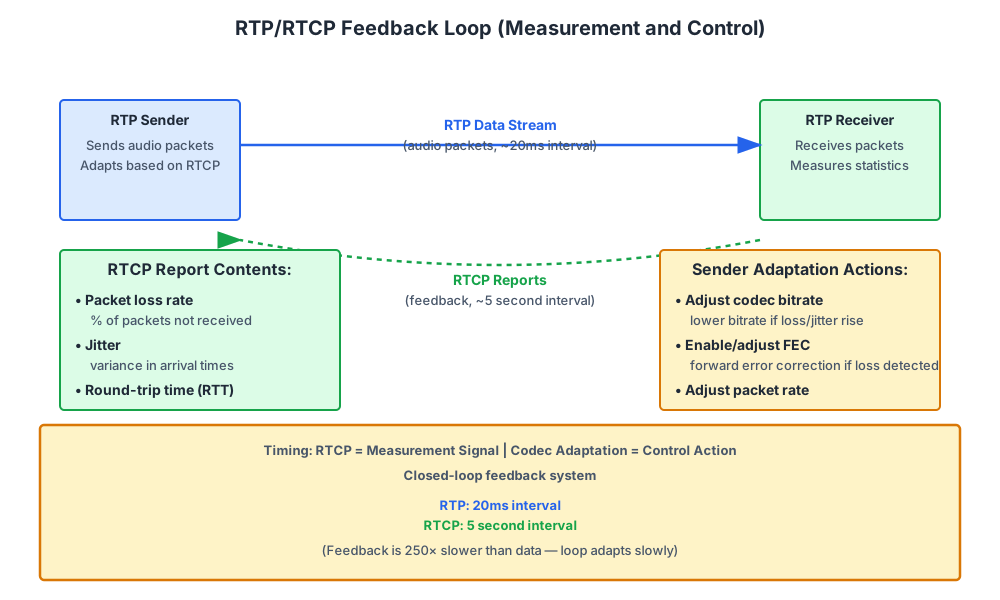
Schulzrinne applied disaggregation by separating data transport (RTP) from control feedback (RTCP), and separating loss detection (sequence numbers) from timing reconstruction (timestamps). He applied closed-loop reasoning with RTCP as the feedback channel — receivers periodically report fraction-lost, jitter estimate, and interarrival variance back to the sender, which can adapt bitrate or switch codecs in response. The interaction between the forward data channel and the reverse feedback channel is shown in Figure 12.1.
12.2.1 Invariant Analysis: RTP/RTCP (1996)
| Invariant | RTP’s Answer (1996) | Gap? |
|---|---|---|
| State | 16-bit sequence number detects loss; SSRC identifies stream | No belief about the network — only about packets |
| Time | 32-bit timestamp reconstructs playout clock; NTP wallclock in RTCP Sender Reports enables inter-media synchronization (lip-sync); RTCP reports every few seconds | Timestamp accuracy depends on sender clock; RTCP feedback too slow for reactive congestion control |
| Coordination | End-to-end; sender adapts from RTCP reports | Periodic (seconds) — misses transient spikes |
| Interface | Thin layer on UDP; payload type identifies codec | Middleboxes (NAT, firewall) do not understand RTP |
The State gap is structural: a sequence number tells you a packet is missing but nothing about why — was the buffer full, was the radio in a fade, did a router reboot? The sender sees only “packet missing” — congestion loss and channel loss look identical, leaving the choice between “slow down” and “add FEC” unresolved. The Time gap is operational: RTCP reports arriving every five seconds tell the sender about conditions that are already five seconds stale. For a VoIP call that tolerates 150ms delay, a five-second feedback loop cannot track fast fades. One critical Time contribution, however, is inter-media synchronization: the NTP wallclock timestamp carried in each RTCP Sender Report allows a receiver to align audio and video streams from different RTP sessions onto a common timeline — the mechanism behind lip-sync.
12.2.2 Environment → Measurement → Belief
| Layer | What RTP Has | What’s Missing |
|---|---|---|
| Environment | True loss rate, jitter, available bandwidth along path | Path conditions vary per-hop; RTP sees only endpoints |
| Measurement | RTCP receiver reports (fraction lost, jitter, last-SR delay) | Sampling period seconds; no per-packet RTT |
| Belief | Average recent loss and jitter on this session | Belief lags environment by one RTCP interval |
The E→M gap is accidentally noisy: receiver reports are honest but too infrequent. Better estimators leave the gap intact because the measurement rate itself is the constraint — and RTCP’s bandwidth cap (5% of session) is deliberate, to prevent feedback from consuming the media budget.
12.2.3 “The Gaps Didn’t Matter… Yet.”
In 1996 the Mbone was a cooperative research network. Endpoints were workstations with public IPs. Bandwidth was low but predictable. Sessions were small enough that RTCP scaled. Slow feedback was acceptable because sender adaptations were coarse (switch codecs, add redundancy) and the consequence of slow adaptation was modest (a noisy few seconds, then recovery).
The gaps would matter when two environmental shifts collided: commercial deployment at internet scale (1999-2005) introduced NATs and firewalls that broke UDP reachability, and cellular networks (2007 onward) introduced bandwidth that varied by an order of magnitude over seconds. RTP’s UDP packets were blocked at NATs and firewalls, and when they did arrive, RTCP’s feedback loop was too slow for cellular variability.
12.3 Act 2: “It’s 2009. The iPhone Won’t Talk RTP.”
It’s 2009. Apple ships iOS 3.0 and the iPhone is the first consumer device carrying HD video over cellular. The network bandwidth between the tower and the phone varies from 500 kbps to 5 Mbps within a minute. Corporate firewalls block UDP outright. Content delivery networks understand one protocol: HTTP. Apple needs a streaming format that reaches every user, through every network, over the existing CDN fabric.
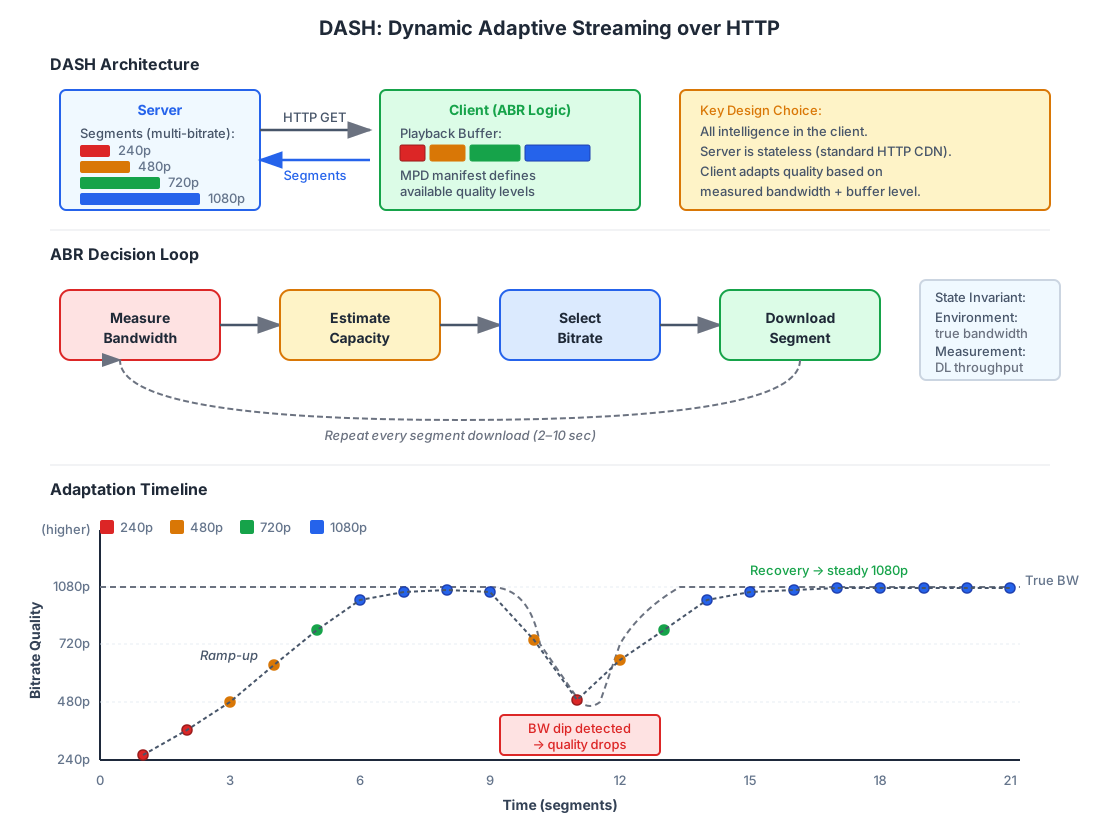
Roger Pantos’ answer was as simple as it was blunt: chop the video into short .ts segments, list them in a .m3u8 text file, serve both over HTTP. The client downloads the playlist, then fetches segments one at a time, choosing a bitrate based on how fast previous segments arrived. HTTP Live Streaming (HLS) became an RFC in 2017 (Pantos and May 2017), and DASH standardized the same model as an ISO standard (ISO/IEC 2019), but the architecture crystallized at launch.
“A client obtains the Playlist and then accesses each Media Segment in the Playlist in order… The client presents the Media Segments so as to give the end user a continuous experience of the Presentation.” — Pantos & May, 2017 (Pantos and May 2017)
What Pantos saw: HTTP everywhere. CDNs that cache files for free. Firewalls that pass port 443. A client (iPhone) with enough CPU to manage its own state. The encoder’s job was to produce the bitrate ladder once; the client’s job was to choose.
What remained invisible: A 10-second chunk cadence put a 30-second floor on live latency (segment, playlist refresh, client buffer). Real-world networks experience wild throughput fluctuations — drops from 17 Mbps to 500 kbps within seconds due to WiFi interference or mobile congestion — and throughput estimation from chunk download time would oscillate when bandwidth varied faster than chunk duration. Worse, throughput-based adjustments often fall into a “conservative trap”: after a bandwidth dip, the estimator becomes overly cautious and picks a low bitrate even when capacity has already recovered, wasting quality the user could have enjoyed. Millions of clients sharing a bottleneck would synchronize bitrate decisions, creating thrash.
The protocol flow begins with the client requesting a manifest file — an M3U8 playlist in HLS (Pantos and May 2017), a Media Presentation Description (MPD) in DASH (Sodagar 2011) — that lists every available bitrate, resolution, and codec alongside the URLs for each segment at each quality level. The manifest is the client’s map of the bitrate ladder: it tells the client what choices exist before a single byte of video is fetched.
Pantos applied decision placement at the client: the client owns buffer state, observes network conditions, and picks bitrate. The server is stateless — it just serves files. The network is oblivious — it just passes HTTP. He applied disaggregation between content production (encoder ladder) and delivery policy (client ABR). He applied closed-loop reasoning with chunk-download-time as the throughput sensor, smoothed by an exponential moving average. The resulting feedback loop is shown in Figure 12.2, for DASH, which standardized the same architecture two years later (Sodagar 2011).
12.3.1 Invariant Analysis: HLS (2009) / DASH (2011)
| Invariant | HLS/DASH Answer (2009-11) | Gap? |
|---|---|---|
| State | Client tracks buffer level + chunk download time | One throughput sample per chunk — noisy, lagged |
| Time | Chunk cadence (6-10s); playlist refresh cadence | Chunk duration floors live latency (~30s) |
| Coordination | Client-driven; stateless server | No cross-client coordination — synchronized oscillation |
| Interface | HTTP GET of segments + text manifest | Manifest polling is verbose; no server push |
The State gap is accidentally noisy: one chunk per 10 seconds is a single throughput sample against a bandwidth process that varies every 100ms on cellular links. The variance is large, and increasing the sampling rate requires shrinking chunks, which inflates HTTP overhead. The Coordination gap produced the famous “bitrate thrash” — multiple clients on the same bottleneck see identical high throughput, all request 4K chunks, the link saturates, all see identical low throughput, all drop to 480p together.
12.3.2 “The Gaps Didn’t Matter… Yet.”
For on-demand Netflix-style streaming, a 30-second startup was tolerable (users expect a loading screen) and rebuffering was rare once the buffer filled. Throughput variance mattered less than average, because a 60-second buffer absorbs seconds of bandwidth dips. Synchronized oscillation across clients was tolerable as long as absolute quality stayed above perceptual thresholds.
Two shifts broke this tolerance: live sports (2013 onward) demanded sub-10-second latency because viewers with notifications on their phones saw goals scored before their stream showed the kick, and mobile bandwidth variability (LTE handovers, congestion) outpaced the throughput estimator’s smoothing window, producing visible quality oscillations that users hated more than occasional rebuffering.
12.4 Act 3: “It’s 2014. Throughput Estimation Oscillates — Drop It.”
It’s 2014. Huang, Johari, McKeown and colleagues run a large-scale study of ABR on a real streaming service. Their finding is counterintuitive: throughput-based ABR algorithms oscillate badly because the throughput signal is itself the output of the client’s prior decisions. A client that chose a low bitrate gets an artificially high throughput estimate (downloads finish fast), which tempts it to jump high, which then fails. Throughput and bitrate are coupled — the sensor lies.
“Our experiments … show that a primary cause of rebuffering is the instability of the throughput estimator itself. We propose a buffer-based approach that avoids throughput estimation entirely.” — Huang et al., 2014 (Huang et al. 2014)
What Huang saw: The buffer level is a direct measurement of the gap between network delivery and player consumption. If the buffer is growing, the network is fast enough; if it’s shrinking, it isn’t. The buffer itself is the estimator.
BBA (Buffer-Based Algorithm) is almost embarrassingly simple: define a piecewise-linear function from buffer level to chosen bitrate, with a reservoir (buffer below which you pick the lowest bitrate) and a cushion (buffer above which you pick the highest). Ignore throughput entirely. Huang applied closed-loop reasoning with a different sensor — buffer level, which is structurally honest because the controller’s own decisions leave it unaffected.
What remained invisible: Buffer level is slow — a sensor that lags by the chunk duration. On fast-varying networks BBA underreacts. And it leaves a lot of quality on the table: when the network is stable and abundant, BBA’s conservatism wastes bandwidth that a smarter algorithm could spend on higher bitrates. There is also a startup paradox — a “broken invariant” at session start: an empty buffer contains zero information about network conditions, so BBA’s core principle (let the buffer decide) is vacuous. During startup, BBA reverts to throughput estimation to ramp up — the very signal it was designed to replace. The buffer-based invariant only holds once the buffer has accumulated enough history to be informative.
12.4.1 Invariant Analysis: BBA (2014)
| Invariant | BBA’s Answer | Gap? |
|---|---|---|
| State | Buffer level only — direct and honest | Slow sensor; lags by chunk duration |
| Time | Per-chunk decision | Same as HLS/DASH |
| Coordination | Client-driven, same interface | — |
| Interface | Standard DASH/HLS | — |
BBA’s key contribution is measurement-quality reasoning: it identifies that chunk-throughput is structurally filtered by the controller (the sender’s own decisions shape what the sensor sees), and switches to a sensor free of that filtering. This is the same reasoning pattern as BGP route advertisements (where stability comes from structural constraints rather than better estimation, per Ch09).
12.5 Act 4: “It’s 2015. Combine Buffer and Throughput — Optimally.”
It’s 2015. BBA is stable but leaves quality on the table. Throughput-based ABR is responsive but oscillates. Yin, Jindal, Sekar, and Sinopoli ask: what does the optimal policy look like? They frame ABR as a finite-horizon constrained optimization — choose a sequence of bitrates to maximize sum-of-quality minus a rebuffering penalty minus a switch-magnitude penalty, subject to buffer dynamics.
“We present a principled understanding of bitrate adaptation and analyze several practical adaptation algorithms through a common control-theoretic framework. We propose a novel model predictive control algorithm.” — Yin et al., 2015 (Yin et al. 2015)
What Yin saw: ABR is textbook model predictive control. Predict future throughput over a planning horizon (harmonic mean of the last 5 chunks is a robust predictor). Model buffer evolution as a function of chosen bitrate and predicted throughput. Solve the optimization (small enough to be tractable per-chunk). Execute the first decision. Re-solve next chunk. This is the classic MPC loop: predict → optimize → act → measure → re-predict.
Yin applied closed-loop reasoning with an explicit optimization horizon — the loop is no longer myopic (one chunk ahead) but plans over 5 chunks (~50 seconds). He combined both sensors: throughput prediction feeds the optimizer, buffer level constrains it. The principles of optimization and feedback control, decades old in systems engineering, were finally named for ABR.
What remained invisible: The prediction horizon grew the state invariant (now we predict 5 chunks of throughput) and added prediction error as a new failure mode. When networks are non-stationary (LTE handover, WiFi congestion), the harmonic-mean predictor is systematically wrong. Mao et al. with Pensieve (Mao et al. 2017) replaced the hand-tuned predictor with a learned policy trained via reinforcement learning two years later, implicitly acknowledging that static predictors fail on the tails.
12.5.1 Invariant Analysis: MPC (2015)
| Invariant | MPC’s Answer | Gap? |
|---|---|---|
| State | Predicted throughput (harmonic mean, 5 samples) + buffer level | Prediction error compounds over horizon |
| Time | 5-segment optimization horizon (~50s) | Horizon too long for live streaming |
| Coordination | Client-driven, same as DASH | — |
| Interface | Same MPD; modified client only | — |
The prediction horizon is the crux. Too short and MPC collapses to myopic throughput-based ABR. Too long and prediction errors dominate the optimum. Yin’s 5-chunk horizon was a sweet spot for on-demand streaming — but it places a 50-second floor on responsiveness, which is incompatible with live. For live streaming, playback latency becomes a critical additional state variable: the optimizer must now minimize not just rebuffering and quality switches but also the gap between the live edge and the playback position. This adds a skip penalty to the QoE function — the cost of dropping frames to catch up when the player falls behind the live edge — turning the two-dimensional (bitrate, buffer) optimization into a three-dimensional one (bitrate, buffer, latency).
12.5.2 Environment → Measurement → Belief After MPC
| Layer | What MPC Has | What’s Missing |
|---|---|---|
| Environment | True throughput process + buffer state | — |
| Measurement | Per-chunk throughput samples + current buffer | Same sampling rate as DASH |
| Belief | Explicit predictor + horizon-optimal bitrate plan | Prediction residual grows with horizon |
The E→M gap is still accidentally noisy (same chunk-rate samples as DASH), but MPC partially closes it by combining two complementary sensors. The new failure mode is prediction bias: the predictor assumes stationarity that mobile networks violate.
12.6 Act 5: “It’s 2019. Live Latency Hits the Chunk Floor.”
It’s 2019. Twitch, YouTube Live, and sports streaming services push the latency bar below 10 seconds, then below 5, then below 2. HLS’s 10-second chunks floor the latency at ~30 seconds (segment + playlist refresh + 3-chunk client buffer). DASH faces the same floor. A football fan with the game on their phone hears the neighbor’s TV cheer before their stream shows the goal.
Apple’s answer is Low-Latency HLS (LL-HLS) (Pantos 2019): keep HTTP, keep chunks, but subdivide each chunk into partial segments of 200-500 ms, and use HTTP/2 push to deliver partials as they are produced. The client polls a blocking manifest that returns the instant a new partial becomes available. CMAF (ISO/IEC 2018) chunked transfer is the container-level analogue: a single fragment that is transmitted progressively as it is encoded, allowing the player to begin decoding before the fragment ends.
What the designers saw: Chunks need not be downloaded atomically. If the server produces the first 200ms of a chunk, it can start pushing it while encoding the rest. If the player can begin decoding 200ms into a chunk, its effective latency is 200ms of content plus RTT plus whatever safety buffer it maintains.
What remains a live tension: Partial segments fragment CDN caching (many small objects instead of a few large ones). ABR algorithms tuned for 10-second chunks oscillate wildly at 200-ms granularity because they re-decide too often. The throughput estimator sees noisier samples. The buffer is shallower, so any congestion burst immediately stalls playback.
LL-HLS applied disaggregation between the segment (the unit of CDN caching and ABR decision) and the partial (the unit of delivery). The segment remains the ABR decision point; partials keep the pipeline fed between decisions. This resolves one tension by introducing another: the player now balances a segment-level bitrate choice against partial-level delivery noise.
12.6.1 Invariant Analysis: LL-HLS / CMAF (2019)
| Invariant | LL-HLS Answer | Gap? |
|---|---|---|
| State | Buffer + partial-segment progress + blocking manifest | Shallower buffer = less error absorption |
| Time | Partial cadence 200-500ms; segment cadence unchanged | Sub-2s latency achievable, but fragile |
| Coordination | Client-driven with HTTP/2 push from server | Cache hierarchy sees many small objects |
| Interface | CMAF chunked transfer; blocking playlist reload | Incompatible with some legacy CDN edge behaviors |
12.7 Act 6: “It’s 2021. WebRTC Puts Real-Time in the Browser.”
It’s 2021. Zoom, Google Meet, Microsoft Teams have made real-time video conferencing a daily fact of life. The pandemic has compressed a decade of adoption into twelve months. The underlying technology — WebRTC, standardized in RFC 8825 (Alvestrand 2021) — descended from Skype’s hybrid P2P architecture (analyzed by Baset and Schulzrinne (Baset and Schulzrinne 2006)) and from a decade of work on getting RTP (Schulzrinne et al. 2003) through NATs.
“WebRTC is a set of protocols that enables real-time communications … directly between web browsers, without the need for specialized plug-ins.” — Alvestrand, 2021 (Alvestrand 2021)
What the WebRTC designers saw: Real-time media has to work from inside a browser, without plugins, through NATs, with end-to-end encryption. Signaling (who is calling whom, what codecs they support) is application-specific and can flow through any channel the app provides. Media has to go peer-to-peer when possible (lowest latency) and through a relay when not.
The stack is disaggregated into layers: - ICE (Interactive Connectivity Establishment): probes every candidate address pair (local, reflexive via STUN, relayed via TURN) and picks the one that works. - DTLS-SRTP (Datagram Transport Layer Security – Secure Real-time Transport Protocol): encrypts media end-to-end on the wire. - GCC (Google Congestion Control): runs a per-packet loss/delay-based congestion control loop, reacting every RTT — the fastest loop in the multimedia stack. - getStats API: exposes per-stream loss, RTT, jitter, bitrate to the application for introspection.
For many-party conferencing, WebRTC by itself is peer-to-peer and scales poorly (each participant sends N-1 streams). The conferencing architecture design space spans two server models:
- Multipoint Control Unit (MCU): The server decodes every incoming stream, composites them into a single mixed layout, re-encodes, and sends one stream to each participant. This minimizes client-side bandwidth and CPU (each client sends one stream and receives one), but maximizes server cost — and critically, the MCU must decrypt media to transcode it, breaking end-to-end encryption.
- Selective Forwarding Unit (SFU): The server terminates ICE/DTLS from each peer, receives their RTP streams, and forwards a subset to each recipient without decoding. Because the SFU never touches the media payload, it preserves end-to-end encryption. Server cost is lower (no transcoding), but each client receives multiple streams and must decode them locally.
Production conferencing overwhelmingly uses SFUs, accepting higher client complexity in exchange for preserved encryption and lower server cost. The SFU’s forwarding decision — which streams to send to which recipient, and at what quality — is the core coordination problem.
The SFU’s quality selection relies on one of two encoding strategies. With simulcast1, each sender independently encodes and transmits 2-3 separate streams at different resolutions (e.g., 1080p, 360p, 180p). The SFU selects which stream to forward to each receiver based on their available bandwidth and display size — high resolution for the active speaker’s large tile, low resolution for thumbnails. With SVC (Scalable Video Coding) (Schwarz et al. 2007; Wiegand et al. 2003), the sender produces a single layered bitstream: a base layer that decodes independently, plus enhancement layers that add resolution or frame rate. The SFU can drop enhancement layers for bandwidth-constrained receivers without re-encoding. Simulcast is simpler to implement and codec-agnostic but wastes sender upload bandwidth on redundant encodes; SVC is more bandwidth-efficient but requires codec support (VP9 SVC, AV1 SVC (Chen et al. 2018)) and adds encoding complexity.
To further conserve bandwidth in large meetings, SFUs implement “Last N” forwarding: only the video streams of the active speaker and the N most recent speakers are forwarded; all other participants receive audio only. This reduces the forwarding fan-out from O(N2) toward O(N), making 100-participant meetings feasible without saturating either server or client bandwidth.
WebRTC applied decision placement adaptively — distributed (P2P) when possible, centralized (SFU) when scale demands. It applied closed-loop reasoning at two timescales: GCC per-packet (~RTT), and application-layer stream selection per-second. It applied disaggregation of signaling from media, of transport from security, of media distribution from media transport.
12.7.1 Invariant Analysis: WebRTC (2021)
| Invariant | WebRTC’s Answer | Gap? |
|---|---|---|
| State | getStats: per-stream loss, RTT, jitter, bitrate | Browser opacity; app cannot see per-packet |
| Time | GCC adapts per-RTT (~10-100ms); frame cadence 30-60 fps | GCC tuning opaque to application |
| Coordination | ICE chooses P2P or TURN; SFU for scale (preserves E2E encryption, unlike MCU which must decrypt to transcode) | SFU centralizes routing but not trust; MCU centralizes both |
| Interface | PeerConnection API + SDP (Session Description Protocol) offer/answer | SDP legacy baggage; no native many-to-many |
12.7.2 Environment → Measurement → Belief in WebRTC
| Layer | What WebRTC Has | What’s Missing |
|---|---|---|
| Environment | True path loss, RTT, available bandwidth | — |
| Measurement | Per-packet RTT, loss, delay gradient (GCC sensors) | Still no view into router queues or competing flows |
| Belief | GCC bandwidth estimate, updated per RTT | Estimate can lag during congestion onset or recovery |
The E→M gap is accidentally noisy but narrowed dramatically compared to RTCP: GCC samples per-packet, not per-report, and uses delay-gradient (the rate of change of one-way delay) as an early-warning signal for congestion. This is the same principle as BBR’s RTT-probing in transport (Ch08) — closing the measurement loop by measuring faster.
12.8 The Grand Arc: From Schulzrinne to WebRTC
12.8.1 The Evolving Anchor
| Era | Year | Binding Constraint | Invariant Locked First |
|---|---|---|---|
| RTP/RTCP | 1996 | Perceptual deadline + best-effort IP | Time (timestamps) |
| HLS / DASH | 2009-11 | Deployability via HTTP/CDN/firewalls | Interface (HTTP) |
| BBA | 2014 | Throughput signal is gamed by controller | State (buffer as honest sensor) |
| MPC | 2015 | QoE as joint function of bitrate, rebuffer, switches | State (predictive model) + Time (horizon) |
| LL-HLS / CMAF | 2019 | Live latency floor <2s | Time (sub-chunk cadence) |
| WebRTC | 2021 | Browser sandbox + NAT + E2E encryption | Interface (browser API) + Coordination (ICE) |
12.8.2 Three Design Principles Applied Across the Arc
Disaggregation appears at every generation. RTP separates data from control; HLS separates content production (encoder ladder) from delivery policy (client ABR); MPC separates prediction from optimization; WebRTC separates signaling, transport, security, and media distribution. Each separation creates an interface — HTTP chunks, MPD manifest, PeerConnection API — and each interface has the potential to ossify. HTTP as the multimedia interface ossified hard enough that every subsequent innovation (LL-HLS, CMAF, Media over QUIC) has had to either preserve HTTP semantics or build parallel infrastructure.
Closed-loop reasoning is the through-line. Every system has a sensor, an estimator, a controller, and an actuator. What changes is the sensor: RTCP receiver reports (slow, periodic), chunk download time (noisy, filtered), buffer level (honest, lagged), predicted throughput (extrapolated, biased), per-packet delay gradient (fast, noisy). The measurement-quality vocabulary from Ch01 tracks the arc: RTCP and chunk-throughput are accidentally noisy (fix with better estimators); chunk-throughput when used by an ABR controller is structurally filtered (fix with a different sensor like buffer); GCC’s delay-gradient is physically bounded (as close to the true path state as the endpoint can see).
Decision placement shifted once and then oscillated. RTP placed decisions at endpoints. HLS crystallized decisions at the client. WebRTC started at peers and reintroduced centralization via SFU when scale demanded it. The spectrum from distributed to centralized oscillates — each generation re-chooses based on the binding constraint of its moment.
12.8.3 The Dependency Chain
12.8.4 Pioneer Diagnosis Table
| Year | Pioneer | Invariant | Diagnosis | Contribution |
|---|---|---|---|---|
| 1996 | Schulzrinne | Time + State | Media needs loss detection + timing over UDP | RTP/RTCP |
| 2009 | Pantos | Interface | Only HTTP reaches every user | HLS |
| 2011 | Sodagar | Interface | Need vendor-interoperable format | DASH / MPD standard |
| 2014 | Huang | State | Throughput sensor is gamed by controller | BBA |
| 2015 | Yin | State + Time | Myopic ABR cannot optimize QoE | MPC for ABR |
| 2017 | Mao | State | Hand-tuned predictors fail on tails | Pensieve (neural ABR) |
| 2019 | Apple / MPEG | Time | Chunk cadence floors live latency | LL-HLS / CMAF |
| 2021 | Alvestrand et al. | Interface + Coordination | Browser RTC needs native stack + NAT traversal | WebRTC / ICE / SFU |
12.8.5 Innovation Timeline
flowchart TD
    subgraph sg1["Encoding & Transport"]
        A1["1948 — Shannon: rate-distortion"]
        A2["1994 — MPEG-2"]
        A3["1996 — Schulzrinne: RTP/RTCP"]
        A4["2003 — H.264/AVC"]
        A5["2013 — H.265/HEVC, VP9"]
        A6["2018 — AV1"]
        A1 --> A2 --> A3 --> A4 --> A5 --> A6
    end
    subgraph sg2["ABR Streaming"]
        B1["2009 — Pantos/Apple: HLS"]
        B2["2011 — Sodagar/MPEG: DASH"]
        B3["2014 — Huang: BBA"]
        B4["2015 — Yin: MPC"]
        B5["2017 — Mao: Pensieve"]
        B1 --> B2 --> B3 --> B4 --> B5
    end
    subgraph sg3["Low-Latency & Real-Time"]
        C1["2006 — Baset: Skype analysis"]
        C2["2019 — LL-HLS / CMAF"]
        C3["2021 — WebRTC RFC 8825"]
        C1 --> C2 --> C3
    end
    sg1 --> sg2 --> sg3
12.9 Voice Over IP: The Tightest Budget
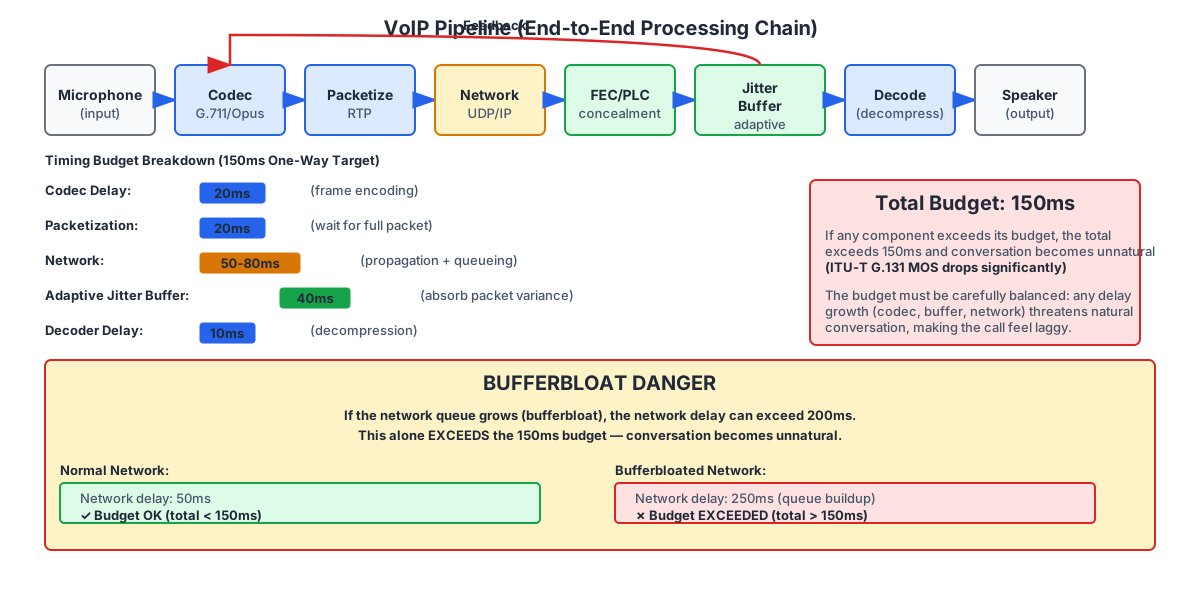
VoIP operates under the most aggressive version of the binding constraint. The end-to-end delay budget decomposes into:
| Component | Typical Budget | Constraint |
|---|---|---|
| Encoding (Opus/G.711, 20ms frames) | ~20 ms | Frame size × compute |
| One-way propagation (continental) | ~50 ms | Speed of light |
| Queueing + transmission | 0-100 ms | Network congestion |
| Jitter buffer2 | 50-100 ms | Arrival variance |
| Decoding + playout | ~10 ms | Codec compute |
The sum approaches 200ms on a good path and exceeds the 150ms conversational bound on congested paths. This tight budget has three consequences illustrated in Figure 12.3. First, retransmission is infeasible — an RTT round trip at 100ms alone eats the jitter budget. Second, loss concealment replaces retransmission — codecs interpolate missing frames. Third, adaptive playout adjusts buffer depth at talkspurt boundaries (silence intervals) to match actual jitter without adding fixed overhead.
The playout delay is estimated as p = d̂ + k·v̂, where d̂ is the EWMA of one-way delay and v̂ is the EWMA of deviation, with k ≈ 3-4. Larger k adds robustness at the cost of latency. Talkspurt-boundary adjustment exploits human perception: adding 20ms of delay during silence is imperceptible, while adding it mid-word is audible.
12.10 Generative Exercises
TipExercise 1: The 5G Handover
A user watching a 4K DASH stream walks from 5G macro coverage into a WiFi-only zone. Bandwidth drops from 100 Mbps to 10 Mbps within 200ms. The MPC predictor uses a 5-chunk harmonic mean. Predict what happens to bitrate selection over the next 60 seconds. At what point does MPC recover? What would Pensieve (neural ABR) do differently?
TipExercise 2: E2E Encrypted Conferencing
Design a conferencing system that preserves end-to-end encryption (no server sees cleartext media) and supports stream selection (send hi-res to active speaker, lo-res to thumbnails) and scales to 100 participants. Which invariant must you relax? Where does the decision about stream selection move, and at what cost?
TipExercise 3: Interplanetary Video
A Mars-to-Earth video link has 8-20 minute one-way latency and ~1 Mbps bandwidth. Apply the four invariants: what does State look like? Can you run any closed loop? What sensor would you use for ABR? Is conversational video possible? If not, what is the best achievable interaction model?
Simulcast transmits multiple independent encodings of the same source at different resolutions simultaneously. Unlike scalable coding, each encoding is self-contained — the SFU selects which to forward without needing to understand the codec’s layer structure.↩︎
A jitter buffer accumulates arriving packets for a fixed duration (typically 20-60 ms) before passing them to the decoder. This absorbs inter-arrival time variations (jitter) at the cost of adding fixed delay. Larger buffers tolerate more jitter but add more latency — a direct tradeoff between State (buffer depth) and Time (end-to-end delay).↩︎