8 System Composition—Transport Meets Queue Management
8.1 The Composition Problem
Two independently designed systems meet at a link. Transport (Chapter 4) sends packets. Queue management (Chapter 5) absorbs them, decides who gets serviced, and signals back. Neither system owns the full path. Neither can see far enough to act in isolation. Transport believes it observes congestion via loss; queue management believes it controls delay via dropping. Between these two systems lives a coupling boundary—and when that boundary breaks, networks degrade catastrophically.
This chapter answers a hard question: what happens when independently designed systems compose? The answer is not “they cooperate.” It is “they fight unless someone redesigns the interface.” Transport’s feedback assumptions clash with queue management’s signaling choice. Queue management’s target (minimize delay) conflicts with transport’s target (maximize throughput). Administrative autonomy creates an asymmetry: transport does not know it is being rate-limited; queue management cannot force transport to obey its signals.
The previous chapters analyzed components in isolation. This chapter examines what happens when independently designed components meet — when transport’s rate decisions collide with queue management’s buffer decisions, when application-layer quality metrics diverge from network-layer measurements. In the language of optimization decomposition, this chapter studies the coordination signals that flow between subproblems, and what happens when those signals are delayed, noisy, or missing.
Composition failures are not accidents. They reveal deep misalignments in the invariant answers of the two systems. Transport assumes measurement comes from loss events (rare, destructive signals). Queue management assumes it can defer packet loss indefinitely using buffers (high-precision control). Neither is true when they meet at the same link. The gap between assumption and reality is where failures compound.
Three failure modes drive the chapter. L4S (Low Latency Low Loss Scalable throughput) redesigns the measurement signal at the coupling boundary, replacing loss with ECN marks to enable tighter feedback. PowerBoost breaks the coupling entirely—it imposes an invisible rate limit that transport cannot observe, causing transport to overestimate capacity and buffer persistently. QoS vs. QoE reveals a third gap: networks optimize metrics (loss, delay) that do not map linearly to user perception. Together, these examples show that composition quality depends on the interface at the boundary—and on administrative consolidation that enables tighter coupling.
8.2 The Transport-Queue Feedback Loop
Start with the simplest model: one flow, one link, one queue. Transport sends at rate R. Queue management accepts packets into buffer B and dequeues at link capacity C. When R > C, the queue fills. When the queue is full, packets drop. Transport observes loss via missing ACKs, infers congestion, reduces R via AIMD. The loop closes: higher loss → lower R → queue drains → loss decreases → cycle repeats.
Two independently designed systems meet at a link. Transport (Chapter 4) sends packets at a rate determined by its congestion window—a belief about available capacity. Queue management (Chapter 5) absorbs packets into a buffer, decides who gets serviced, and provides signals back via loss or delay. Neither system owns the full path. Neither can see far enough to act in isolation. The coupling between them determines network performance—and when the coupling breaks, networks degrade catastrophically. Figure 8.1 illustrates this fundamental interaction.
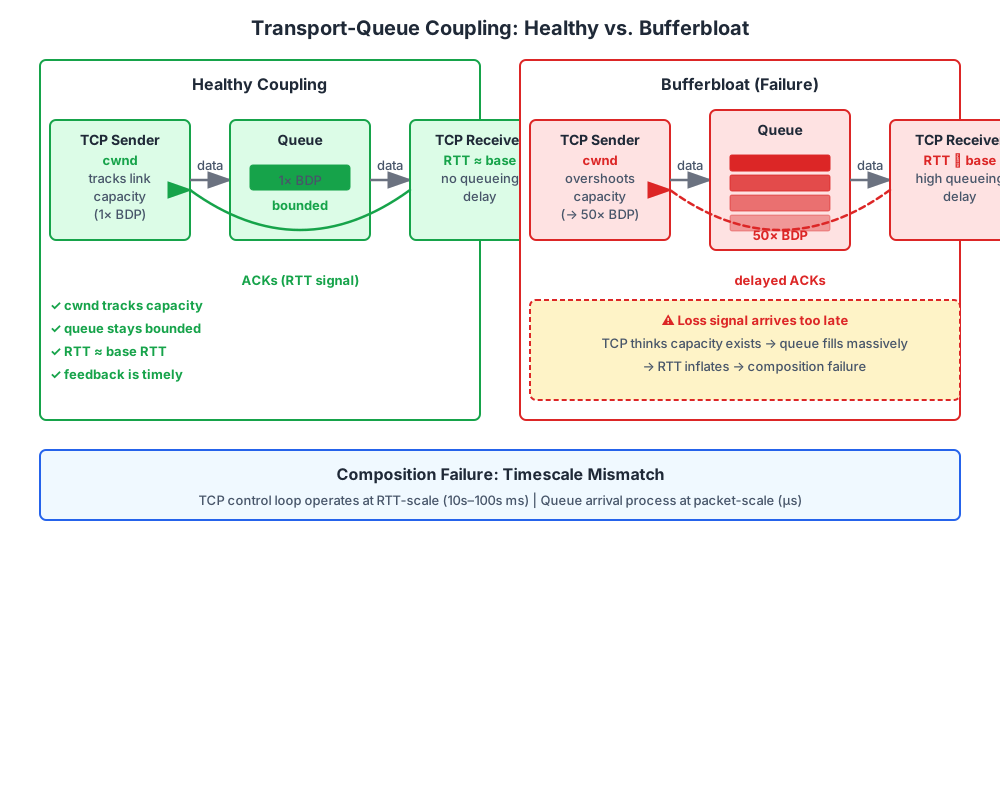
Two independently designed systems meet at a link and couple bidirectionally: transport sends packets at a rate determined by its congestion window (a belief about available capacity), while queue management absorbs packets into a buffer, decides which packets get serviced, and provides signals back to transport via loss or delay. The feedback loop operates as follows: when the sender’s rate R exceeds link capacity C, the queue fills. When the queue is full, packets drop. Transport observes loss via missing ACKs, infers congestion, and reduces its sending rate via AIMD (additive-increase, multiplicative-decrease). The loop closes: higher loss → lower R → queue drains → loss decreases. This creates a control loop that should stabilize the system at an equilibrium sending rate.
This feedback loop has a critical temporal assumption: the loss signal reaches transport quickly enough for control to remain stable. TCP’s RTT-based congestion control operates on the round-trip timescale. One dropped packet per RTT is the classical assumption. The response is smooth: TCP reduces its window, the sending rate falls, the queue drains. This works at moderate speeds—10 Mbps links, RTTs of tens of milliseconds.
But the loop breaks at high speeds. At 100 Gbps, one packet per RTT is a minuscule loss rate. TCP’s congestion window is typically many thousands of packets—dropping one packet causes a 0.01% rate reduction. Feedback becomes too sparse. Transport’s belief (available capacity is high) diverges from reality (queue is building). With sparse feedback, the queue fills faster than TCP can reduce the sending rate. Buffering increases. Latency increases. The feedback mechanism that was supposed to stabilize the loop destabilizes it instead.
Transport sends at rate R determined by congestion window (cwnd). Queue management observes arrival stream and decides: enqueue or drop? If R > link capacity C, the queue fills. When full, packets drop. Transport observes loss via missing ACKs, infers congestion, reduces rate via AIMD. The loop closes: higher loss → lower R → queue drains → loss decreases. But this loop has a critical temporal assumption: the loss signal must reach transport quickly enough for control to remain stable. At high speeds (100 Gbps), one dropped packet per RTT is a minuscule loss rate. Feedback becomes too sparse. With sparse feedback, the queue fills faster than TCP can reduce rate. Buffering increases. Latency spikes. This is bufferbloat: the measurement signal (loss) is so sparse that the queue grows to enormous size before transport reacts.
The bidirectional coupling becomes explicit: transport needs tighter feedback; queue management needs more frequent signals. But the interface at the coupling boundary constrains both. Loss is destructive—when a packet is dropped, it must be retransmitted, creating a spike in arrival rate at the queue (the retransmit storm problem). Loss is also infrequent at high speeds, providing weak control. The choice to use loss as the primary signal—inherited from the IP interface’s best-effort semantics—now constrains both systems unfavorably.
Queue management operates on the buffer. Large buffers provide transient surge capacity (if traffic bursts briefly, packets queue without loss). But large buffers also decouple transport’s transmission rate from queue occupancy. If the queue can absorb 10 million packets, transport cannot observe that 5 million are sitting in the buffer until the 10 millionth arrives and packets start dropping. By then, bufferbloat has set in—persistent queuing with no throughput benefit.
The fundamental tension is this: transport wants to know “am I congesting the link?” as quickly as possible. Queue management wants to handle transient bursts without dropping. These goals conflict when the buffer is large and feedback is sparse.
The solution requires redesigning one or both sides of the interface. Over-provisioning sidesteps the problem by ensuring R < C always—no queue fills, no loss signal. But this is economically wasteful and doesn’t scale to all paths. Active queue management (RED, CoDel, PIE from Chapter 5) sidesteps the buffer problem by keeping the queue small—but it still relies on drop-based feedback. L4S solves both by redesigning the measurement signal itself: replace loss with ECN marks.
8.3 L4S: Tightening the Coupling Interface with ECN
L4S starts from explicit recognition that the loss-based feedback interface is broken. The invariant under pressure: Time (feedback frequency) and State (the signal that transport observes). The interface inherits from IP’s best-effort service—routers only see two events: deliver or drop. ECN adds a third: mark. L4S addresses composition failures through richer measurement interface: ECN-capable flows receive early marking in an L queue (sub-millisecond latency target), legacy TCP in a C queue (backward compatibility), with a scheduler maintaining fairness. Figure 8.2 shows the dual queue architecture that enables this tighter coupling.
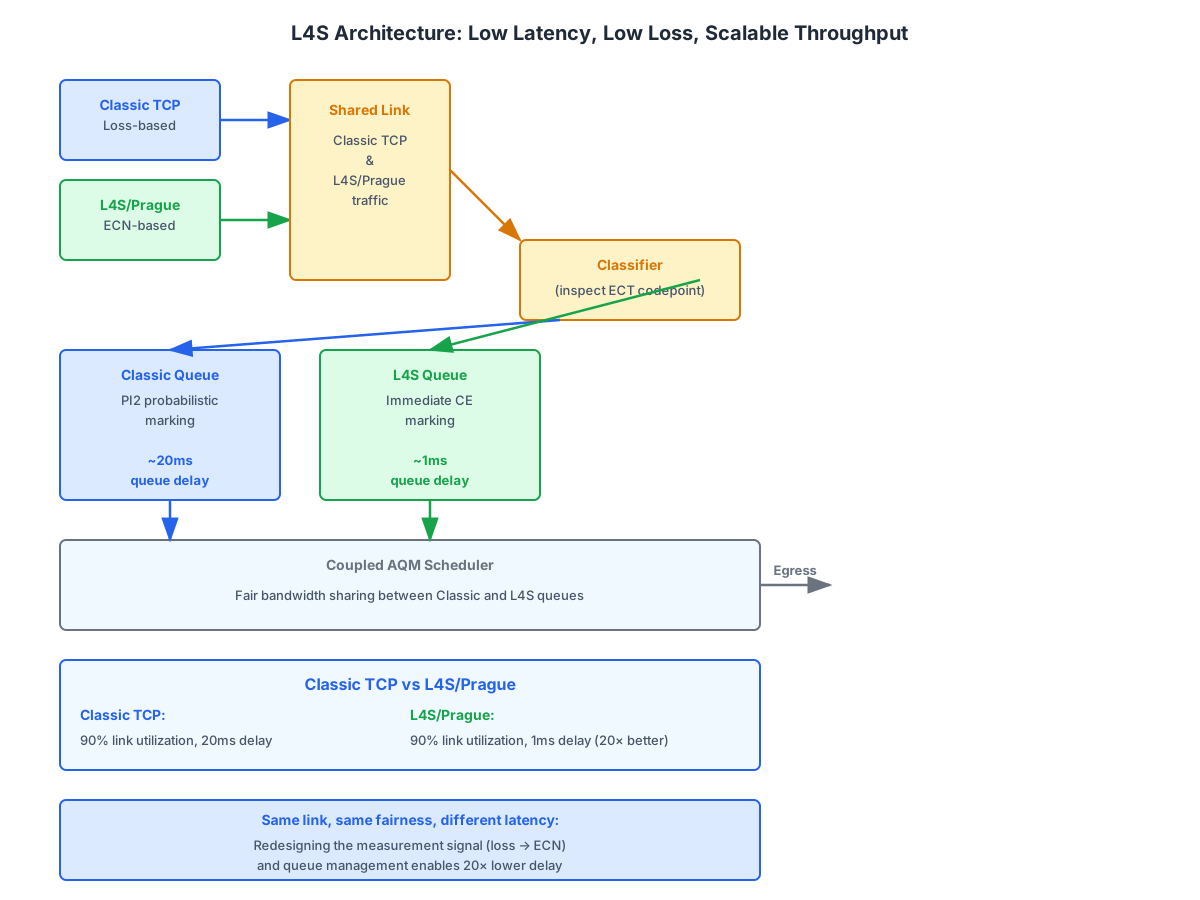
L4S (Low Latency Low Loss Scalable) addresses the composition failure between transport and queue management by redesigning the feedback interface. The core insight is that loss-based feedback is fundamentally broken at high speeds: drops are too sparse to provide meaningful control signals. L4S solves this by replacing loss with ECN marks (explicit congestion notification bits in the IP header) and introducing a dual-queue architecture that maintains backward compatibility with legacy TCP.
8.3.1 ECN Fundamentals: The IP Header Bits
The IP header contains two explicit congestion notification bits in the DSCP field. These bits encode four states:
- ECT(0) (Endpoint Congestion Transmission, state 10): Sender supports ECN, prefers this marking.
- ECT(1) (state 01): Sender supports ECN, uses this state for alternate purposes (e.g., L4S differentiation).
- CE (Congestion Experienced, state 11): Router marks the packet; the sender received this packet and is experiencing congestion.
- Not-ECT (state 00): Sender does not support ECN; router must drop if congested.
When a router detects congestion (queue depth approaching threshold), instead of dropping an ECT-marked packet, it sets the CE bits instead. The packet continues to the receiver, which echoes the CE marking in its next ACK. Transport sees the ECN mark, infers congestion, and reduces sending rate—exactly as it would for loss—except the packet was not lost.
This simple redesign changes everything. Feedback frequency increases by orders of magnitude. With loss-based signals, dropping one packet per RTT provides sparse control. With ECN marks, a queue management algorithm can mark many packets per RTT. Instead of “queue is full, drop,” queue management can signal “queue is at 10% of target, no mark; at 20%, mark with probability 5%; at 50%, mark with probability 30%.” Transport observes the marking trend and adjusts smoothly. Control converges faster. Oscillations dampen. Latency decreases at the same throughput—the feedback loop stabilizes because the signal is frequent enough.
8.3.2 Dual Queue Architecture and Fairness Coupling
But the simple benefit masks complex coupling challenges. Two different transport types now share the link: ECN-aware senders and legacy TCP senders. They interpret the same queue differently. A legacy sender sees a loss signal only when the queue is full; an ECN-aware sender sees marks when the queue is shallow. Fairness breaks—one sender gets squeezed into a persistent queue while the other gets early feedback. Queue management must now coordinate across two feedback mechanisms.
L4S addresses this with dual queuing: one queue for ECN-capable flows (the “L queue”), one for legacy TCP (the “C queue”). The ECN queue operates with early marking (high marking probability at shallow queue depths) targeting sub-millisecond latency. The legacy queue operates with drop-based feedback (mark only when queue is deep or full) maintaining backward compatibility. Between the two queues sits a coupling mechanism—a fairness controller that allocates buffer space, ensures neither queue starves, and maintains proportional bandwidth sharing.
The coupling mechanism is the hard part. How much buffer should each queue have? If the ECN queue reserves too much, legacy flows starve. If too little, ECN senders do not feel the benefit. The allocation must adapt to traffic dynamics—when there is no legacy traffic, why waste buffer space on an empty queue? The answer: implement scheduling that gives ECN senders priority only within a bandwidth budget, then proportional scheduling thereafter. The scheduler becomes part of the interface.
Concretely, a scheduler might allocate 50% of link capacity to the L queue and 50% to the C queue when both are active. Within each queue, CoDel or PIE applies per-queue AQM. When the L queue is empty, its capacity surplus flows to the C queue. This dynamic fairness prevents starvation while delivering ECN benefits to ECN-aware endpoints.
8.3.3 The Scalable Congestion Control Property
L4S imposes a requirement on transport’s response to ECN marks: the scalable congestion control property. A scalable CC algorithm adjusts its rate proportionally to the marking rate, not proportionally to the number of marks. Classical TCP’s response is roughly: send rate = C / sqrt(loss), which means at very low loss rates (0.001%), the reduction is minuscule. DCTCP, Prague, and other scalable CC algorithms use: send rate = C × (1 - k × mark_rate), where k is a constant and mark_rate is the fraction of marked packets. This linear relationship means even a 1% marking rate produces a meaningful 1% rate reduction—tight feedback appropriate for high-speed links where mark rates are necessarily low.
8.3.4 Deployment Barriers and the Chicken-Egg Problem
Deployment reveals the interface’s fragility. ECN requires support at three points: sender, routers, and receiver. If any middlebox (firewall, proxy, WAN optimizer) clears the ECN bits to “improve” congestion signaling, the signal vanishes. If a router on the path does not support ECN marking, it defaults to drops, and ECN senders fall back to loss-based sensing. Incremental deployment is painfully slow—L4S benefits only when the critical mass of support is achieved. This is a chicken-and-egg problem: operators do not deploy ECN because the benefits are not obvious; benefits are not obvious because deployment is incomplete.
Empirically, ECN adoption in the public internet remains below 50% despite being standardized since RFC 3168 (2001). Middleboxes remain a barrier—some clear ECN bits preemptively. Even when all three points support ECN, the benefit is only visible when both the queue management algorithm (running the AQM) and the transport algorithm (running the CC) are properly tuned. Datacenters, under single administrative control, achieve the necessary consolidation and can deploy L4S end-to-end.
8.3.5 Datacenter Deployment: The Proof of Concept
Yet despite these deployment barriers, L4S exemplifies a deeper principle: Prediction 3 in action. Relaxing the interface (replacing loss-only signaling with ECN marks) enables tighter belief-environment coupling. Transport’s belief about available capacity now tracks reality more closely. The margin between capacity and actual sending rate tightens. Networks operate at higher utilization and lower latency—precisely because the measurement signal became richer.
Compare datacenter L4S deployments (DCTCP, HPCC, Libra) with wide-area TCP. DCTCP operates at RTT collapse (microseconds), ECN marking rates near 10%, and achieves 95%+ link utilization with single-digit millisecond tail latencies. Wide-area TCP with loss-based feedback operates at RTT dozens of milliseconds, loss rates of 0.1% or less (if detected at all), and achieves 60-70% utilization while struggling with tail latencies in hundreds of milliseconds. The difference in margin—how tightly the network can be operated—is directly attributable to signal richness. Datacenter networks relax the administrative coordination constraint (single operator, full ECN support). Transport and queue management can couple tightly because one entity controls both sides of the interface.
L4S implements the ECN interface redesign with dual queuing: one queue (L queue) for ECN-capable flows, marked early at shallow depths; one queue (C queue) for legacy TCP, marked only when deep or full. A fairness controller allocates bandwidth between queues, preventing the L queue from starving the C queue. This preserves backward compatibility—legacy TCP continues to work, just at lower speed—while delivering massive benefits to ECN-aware endpoints. DCTCP (operating in the L queue) scales congestion control: instead of halving window on loss, it reduces proportionally to the marking fraction. This proportional response, enabled by high-frequency marks, achieves 95%+ utilization with single-digit millisecond latency in datacenters. The coupling becomes explicit and tunable: operators set marking thresholds, scheduler sets fairness ratios, both sides of the interface participate in control.
8.4 PowerBoost: Breaking the Coupling Through Invisible Policy
L4S redesigns the interface to make the coupling visible and explicit. PowerBoost—a rate-limiting mechanism deployed invisibly in DOCSIS cable modems—goes the opposite direction. It breaks the coupling by operating outside of it entirely, creating a hidden constraint that transport cannot observe.
8.4.1 The Mechanism and Buffering Consequence
PowerBoost implements a two-tier rate model: burst rate (high) for short periods, sustained rate (low) thereafter. The mechanism is a token bucket with depth PBS (PowerBoost Bucket Size) and sustained refill rate MSTR (Maximum Sustained Data Rate). A sender opens an upload to the modem and initially transmits at burst rate R, consuming tokens. When the bucket depletes after duration D = PBS / (R - MSTR), the rate drops to MSTR without warning or signal. Packets still flow—there is no loss, no congestion signal. Transport does not observe anything changing in its environment. It continues sending at the rate it believes the link supports, but the modem silently throttles.
Concrete example: Comcast cable internet. A customer subscribes to a plan with: - MSTR (Maximum Sustained Data Rate): 12 Mbps - R (Burst Rate): 25 Mbps - PBS (PowerBoost Bucket Size): 12 MB
The duration of the burst: D = 12 MB / (25 - 12) Mbps = 12 MB / 13 Mbps ≈ 7.4 seconds.
For the first 7.4 seconds of a sustained upload, packets flow at 25 Mbps. TCP’s congestion window is sized for the sustained rate the sender infers from this initial behavior (let’s say 1000 packets = 1.5 MB). At t=7.4 seconds, the rate cliff happens. Transport’s window is still 1000 packets, but the modem dequeues at 12 Mbps. Packets arrive at the modem faster than it transmits. The internal modem buffer fills. Packets experience additional queueing delay—not because of network congestion, but because of an artificial rate limit. The buffer might fill to 100ms of data, causing RTT to inflate from 50ms to 150ms, persisting until the upload completes.
This temporal mismatch—PowerBoost changing rate at a deterministic boundary while TCP adapts over round-trip timescales—creates a gap between what transport observes and what is actually constraining the flow. Transport sees a queue building and infers network congestion. It reduces its window via AIMD, backing off to 800 packets. But the queue continues building because the modem is sending at only 12 Mbps. Transport backs off further. By the time the upload completes, transport has reduced its window to match the sustained rate, but only after a hundred round-trips of adaptation and persistent latency inflation. Figure 8.3 visualizes how the burst-to-sustained rate transition creates these dynamic effects.
PowerBoost implements a token bucket rate limiter that presents two tiers to applications: an initial burst rate (20 Mbps) for a deterministic window (typically several seconds), followed by a sustained rate (6 Mbps) indefinitely. The left panel shows the bucket metaphor: tokens accumulate up to capacity C at rate r tokens per second. When the application transmits, it consumes tokens at a rate proportional to bytes sent. While tokens exist, transmission proceeds at the burst rate; when the bucket empties, transmission drops to the sustained rate (governed by replenishment rate). The timeline clearly shows the rate cliff: at approximately 2 seconds, the transmission rate drops sharply from 20 Mbps to 6 Mbps, a 70% decrease. ISPs deploy PowerBoost to advertise high burst speeds (“get 25 Mbps burst!”) while capping sustained capacity (“but only 12 Mbps long-term”), presenting a favorable marketing message despite underlying sustained capacity constraints.
8.4.2 The Coordination Invariant Failure
This violates every principle of the coupling interface. The two systems have different timescales: PowerBoost operates in seconds (the duration of the burst); TCP operates in tens of milliseconds (the RTT). PowerBoost is deterministic—it drops the rate at a fixed time; TCP is stochastic—it backs off probabilistically in response to loss. PowerBoost is invisible at the API—no system call reveals the rate limit; TCP infers its environment from observable signals. They are not coupled at all. They are two control loops operating on the same queue, with no knowledge of each other.
The Coordination invariant is the core failure. PowerBoost (ISP modem) decides unilaterally to limit rate. TCP (sender) does not participate in the decision. TCP believes it is observing natural congestion—queue buildup on the path—when it is actually observing an arbitrary policy. The measurement signal (increased RTT, filled buffer) is ambiguous—does it indicate congestion on the shared link, or an ISP rate limit?
8.4.3 Why PowerBoost Exists and the Business Model
Why does PowerBoost exist? It allows ISPs to advertise high burst rates (“get 25 Mbps for 30 seconds!”) while capping sustained rates (“but only 12 Mbps thereafter”). For customers downloading small files, they see high throughput. For sustained uploads, they are throttled. This is a business model decision, not a network design decision. The technical consequence is that buffering becomes worse—not better—at the point where it matters most (long bulk transfers).
8.4.4 Possible Fixes: Restoring the Interface
The fix requires bringing coordination into view. One approach: expose the rate limit to TCP explicitly via socket options, allowing transport to adapt its congestion window based on explicit bandwidth signaling. Another approach: implement AQM at the rate-limiting boundary, keeping the queue small even during the sustained-rate regime—so transport can observe the rate limit through normal congestion signals (CoDel-style delay feedback). A third approach: implement ECN marking at the rate limit threshold, signaling transport before the queue fills.
None of these approaches have deployed widely. PowerBoost persists because ISPs benefit from the opacity—it allows them to oversell burst capacity without investing in infrastructure. Transport suffers because it cannot adapt. The result is a case study in how broken interfaces persist in practice: when one system can be invisible to the other, and one system is economically advantaged by invisibility, the coupling interface degrades in the direction of opacity.
8.5 QoS vs. QoE: The Environment-Measurement-Belief Gap at Application Layer
The coupling problems between transport and queue management are mirrored at a higher layer: between network metrics (QoS—Quality of Service) and user perception (QoE—Quality of Experience). The state invariant again reveals the failure mode: network layer measures environment state (loss %, latency, jitter) that only partially correlates with user-perceived state (does the video buffer? can I understand the voice call? does the page load?).
8.5.1 The Non-Linear Mapping Problem
Network operators measure what is easy: packet loss, round-trip time, link utilization. These metrics are objective—a packet analyzer can count them. But they do not map directly to user satisfaction. 1% packet loss in a file transfer is invisible (TCP retransmits). 1% loss in a voice call is intolerable (audible clicks). 100 ms of latency is irrelevant for video streaming (you buffer anyway) but unusable for interactive video conferencing (humans perceive lag). The same QoS metric means different things to different applications.
Concrete QoE mappings with empirical data:
- Voice/VoIP:
- 0% loss → MOS 4.5 (excellent)
- 1% loss → MOS 3.8 (acceptable but degraded)
- 3% loss → MOS 2.9 (poor, users notice)
- 150+ ms one-way delay → MOS drops 0.5 points (lag is noticeable)
- Target: RTT < 150 ms, loss < 1%, MOS > 4.0 for acceptable service
- Video Streaming (DASH):
- Loss is imperceptible (codecs are loss-tolerant via FEC)
- Buffer stalls: each 2-second stall reduces engagement by ~5% (watch-abandonment)
- Bitrate switches: each switch reduces engagement by ~2%
- Target: zero buffer stalls, minimize bitrate switches, maintain highest quality affordable
- Counterintuitive: a 10% quality reduction is better than one buffer stall
- Interactive Video Conferencing:
- 30 ms delay → natural conversation
- 100 ms delay → noticeable lag, but tolerable
- 250 ms delay → unusable (conversation feels broken)
- Loss/jitter secondary (audio codecs have good concealment up to 5% loss with FEC)
- Target: RTT < 150 ms one-way, loss < 2%, jitter buffer handles up to 50 ms variance
- Web/File Download:
- Loss and jitter: invisible (TCP’s congestion control and retransmission handle)
- Time-to-first-byte (TTFB): dominates perceived responsiveness. Each 100 ms increase in TTFB increases perceived load time by ~0.5 seconds (due to cognitive psychology of waiting)
- Throughput matters only if it’s the bottleneck on page load (typically only for pages < 1 MB)
- Target: TTFB < 100 ms, throughput > 5 Mbps for typical pages
- Gaming:
- Latency: 50 ms acceptable, 100 ms noticeable lag, 150+ ms unplayable
- Jitter (latency variance): nearly as bad as high latency. 50 ms ± 30 ms is worse than 80 ms constant.
- Loss: 0.5-1% tolerable (position extrapolation handles occasional missing updates)
- Target: RTT < 100 ms, jitter < 20 ms, loss < 0.5%
This is not a measurement problem at the transport layer—it is a binding problem at the application layer. Applications must interpret network signals (loss, delay) and decide how to present the result to users. A video player observes network throughput, estimates when the buffer will run out, and proactively adjusts codec bitrate to avoid stalls. A voice application observes loss and jitter, applies loss concealment, and tries to reproduce natural speech. A gaming client observes latency, extrapolates opponent movement, and renders a responsive experience despite network delay.
The mapping from network state to user experience is fundamentally application-specific and non-linear. Video streaming tolerates loss (FEC handles it) but cannot tolerate buffer stalls (they are the death of engagement). VoIP tolerates latency up to a point but is intolerant of loss. Gaming demands low, consistent latency more than low loss. Web browsing is dominated by time-to-first-byte, not throughput. This diversity means that a single QoS metric is inadequate—operators cannot optimize for “low latency” without asking “low latency for whom?” Figure 8.4 shows how the same 50ms latency is excellent for video streaming, unacceptable for gaming, and irrelevant for file download.
The left panel shows the objective network-layer metrics that operators can measure directly: throughput (100–200 Mbps range), latency (5–10 ms), jitter (1–5 ms variance), and packet loss (0.1–0.5%). These QoS (Quality of Service) metrics are easy to quantify—any packet analyzer can count them. But they do not directly determine user satisfaction (QoE—Quality of Experience). The right panel shows the perceptual outcomes users actually care about: video streaming quality (MOS scores), voice clarity, page load time, and gaming frame rate. The colored arrows reveal the non-linear, application-specific mappings. Throughput improvement from 100 to 200 Mbps dramatically improves video quality (strong correlation) but has minimal effect on gaming response (weak correlation). Latency reduction from 10 to 5 milliseconds significantly improves gaming (strong correlation) but barely affects video quality. Jitter reduction correlates strongly with voice clarity but weakly with video. Loss rate improves page load time but is nearly invisible to video (FEC handles losses). The same network metric means opposite things to different applications.
8.5.2 The Multi-Layer Decomposition
The measurement signal (QoS) and the decision (codec, buffer, bitrate) are separated by application-specific logic. If the application’s logic is misaligned with user preferences, QoE suffers. A DASH video player optimizing for low loss might ignore buffer stalls—buffer stall is a worse QoE killer than pixel noise, but if the algorithm does not know that, it will be suboptimal. A VoIP application optimizing for lowest latency might send at high rate, causing congestion and loss—when instead slightly higher delay with loss concealment would improve intelligibility.
The environment-measurement-belief decomposition is now three layers deep: 1. Network layer: Queue management measures sojourn time and marks packets. Transport infers congestion and adjusts sending rate. 2. Application layer: Application measures throughput from network (belief from application’s perspective) and infers user satisfaction (belief at app layer). 3. Between transport’s belief and application’s belief sits an interface: the socket API and the flow of packets.
The problem is that socket APIs do not expose QoS signals. An application asking “should I switch to lower bitrate?” has only one source of information: the rate at which data can be downloaded. It cannot ask the network “is this loss due to wireless fading or congestion?” or “is this latency due to propagation delay or buffering?” The application’s belief is noisy and incomplete.
8.5.3 Application-Layer Measurement as a Workaround
Multimedia systems work around this with measurement at the application layer. DASH players measure throughput from segment download times, estimate available bandwidth, and proactively switch codecs. YouTube measures and adapts using VMAF (Video Multimethod Assessment Fusion) to predict perceptual video quality. Netflix monitors buffer stalls and bitrate switches, uses these as proxies for QoE, and trains ML models to predict when users will abandon playback.
But measurement at the application layer is redundant—the network has already measured throughput, loss, and delay. The measurement signal is attenuated as it propagates up the stack. By the time the application layer observes it, the signal has been filtered through multiple layers of buffering and retransmission. Better to expose QoS signals directly at the API.
8.5.4 Tighter Coupling in Datacenters
This is where Prediction 3 reappears. Datacenter multimedia systems (VoIP at Google, video streaming at Facebook) can relax the measurement constraint by operating under single administrative control. They expose QoS signals at the application layer: packet-level loss information via in-band signaling or RTCP, fine-grained latency telemetry via INT (In-band Network Telemetry). The application layer can make tighter adaptation decisions because the belief is more accurate. The coupling between network state and application behavior becomes visible and explicit.
The public internet cannot relax this constraint. Applications must infer network state from behavior. The gap between QoS and QoE remains implicit. This gap is why broadband measurement is so important (Chapter 8): if we cannot expose signals through the API, we must measure externally to understand what users actually experience.
8.6 Network Support Approaches: Three Fundamentally Different Answers
When real-time applications (VoIP, video conferencing, streaming) compete with best-effort traffic (web, email, file transfer) on the same network, there is a fundamental tension: real-time applications need predictable service (low loss, low latency), but best-effort traffic tolerates delay and loss gracefully. How should networks handle this conflict? The internet has explored three fundamentally different answers, each representing a different point on the coordination and complexity spectrum.
8.6.1 Over-Provisioning: The Simple Answer That Won
Over-provisioning is the simplest: buy more bandwidth than you need. If you have 1 Gbps of traffic demand and a 10 Gbps link, everything flows smoothly—real-time and best-effort alike. There’s no congestion, no loss, no need for coordination. The problem is cost: over-provisioning is expensive, and it’s hard to predict future demand accurately. Moreover, over-provisioning doesn’t help against packet loss from transmission errors (bit flips) or jitter from queueing variance.
Yet despite being the “brute force” approach, over-provisioning dominates the internet. Why? Deployability. Over-provisioning requires no changes to network infrastructure, no new protocols, no coordination between ISPs. Differentiation requires router configuration (slightly invasive). Per-flow guarantees require complete router replacement and coordination agreements between ISPs (very invasive). The internet chose the least invasive option, even though it’s economically wasteful.
Real-world example: Google’s B4 backbone network uses a 2:1 over-provisioning ratio. With 40+ Tbps of demand, they provision 80+ Tbps of capacity. The excess capacity is pure insurance: if demand spikes or a link fails, the network remains stable. This works because Google can afford the capex; most ISPs cannot.
8.6.2 Differentiation: The Middle Ground
Differentiation (DiffServ, Explicit Congestion Notification) provides lightweight coordination: mark packets with their priority or requirements (voice = high priority, web = low priority), and the network schedules high-priority packets first, low-priority packets later. This requires routers to implement priority queuing but no per-flow state management. A single voice call uses the same hardware resources as thousands of web flows; the router just prefers to send the voice packet first. This is scalable and moderately effective.
The interface uses the IP ToS (Type of Service) field or MPLS labels to indicate priority. High-priority packets are placed in a separate queue and dequeued first. During congestion, low-priority packets are dropped first; high-priority packets are protected.
Scalability: Routers maintain per-class state (typically 4-8 priority classes), not per-flow state. This scales to millions of flows as long as the number of classes is bounded.
Guarantees: Probabilistic per-class service levels (voice gets lower latency than best-effort), but not strict guarantees.
8.6.3 Per-Flow Guarantees: The Powerful but Undeployed Approach
Per-flow guarantees (IntServ, RSVP) provide strict coordination: when you start a call, you send a reservation request through the network. Each router on the path admits your reservation (allocating resources) or rejects it (admission control). If admitted, you get a guarantee: X Mbps bandwidth, Y ms maximum delay, Z ms maximum jitter. This is powerful—you’re guaranteed service—but it requires every router to maintain per-flow state (which flows have reservations?) and implement admission control. This doesn’t scale to millions of flows.
Scalability: Poor. Each router maintains a reservation table (one entry per active reservation). Lookup and update operations on every packet. At ISP scale (billions of flows daily), this becomes prohibitively expensive.
Guarantees: Strict. If admitted, flow gets guaranteed bandwidth and latency bounds.
Failure mode: Cascading rejection. If many users try to make calls simultaneously (e.g., after an earthquake), all are rejected because network is full. No graceful degradation.
8.6.4 The Trajectory: Why Over-Provisioning Dominates
The three approaches form a spectrum from simplicity (over-provisioning) to power (per-flow guarantees). Yet over-provisioning wins because deployment difficulty is the primary factor, not optimality. The lesson: deployment cost dominates technical merit in real-world adoption.
Most of the internet uses over-provisioning. Cellular networks use a blend of over-provisioning (core) and differentiation (marking calls as high-priority). Enterprise networks mix over-provisioning and DiffServ. No widespread per-flow guarantees exist in public internet (too expensive to deploy).
8.7 The Datacenter Trajectory: From Multi-Admin to Single-Admin to Full Observability
The three failure modes—sparse feedback at high speeds (L4S), invisible rate limits (PowerBoost), and opaque QoS-to-QoE mapping (QoE)—all point toward the same solution: administrative consolidation enables tighter coupling. When a single entity controls both sides of a boundary, that entity can redesign the interface without negotiating with counterparties. It can expose signals, require ECN, implement fine-grained measurement. It can operate networks at tighter margins.
Compare three levels of administrative scope:
Multi-administrative networks (the public Internet): - Transport does not know who operates the queue management. - Queue management does not know which congestion control algorithm transport uses. - Neither party can require the other to upgrade. - Interfaces must be backward-compatible. - Coupling is loose: loss-based signals, opaque rate limiting, no QoS API. - Result: Networks operate at low utilization, high latency. Over-provisioning is the primary knob.
Single-administrative access networks (ISP backbone, enterprise LAN): - One operator controls transport and queue management. - That operator can mandate ECN support, can require updated congestion control, can expose QoS signals. - Interfaces can be tighter. - Coupling becomes visible: ECN can be deployed, AQM parameters can be tuned, application-level measurement can be integrated. - Result: Networks operate at higher utilization with lower latency than wide-area networks. - But measurement still depends on per-packet observation or application-level polling.
Fully consolidated datacenter networks (Google, Facebook, Microsoft): - One organization controls the entire stack: transport, queue management, switches, end-to-end measurement. - Congestion control algorithms can be changed via software update. - ECN is standard; every path supports it. - In-band telemetry is deployed: every packet carries information about queue depths and loss. - Applications have direct access to network state. - Result: Networks operate at 95%+ utilization with single-digit millisecond tail latencies (DCTCP, HPCC, Libra).
The trajectory is clear: As administrative scope consolidates, the coupling interface becomes tighter, and the margin between capacity and actual load shrinks. Datacenters operate at higher utilization because they have tighter control over the feedback loop. Wide-area networks operate at lower utilization because they cannot rely on feedback from endpoints they do not control.
This is Prediction 3 in its strongest form. Relax the Coordination invariant (one entity controls both sides), and the State invariant (richer measurement signal) becomes feasible. Richer measurement enables tighter closed-loop reasoning, which enables operation at tighter margins. The prediction is falsifiable: show a wide-area network operating at datacenter-like utilization despite multi-administrative control, and the prediction is challenged.
8.8 The Bidirectional Coupling Diagram: A Complete Picture
Understanding system composition requires seeing how signals flow bidirectionally. Below is a detailed trace of the coupling between transport and queue management across a single RTT, showing where interfaces matter most.
8.8.1 Transport-to-Queue Coupling
Transport sends packets at rate R, determined by its congestion window and RTT estimate. The arrival process is bursty—particularly at the start of a flow (slow start), after loss recovery, or when multiple flows synchronize. Queue management sees this arrival stream and must decide: enqueue or drop?
Queue management’s decision point is the ingress interface. Traditional drop-on-full says: “queue has space → enqueue; queue is full → drop.” AQM refines this: “check sojourn time, or queue length, or loss probability; mark or drop based on the signal.” The critical detail is that queue management makes this decision without any knowledge of transport’s internal state. It has no idea what the congestion window is, what the RTT is, or whether the burst is the start of a new flow or a sustained flow.
8.8.2 Queue-to-Transport Coupling
As packets dequeue and transit the link, queue occupancy feeds back to transport via two channels: loss and delay. Loss-based transport observes missing ACKs (after RTT delay); delay-based transport observes increased RTT (immediately). The time constant of this feedback loop is the RTT itself—packets sent now are acknowledged (or lost) after one RTT.
This introduces a critical temporal lag. Queue management can react to congestion in milliseconds (dropping or marking packets as they arrive). Transport can only react every RTT. If the queue fills in 5 ms and RTT is 50 ms, transport is flying blind for the first 10 RTTs. Queue management is frantically signaling; transport is unaware. This is the temporal mismatch at the core of bufferbloat.
8.8.3 The State Mismatch: What Transport Believes vs. Reality
Transport maintains a belief about available capacity encoded in its congestion window (cwnd). The belief is updated based on measurement signals (loss, delay, or ECN marks). The environment state is the actual queue occupancy and link utilization on the path.
When the gap between belief and environment grows large, systems fail: - Bufferbloat: Large buffers delay the loss signal. Queue is actually full (environment), but transport believes capacity is high (belief). Transport sends more; queue grows; latency inflates. - PowerBoost cliff: Transport believes it is observing natural congestion (belief), but the queue is filling due to an artificial rate limit (environment). Transport increases cwnd, making buffering worse. - ECN-Legacy fairness: ECN-aware transport gets early marks and backs off early (tight belief-environment coupling). Legacy transport gets drops only when queue is deep (loose coupling). Fairness breaks.
8.8.4 Fixing the Interface: Signal Richness
All three problems trace back to signal richness. The interface between transport and queue management is fundamentally constrained by what signals can be carried:
- Loss only: One bit of information per RTT per dropped packet. Coarse, destructive, infrequent at high speeds.
- Loss + Delay: Two types of signals, but delay inference is noisy (includes propagation delay, processing delay, queueing delay mixed together).
- Loss + ECN: Two channels, enabling differentiation. ECN marks can be frequent; loss signals critical events.
- Loss + ECN + In-band telemetry: Multiple channels, fine-grained information. Routers can report queue depth, loss rate, congestion level directly in packet headers.
Each level of richness enables tighter coupling. But richness has a cost: standardization burden, middlebox complexity, backward compatibility breaks. The interface evolution is constrained by deployability.
8.9 The Framework Applied: Why Composition Fails and How to Fix It
Returning to the four invariants (State, Time, Coordination, Interface) and three principles (Disaggregation, Closed-loop reasoning, Decision placement), we can now diagnose composition failures precisely.
State failures: Transport and queue management have misaligned models of congestion. Transport models congestion as loss (rare) or delay (noisy). Queue management models congestion as queue depth (space-based). The gap grows with buffer size. L4S fixes this by aligning models: both now see ECN marks (time-based signals, frequent). PowerBoost breaks this by introducing a third, hidden model (rate limiting) that neither transport nor queue management acknowledges.
Time failures: Transport operates on RTT timescale (10 ms to 100 ms). Queue management makes per-packet decisions (microseconds). The mismatch means queue management is reacting 100× faster than transport. Large buffers hide this mismatch by absorbing transient queuing. Small buffers expose it, forcing faster feedback. This is why CoDel (which uses sojourn time, a temporal metric) is more effective than RED (which uses queue length, a spatial metric). Sojourn time speaks transport’s language—time—rather than space.
Coordination failures: Transport decides sending rate independently. Queue management decides which packets to drop independently. They are not coordinated—they observe each other only through side effects (loss, delay). PowerBoost makes this explicit: ISP decides to rate-limit without telling TCP. Better designs require explicit coordination: ECN marks are TCP’s way of hearing what the queue is doing; proper socket APIs would let TCP hear what the modem is doing.
Interface failures: The IP interface (best-effort datagrams, drop or forward) constrains both systems. Richer interfaces (ECN, in-band telemetry, socket options) enable tighter composition. But richer interfaces require standardization and deployment effort. Datacenters can enforce rich interfaces; the public internet cannot. This is why datacenter networks achieve higher utilization than wide-area networks—they chose a richer interface at the boundary.
8.10 Generative Exercises
8.10.1 Exercise 6.1: ECN Feedback Frequency and Control Dynamics
DCTCP uses ECN marking instead of dropping to provide high-frequency feedback. The marking probability p is proportional to queue depth: mark when queue > threshold, with probability p = (queue - threshold) / max_queue. DCTCP’s window adjustment is: cwnd_new = cwnd × (1 - marking_fraction / 2), enabling proportional response to high-frequency marks.
Given: - Path RTT = 50 microseconds - Link capacity = 100 Gbps = 12.5 GB/s - Packets per second = 12.5 × 10^9 / 1500 bytes ≈ 8.3 × 10^9 packets/s - Packets per RTT = 8.3 × 10^9 × 50 × 10^-6 ≈ 4 × 10^5 packets/RTT
At 80% utilization, queue depth oscillates between 1% and 5% of buffer. With ECN marking at 2% queue depth: - Marking rate ≈ 1 marked packet per 50 packets - Per-RTT marks ≈ 8,000 marks per RTT
Compare: Traditional TCP would require one dropped packet per RTT (4 × 10^5 packets) to send equivalent feedback signal. ECN provides 8000× higher feedback frequency. This is the fundamental reason DCTCP can operate at microsecond RTTs with high utilization—the feedback loop runs 8000 times faster than loss-based TCP.
Questions: 1. How does this feedback frequency change the closed-loop dynamics? Show that DCTCP’s convergence time is O(RTT × sqrt(marking_rate)) while TCP’s is O(RTT / loss_rate). 2. Calculate RTTs to convergence after a bandwidth shift from 100 Gbps to 80 Gbps. Assume initial cwnd = 1000 packets, and that each RTT in which marking_rate increases by 1%, cwnd decreases by 0.5%. 3. What happens if marking rate stays constant but RTT increases to 500 microseconds? Does the system remain stable? (Hint: think about the feedback loop’s phase lag.) 4. Design a hybrid approach: what if a network deployed ECN everywhere, but kept some packet drops as a “safety signal” when marks are lost? What rate of loss would you maintain?
8.10.2 Exercise 6.2: PowerBoost Reverse-Engineering and Buffering Impact
A cable modem shows this throughput profile over 60 seconds of sustained upload via iperf: - 0-5 seconds: 25 Mbps - 5-20 seconds: 15 Mbps - 20-60 seconds: 12 Mbps
Assuming two token buckets (staged PowerBoost) with refill rate (sustained rate) 12 Mbps, working as follows: Bucket 1 provides rate R₁ until empty, then Bucket 2 provides rate R₂, then the sustained rate MSTR applies. Each bucket refills at 12 Mbps whenever the next-level rate is active (when Bucket 1 is depleted, it refills while Bucket 2 drains; both refill at 12 Mbps when sustained rate applies).
Questions: 1. What are PBS₁, PBS₂ for bucket 1 and bucket 2? Calculate: - D₁ = PBS₁ / (R₁ - MSTR) = 5s, so PBS₁ = 5 × (25 - 12) = 65 Mb = 8.125 MB - D₂ = PBS₂ / (R₂ - MSTR) = 15s, so PBS₂ = 15 × (15 - 12) = 45 Mb = 5.625 MB
- How long does it take to refill each bucket from empty?
- RT₁ = PBS₁ / 12 Mbps = 8.125 MB / 12 Mbps ≈ 5.4 seconds
- RT₂ = PBS₂ / 12 Mbps = 5.625 MB / 12 Mbps ≈ 3.75 seconds
- When would a user experience the rate cliff if they upload a 1 GB file? At what time would RTT inflation become observable?
- File upload at 25 Mbps: (1 GB / 25 Mbps) = 320 seconds total
- Rate cliff occurs at t=5s (end of Bucket 1), again at t=20s (end of Bucket 2)
- TCP’s congestion window is sized for 25 Mbps (say, 1000 packets). At t=5s, rate drops to 15 Mbps but cwnd stays at 1000. Packets queue.
- Modem buffer fills: if internal buffer is 100 ms of data, RTT inflates by 100 ms immediately.
- How would CoDel-based AQM at the modem change the user’s experience?
- CoDel measures sojourn time (time in queue). When queue depth exceeds target (say, 5 ms), it drops packets.
- At the rate cliff (t=5s), when cwnd packet arrival rate exceeds egress rate, sojourn time rises above target.
- CoDel drops a packet. TCP receives duplicate ACK, reduces cwnd, sending rate drops below egress rate.
- Queue drains. Buffering is minimized. User observes smoother throughput and lower RTT.
- Design a socket API that exposes PowerBoost parameters to TCP. What changes to TCP’s congestion window algorithm would improve performance?
- Example API:
setsockopt(SOL_TCP, TCP_RATE_LIMIT_INFO, {burst_rate, sustained_rate, burst_duration}) - TCP adaptation: if
time_since_start > burst_duration, set cwnd = (sustained_rate × RTT) / packet_size to match the new rate. - Without this, TCP overshoots for another RTT, causing buffering.
- Example API:
8.10.3 Exercise 6.3: QoE Model for Adaptive Video Streaming
A DASH video streaming system observes these network metrics: - Throughput: varies from 5 Mbps to 15 Mbps over time - Loss: 0.1% to 2% - Latency: 50 ms to 200 ms (varies with congestion)
Empirically, user engagement (watch-time before abandonment) follows: - Buffer stalls: 1 stall reduces watch-time by ~5% - Bitrate switches: 1 switch reduces watch-time by ~2% - Pixel quality (VMAF): increases watch-time logarithmically with a_quality = 10 × ln(VMAF)
The system must choose: (1) high bitrate, lower loss tolerance, more stalls; or (2) low bitrate, fewer stalls, lower quality.
Questions: 1. Build a simple QoE model: engagement = f(bitrate, stalls, switches, quality). What are the key variables? 2. Given current network state (5 Mbps throughput, 0.5% loss), should you reduce bitrate to lower stall risk, or maintain high bitrate to preserve quality? How would you decide? 3. How would exposing ECN marking (instead of relying on loss inference) change your adaptation strategy? Can you predict buffer stalls before they happen? 4. Design an adaptation algorithm that uses RTT inflation as a signal. When RTT exceeds 100 ms, reduce bitrate by 10%. How would this compare to throughput-based adaptation?
8.10.4 Exercise 6.4: Administrative Scope and Coupling Tightness
Given three network architectures:
Architecture A: Wide-Area TCP - Multi-administrative (thousands of ISPs) - Best-effort IP interface - Loss-based congestion feedback - RTT: 50-200 ms - Typical utilization: 60-70%
Architecture B: ISP Backbone - Single administrative domain - DiffServ marking support - Loss-based feedback with priority queueing - RTT: 5-20 ms - Typical utilization: 75-85%
Architecture C: Datacenter - Single organization - ECN mandatory - DCTCP congestion control - RTT: < 1 ms - Typical utilization: 90-95%
Questions: 1. For each architecture, calculate the minimum marking/loss rate needed to achieve stability. Use the formula: stability requires feedback frequency ≥ 1000 packets per RTT. 2. How does administrative consolidation reduce the cost of interface redesign? Specifically, what protocol changes are needed in each architecture? 3. Design an experiment to validate Prediction 3. How would you show that moving from Architecture A to Architecture C allows tighter coupling? 4. What would happen if you deployed L4S on Architecture A (wide-area)? Where would the deployment barriers appear? How many hops need ECN support before benefits appear?
8.11 References
- Alizadeh, M., Greenberg, A., Maltz, D.A., et al. (2010). “Data Center TCP (DCTCP).” Proc. ACM SIGCOMM.
- Briscoe, B., De Schepper, K., Albanese, M., et al. (2016). “Low Latency, Low Loss, Scalable Throughput (L4S) Internet Service.” RFC 8033 (informational).
- Cardwell, N., Cheng, Y., Gunn, C.S., Yeganeh, S.H., and Jacobson, V. (2017). “BBR: Congestion-Based Congestion Control.” ACM Queue, 14(5).
- Hoiland-Jørgensen, T., Baker, F., Taht, D., et al. (2018). “CAKE: Common Applications Kept Enhanced.” Proc. 2018 IETF Interim Meeting.
- Li, Y., Miao, R., Kim, H., et al. (2019). “HPCC: High Precision Congestion Control.” Proc. ACM SIGCOMM.
- Nichols, K. and Jacobson, V. (2012). “Controlling Queue Delay.” ACM Queue, 10(5).
- Pan, R., Natarajan, P., Baker, F., et al. (2013). “PIE: A Lightweight and Effective Active Queue Management Scheme.” Proc. ACM SIGCOMM.
- Ramakrishnan, K., Floyd, S., and Black, D. (2001). “The Addition of Explicit Congestion Notification (ECN) to IP.” RFC 3168.
- Verkaik, P., Chen, S., Sandvine, et al. (2012). “Empirical Study of the PowerBoost Cable Modem Rate Limit.” Technical Report.
This chapter is part of “A First-Principles Approach to Networked Systems” by Arpit Gupta, UC Santa Barbara, licensed under CC BY-NC-SA 4.0.