7 Multimedia Applications
7.1 The Perceptual Anchor: Human Requirements as System Constraints
Multimedia applications exist in an unusual design position. Unlike most networked systems (file transfer, web browsing, email), where time is either irrelevant or flexible, multimedia applications answer to human perception. The constraints are not negotiable. The human ear detects a 50-millisecond delay in a voice call. The eye perceives a video freeze lasting a quarter-second. These are not engineering targets—they are biological facts that cascade through every layer of the system.
This chapter anchors in a single observation: multimedia applications sit atop the entire system stack (medium → transport → queue management → application). The transport layers below provide whatever throughput, delay, and loss characteristics exist. Multimedia applications cannot change the network. Instead, they must transform raw media into compressed bitstreams, buffer variability, adapt to available bandwidth, and reconstruct media at the receiver—all while respecting the constraints of human perception.
Multimedia applications are the components closest to the user. Their engineering question: how do I deliver time-sensitive content over a best-effort network? The application sits at the top of the protocol stack decomposition, inheriting constraints from every component below — transport’s reliability model, the network’s latency distribution, the physical layer’s capacity.
The chapter traces how a single invariant—Time—propagates through the entire multimedia stack. Application categories are defined by when data must arrive. Encoding determines the bitrate that must arrive. Buffering absorbs network variability. Adaptive bitrate (ABR) control creates a closed loop from measured network conditions back to encoding bitrate. VoIP tightens the time constraint to its extreme: 150 milliseconds end-to-end delay is the boundary between usable and unusable systems. The Skype architecture shows how coordination (peer-to-peer, relay) is driven by temporal requirements and network constraints.
Human perception anchors every choice.
7.2 Encoding: State Transformation for Network Delivery
Raw media is bandwidth-prohibitive. A 1920×1080 video frame at 60 frames per second = 1.5 Gbps. No network carries this; no storage holds it. Encoding exploits redundancy—spatial (adjacent pixels are similar), temporal (consecutive frames are similar), perceptual (human eyes and ears are insensitive to certain distortions)—to compress media into transmittable bitstreams.
7.2.1 Audio and Video Compression Fundamentals
Audio encoding samples analog signals at fixed intervals. Telephone audio samples at 8,000 times per second (8 kHz). Each sample quantizes to discrete levels (typically 256 values = 8 bits). The result: 8,000 samples/sec × 8 bits/sample = 64 kilobits per second (kbps). This is the standard codec for traditional VoIP: G.711 (PCM), ubiquitous because of its simplicity and universal hardware support.
Compression exploits redundancy within the audio spectrum. The human ear is insensitive to certain frequency components, especially in the presence of louder frequencies (auditory masking). Modern codecs achieve dramatic compression: - Opus: 6–510 kbps, adaptive bitrate, optimized for real-time communication (used in WebRTC, Discord) - G.729: 8 kbps, fixed-rate, lower quality but extremely efficient for bandwidth-constrained scenarios - MP3: Achieves 16:1 compression (1.41 Mbps CD quality to 128 kbps perceived quality) via selective frequency discard
Video encoding operates in two dimensions: spatial (within a frame) and temporal (across frames).
Spatial coding observes that adjacent pixels in a frame are often identical or nearly identical. A region of 1,000 identical blue pixels encodes as “color blue, count 1,000”—enormous compression.
Temporal coding observes that consecutive frames differ minimally. A video of a stationary scene with a small object moving encodes the static background once, then describes only the object’s motion. In high-motion scenes, temporal compression is less effective, requiring more bits.
Frame types formalize this: - I-frame (intra-coded): Self-contained, full image. Approximately 10 times the size of a P-frame. Required for random seeking and error recovery. - P-frame (predicted): Encodes difference from prior I or P frame. Requires ~1/10 the bits of I-frame but depends on history. - B-frame (bidirectionally predicted): References both past and future frames. Maximum compression but requires lookahead (adds latency).
GOP structure (Group of Pictures) determines the pattern. Periodic I-frames every 8 seconds (at 30 fps) allow seeking and bound error propagation. Frequent I-frames (every 1 second) enable fast resynchronization and low-latency applications but waste bandwidth. The choice depends on application category (stored streaming can space I-frames 8 seconds apart; video calls require I-frames every frame).
7.2.2 Bitrate Ladders: Concrete Numbers
Content providers encode video at multiple bitrates: - Netflix bitrate ladder (for 1920×1080 source): - 145 kbps (very low), 356 kbps, 771 kbps, 1,418 kbps, 2,358 kbps (1080p medium), 5,800 kbps (1080p high) - YouTube (similar structure): - 180p (144 kbps) to 4K (25+ Mbps)
The encoder maintains state—the reference frame buffer holding recent I and P frames used for prediction. The decoder maintains the identical buffer. If the decoder’s buffer diverges from the encoder’s, errors cascade through subsequent frames until the next I-frame.
7.2.3 Latency-Quality Tradeoff
Encoding trades off latency against quality: - Real-time encoders (video calls, live streams): Must complete within ~100 milliseconds to avoid cascading delay. This limits algorithm complexity. Real-time Opus encoding uses fast heuristics for motion estimation. - Pre-recorded encoders (Netflix, YouTube): Can spend hours per frame on optimization. Results in superior quality at the same bitrate (10–20% efficiency gain over real-time encoding of identical content).
7.3 Application Categories: The Time Invariant Taxonomy
Multimedia applications fall into three categories defined solely by Time: when must data arrive? This single dimension cascades, determining buffering strategy, protocol choice, loss tolerance, and latency budget.
7.3.1 Stored Streaming: Time-Shifted, Client-Paced
Content is pre-recorded, server-stored. Playback is time-shifted—the client starts whenever it chooses, pauses, seeks, rewinds at will. There is no deadline on chunk arrival. Network throughput variability is absorbed by client-side buffering.
Design consequences: - Buffering: Large buffer acceptable (30–60 seconds typical; Netflix targets ~200 seconds). Tolerates 30-second network slowdowns without stalling. - Encoding: Advanced, computationally intensive codecs (H.265, AV1). Variable bitrate encoding allocates more bits to high-motion scenes, fewer to static. - Protocol: HTTP/HTTPS (stateless, cacheable, CDN-friendly). No special infrastructure. - Coordination: Client-driven. Client decides what bitrate to request next via Adaptive Bitrate (ABR) algorithm. - Loss tolerance: Zero packet loss acceptable—TCP retransmission ensures all bits arrive (slowly, but reliably).
Key metric: Rebuffering (mid-stream stalls) is catastrophic. Users abandon content if frozen. Startup delay is acceptable—users expect “loading.”
7.3.2 Conversational: Real-Time, Synchronized
Real-time, interactive communication between two or more participants. Data must arrive within ~100–150 milliseconds end-to-end. Latency is a hard constraint—speakers beginning responses before the other finishes is untenable.
Design consequences: - Buffering: Minimal (jitter buffer only, 50–200 milliseconds). Buffering >1 second breaks conversation. - Encoding: Low-bitrate, low-latency codecs (Opus at 20–64 kbps, G.711 at 64 kbps). I-frames must be frequent (typically every frame for video) to enable fast resynchronization. - Protocol: RTP over UDP (lightweight, low-latency). No retransmission (adds latency). Optional forward error correction (FEC) to recover from loss without retransmission. - Coordination: Peer-to-peer when possible (direct connection minimizes latency). Fallback to relay servers for NAT traversal. - Loss tolerance: ~1% acceptable (humans tolerate occasional dropped syllables). >5% severely degrades intelligibility.
Key constraint: 400-millisecond latency is the boundary—below, conversation feels natural; above, awkward; beyond 2 seconds, untenable.
7.3.3 Live Streaming: Near-Real-Time, Server-Buffered
Live events (sports, broadcasts) are generated in real-time. Viewers accept a latency offset (5–60 seconds). Server buffers live input, then distributes with delay offset, absorbing jitter. Viewers are always a few seconds behind the live source.
Design consequences: - Buffering: Server-side buffering (2–60 seconds) absorbs input jitter. Viewer-side buffering (similar to stored streaming, 10–60 seconds) enables quality adaptation. - Encoder bitrate: Adapts to encoding difficulty. Server ingest buffers and distributes via HTTP (HLS/DASH) to viewers—scalable, CDN-friendly. - Protocol: RTMP (Real-Time Messaging Protocol) from broadcaster to server; HLS/DASH (HTTP) from server to viewers. Two-tier model decouples broadcast ingest from viewer distribution. - Coordination: Source-centric (broadcaster controls content, bitrate). Viewers passive. Server mediates (buffers, distributes). - Loss tolerance: Similar to stored (use TCP for ingest, FEC for egress), but lower latency requirement than stored (accept 5–60s latency, not indefinite).
Latency-interactivity tradeoff: YouTube Live (30–60s latency) prioritizes scalability. Twitch (5–10s latency, gaming focus) prioritizes viewer-streamer interactivity and chat coordination.
7.4 Client-Side Buffering and Startup Delay
Client-side buffering decouples network dynamics from playback. Network throughput is bursty and variable (10 Mbps spike, drop to 1 Mbps). Playback is smooth and constant (24 fps = steady bitrate). The buffer absorbs the difference: fills during fast periods, drains during slow periods, stabilizes playback rate.
The fundamental tradeoff: startup delay vs. resilience. Large buffer (30s) tolerates network slowdowns, avoids rebuffering—but user waits 30s before playback starts. Small buffer (1-2s) starts immediately but risks stalls if throughput dips.
QoE diverges from network metrics: Two streams averaging 5 Mbps. Stream A: steady 5 Mbps (buffers efficiently). Stream B: spikes to 10 Mbps, drops to 1 Mbps, back to 10 Mbps (buffer drains, rebuffering stalls). Users prefer A despite identical average. Throughput variability matters more than average for QoE.
7.4.1 Buffering Architecture and Metrics
Buffer state: client maintains seconds of content buffered (e.g., “15s buffered”).
Chunk download cycle: 1. Client requests segment N at bitrate B (HTTP GET) 2. Downloads in time T_N (depends on network) 3. Client infers throughput: THR = chunk_size / T_N 4. Based on throughput and buffer level, ABR decides next bitrate 5. Playback continues while chunks are buffered; pauses if buffer empties
Startup: User presses play. Client buffers content (startup threshold, e.g., 3s) before playback starts. Time-to-first-frame = buffering time + first chunk download time. Larger startup threshold = longer wait but more resilience.
State tracked: Buffer level (seconds), estimated throughput (exponential moving average), playback position, current bitrate selection.
7.4.2 Buffer Dynamics and Failure Modes
Primary buffering loop: 1. Download chunk N, measure achieved throughput 2. Observe buffer level 3. ABR algorithm decides: higher bitrate (if throughput high, buffer growing) or lower bitrate (prevent stalling) 4. Request next chunk at selected bitrate 5. Repeat
Stable if ABR damping is good (conservative changes). Poor damping causes oscillations: quality swings wildly (high → low → high), visible and annoying.
Failure mode (stalling): 1. Congestion suddenly drops throughput 2. ABR hasn’t adapted yet (decisions per-chunk, not per-packet) 3. Chunk takes 2x longer than expected 4. Buffer drains significantly before ABR reacts 5. Rapid quality reduction or stalling 6. Recovery: several chunks at low bitrate slowly refill buffer
The lag (one chunk = 10 seconds) means ABR always reacts to past congestion, not present/future. This is the fundamental ABR challenge: predicting a non-stationary, adversarial network.
Asymmetric preference: Users tolerate startup delay (expect loading) but hate mid-stream stalls. So initial buffer target is aggressive (e.g., 5–10 seconds before playback), but “safety buffer” later is smaller (maintain low latency once playing).
7.5 DASH and Adaptive Bitrate Control
DASH (Dynamic Adaptive Streaming over HTTP) dominates modern video delivery. It elegantly separates concerns: server becomes simple stateless content store; client becomes responsive controller observing network; network carries standard HTTP.
7.5.1 DASH Architecture and MPD Manifest
Content provider encodes video at multiple bitrates (4K at 15 Mbps, 1080p at 5 Mbps, 720p at 2.5 Mbps, 480p at 1 Mbps, etc.) and divides into short segments (typically 2–10 seconds). A manifest file (MPD, Media Presentation Description) describes available bitrates, segment URIs, timing. Client downloads manifest once, then downloads one segment at a time.
7.5.2 The Closed-Loop Control System
DASH implements fundamental closed-loop control:
- Observe: Download segment, measure achieved throughput (bytes ÷ time elapsed). Observe buffer level (seconds of content buffered).
- Estimate: Smooth throughput measurement (exponential moving average) to avoid reacting to transient fluctuations. Estimate available bandwidth.
- Decide: Compare estimated bandwidth to segment bitrate options. If buffer high and bandwidth abundant, increase bitrate. If buffer low or bandwidth drops, decrease bitrate.
- Act: Request next segment at selected bitrate.
- Repeat: Loop continues every segment (~10 seconds typically).
The loop is intentionally slow—one decision per segment. Frequent bitrate changes are perceptible as quality fluctuations. Slow adaptation smooths quality changes, though sacrifices responsiveness to rapid network changes.
DASH State Decomposition: DASH’s closed-loop structure separates concerns into independent components. The client observes throughput (achieved download bandwidth per segment) and buffer state (seconds of content buffered), then makes a bitrate decision based on both signals. The server provides a manifest describing available bitrates and segment locations. The network carries standard HTTP, unaware of adaptive bitrate decisions. This separation is radical disaggregation: the server is stateless (it doesn’t track client condition), the client is stateful (it maintains buffer state and throughput estimates), and the network is oblivious (it just carries HTTP). The feedback loop is visible in Figure 7.1, which traces how bitrate adaptation responds to measured throughput and buffer state.
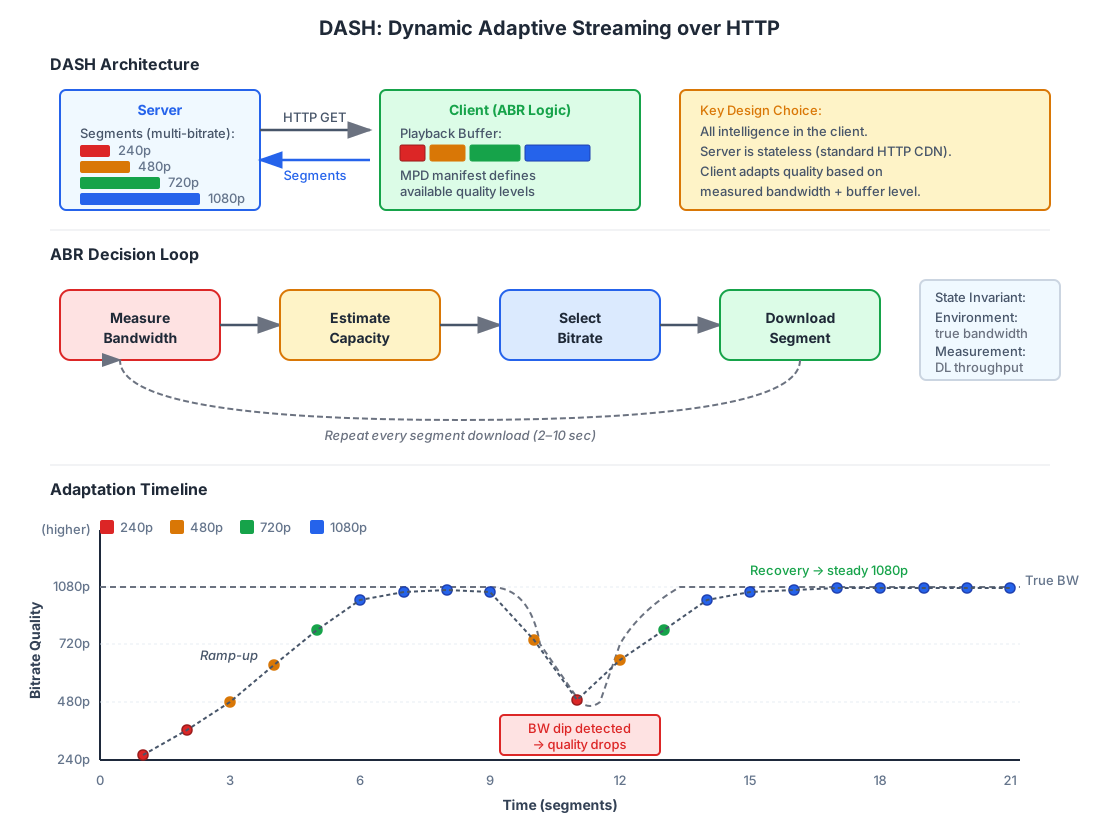
The DASH adaptive bitrate (ABR) control loop operates at segment granularity, typically one decision every 10 seconds. The client observes two critical state variables: achieved throughput (bytes received divided by segment download time) and buffer depth (seconds of content remaining before playback exhausts the buffer). These observations feed a decision system that selects the next segment’s bitrate from a manifest provided by the server.
The ABR decision loop operates at segment granularity: every 10 seconds, the client observes throughput (bytes received / download time), buffer depth (seconds of buffered content remaining), and current quality, then selects the next bitrate. If throughput is high and buffer is growing, the client requests a higher bitrate segment. If throughput drops and buffer is draining, the client immediately reduces bitrate to avoid rebuffering stalls. This state decomposition enables independent optimization: network measurement (throughput) informs but doesn’t control quality decisions; buffer state (playback resilience) prevents stalls without requiring accurate throughput prediction. The tradeoff is inherent: higher bitrate requests exploit available capacity but risk stalling if conditions degrade; lower bitrate requests are conservative but may underutilize a recovering network. Stability depends on ABR damping (using hysteresis to avoid oscillations between adjacent bitrate steps) and lookahead prediction (inferring future throughput from historical patterns rather than reacting only to the past).
7.5.3 Oscillation and Cross-Client Interference
Oscillation: If ABR too aggressive, it requests high bitrate, exhausts buffer, then drops quality sharply. Buffer swings high-to-low, causing perceptible quality fluctuations. Good ABR designs add hysteresis—different thresholds for increasing vs. decreasing bitrate—to damp oscillations.
Cross-client interference: Multiple clients on same bottleneck link. Each sees available bandwidth, acts independently. Synchronized increase triggers congestion, causing all to reduce quality together. This “bitrate thrashing” is visible as synchronized quality drops across viewers on same network.
7.5.4 ABR Algorithms: Buffer-Based and Throughput-Based
Buffer-based (BBA): Monitor buffer level. If buffer > high threshold, increase bitrate. If buffer < low threshold, decrease. Simple, stable, responsive to actual network impact on buffer.
Throughput-based: Estimate available bandwidth from recent chunk downloads. Request bitrate based on bandwidth estimate. More responsive but oscillates more if throughput is noisy.
Hybrid/Model Predictive Control (MPC): Combine buffer, throughput, and prediction of future segment quality to optimize long-term QoE (minimize stalls and quality switches). More complex but better stability.
7.6 VoIP: Conversational Time Constraints
VoIP operates under the tightest time constraint of any multimedia application. The human vocal tract and auditory system tolerate roughly 150 milliseconds of end-to-end delay before conversation becomes awkward. The requirement cascades through the entire system. VoIP operates under the tightest time constraint of any multimedia application. The human vocal tract and auditory system tolerate roughly 150 milliseconds of end-to-end delay before conversation becomes awkward. This requirement cascades through the entire system—from encoding algorithm (must complete in ~20ms to avoid buildup), through network transport (no time for retransmission; lost packets must be concealed), to playout (must buffer variability without adding excessive latency). Figure 7.2 shows how each component (encoding, transmission, buffering, decoding) contributes to the end-to-end delay budget.
The VoIP end-to-end pipeline decomposes the 150-millisecond delay budget across six critical stages. Audio is captured at 8 kHz sampling rate and grouped into 20-millisecond frames (160 samples), then encoded using bandwidth-efficient codecs (G.711 at 64 kbps or Opus at 20–64 kbps). Each packet is timestamped and transmitted over UDP/RTP, carrying a 12-byte RTP header that enables loss detection (via sequence numbers) and timing reconstruction (via timestamps). Unlike video, which can tolerate significant loss via FEC, VoIP cannot afford retransmission: requesting a lost packet adds RTT (50+ milliseconds), violating the delay budget. Instead, loss concealment—where the decoder reconstructs lost frames by interpolation—is the only feasible strategy, making packet loss a quality degradation rather than a reliability failure.
7.6.1 The 150ms Delay Budget
End-to-end delay decomposes into components:
- Encoding: Audio frames captured at 8 kHz (every 125 microseconds). Encoding combines multiple samples into frames (typically 20 milliseconds = 160 samples). Encoding latency ~20 milliseconds.
- Network: One-way propagation delay (e.g., 50 milliseconds across the US). Queueing at routers adds jitter (variable additional delay, 0–100+ milliseconds depending on congestion).
- Jitter buffer and decoding: Buffer (50–200 milliseconds) + decoding latency (~10 milliseconds).
Total: 20ms (encoding) + 50ms (propagation) + 100ms (playout buffer) + 10ms (decoding) = 180 milliseconds. Close to the 150-millisecond bound.
The pipeline decomposes into components: encoding captures and compresses audio (G.711 at 64 kbps, Opus at 20-64 kbps); network transmits RTP packets with sequence numbers and timestamps (enabling jitter buffer to reconstruct timing); jitter buffer (50-200ms) absorbs network variability, decoupling transmission jitter from playout smoothness; adaptive playout adjusts delay at talk-spurt boundaries, matching actual network jitter without excessive latency; decoding reconstructs audio. The sum is tight against the 150ms bound, leaving little margin. This is why retransmission is infeasible (adds RTT, 50+ ms): unlike video, VoIP cannot trade delay for reliability. Loss concealment (codec reconstructs lost frames by interpolation) is the only option.
This tight budget eliminates options available to other multimedia applications. Retransmission is infeasible—retransmitting a lost packet adds RTT (50+ milliseconds) of additional delay, violating the bound. VoIP uses instead: forward error correction (redundancy or parity packets) or graceful concealment (codec reconstructs lost frames by interpolating).
7.6.2 Jitter and Playout Delay Strategies
Network jitter—variability in packet inter-arrival times—is the primary challenge. Packets are transmitted at regular intervals (every 20 milliseconds) but arrive irregularly due to varying queueing delays.
Fixed playout delay: Set playout point to constant offset from first packet’s timestamp (e.g., 100 milliseconds). All packets in talkspurt play according to pre-computed schedule. If jitter exceeds expectation, packets arrive late, missing playout deadline—discarded. Result: audible gaps. If jitter is lower, playout delay is unnecessarily high, adding latency.
Adaptive playout delay: Observe actual jitter from packet arrival times. If jitter high, increase playout delay (give network more time). If jitter low, decrease delay (reduce latency). The playout point adjusts at talkspurt boundaries (silence detection marks boundaries), allowing adjustments without perceptible artifacts.
Adaptive playout adjusts the delay via exponential moving average of inter-arrival times. For the ith packet: - Delay estimate: d_i = (1 - α)·d_{i-1} + α·(r_i - t_i), where r_i is receive time, t_i is send time, α ≈ 0.01 - Deviation (jitter) estimate: v_i = (1 - β)·v_{i-1} + β·|r_i - t_i - d_i|, where β ≈ 0.01 - Playout delay for talkspurt start: p = d_i + k·v_i, where k = 3–4 (depends on network variability)
Adaptive playout adapts to actual network conditions rather than guessing once at startup. Complexity is modest but improves both latency and robustness.
7.6.3 Packet Loss Concealment
VoIP codecs implement packet loss concealment (PLC): when a packet is detected as lost (gap in sequence numbers), the decoder extrapolates or repeats the previous frame to mask the gap. Imperfect but far better than silence. Users tolerate 1% loss with PLC; 5% loss causes severe degradation (intelligibility collapses).
7.7 Real-Time Transport Protocols: RTP and RTCP
RTP (Real-time Transport Protocol) and RTCP (Real-time Control Protocol) form the foundation of VoIP and live streaming. RTP is a thin layer on top of UDP solving three problems bare UDP cannot: (1) loss detection via sequence numbers (gaps indicate lost packets), (2) timing reconstruction via timestamps (receiver buffers to correct network jitter, then plays out at correct intervals), (3) codec identification via payload type. RTCP provides the reverse channel: endpoints periodically report reception quality (fraction lost, jitter estimate, round-trip delay), enabling the sender to observe path conditions and adapt. The interaction between RTP and RTCP is shown in Figure 7.3, illustrating how the forward data path and reverse feedback channel coordinate.
RTP (Real-time Transport Protocol) is a thin layer on top of UDP that solves three critical problems bare UDP cannot: loss detection via 16-bit sequence numbers (gaps indicate lost packets), timing reconstruction via 32-bit timestamps (allowing receivers to buffer and playout at correct intervals despite network jitter), and codec identification via payload type fields (so receivers know how to decode). The sender transmits at regular intervals—approximately every 20 milliseconds for audio—with a 12-byte RTP header prepended to the audio payload. Each packet is numbered sequentially and timestamped at the source sampling time, enabling the receiver to reconstruct the original playout timing: two packets 20 milliseconds apart (in sampling time) are scheduled 20 milliseconds apart during playout, regardless of actual network arrival times. This decouples timing reconstruction from transport jitter, the core innovation enabling adaptive jitter buffers.
7.7.1 RTP: Timing and Loss Detection
RTP header fields: - Sequence number (16 bits): Incremented for each packet. Allows receiver to detect lost packets (gaps indicate loss) and reorder out-of-order delivery. - Timestamp (32 bits): Encodes sampling time of first sample in packet. Allows receiver to reconstruct correct playout timing regardless of network jitter. Two packets with timestamps 20 milliseconds apart, regardless of actual network arrival times, schedule 20 milliseconds apart during playout. - Payload type (7 bits): Identifies codec (G.711, Opus, H.264, VP9, etc.). Receiver knows how to decode. - Synchronization Source ID (SSRC) (32 bits): Identifies stream source. One IP can carry multiple streams; SSRC prevents mixing.
Concrete example: G.711 audio at 64 kbps encodes 160 bytes every 20 milliseconds. RTP packet = audio chunk (160 bytes) + RTP header (12 bytes). Encapsulated in UDP segment, sent.
7.7.2 RTCP: Feedback Channel
RTP is one-way (sender → receiver). RTCP provides reverse channel. At regular intervals (typically every few seconds), each endpoint sends RTCP report describing quality observed on receive path.
Sender reports describe stream: how many packets sent, how many octets, wall-clock time.
Receiver reports describe reception quality: packets lost (fraction of expected), cumulative loss count, jitter estimate (variance in inter-arrival times), round-trip delay.
RTCP bandwidth is capped (typically 5% of session bandwidth) to keep overhead bounded. For 64 kbps audio stream, RTCP is ~3 kbps. This low bandwidth means feedback is periodic (every 5–10 seconds), not instantaneous. Adaptation happens on slow timescale (seconds), missing rapid transient changes.
RTP headers carry sequence numbers (16 bits, incremented per packet) enabling loss detection—the receiver observes sequence gaps and knows packets were lost. Timestamps (32 bits) encode the sampling time of the first sample in the packet, allowing the receiver to reconstruct correct playout timing despite network jitter. Two packets 20 milliseconds apart (in sampling time) are scheduled 20 milliseconds apart during playout, regardless of actual network arrival times—the timestamp decouples timing reconstruction from transport jitter. RTCP operates on a slower timescale (seconds) but completes the feedback loop: endpoints observe loss rate, jitter (variance in inter-arrival times), and RTT, then report back. The sender uses RTCP reports to adapt: if loss is high, add FEC (forward error correction); if jitter is high, increase playout buffer; if RTT is high, reduce bitrate. The adaptation loop is intentionally slow (every few seconds) to avoid oscillations, but fast enough to respond to sustained path changes.
7.7.3 Closed-Loop Adaptation via RTCP
RTCP enables closed-loop feedback: endpoint A transmits → endpoint B measures loss/jitter/delay → RTCP report → endpoint A observes and may adapt. Adaptation possibilities include switching codecs (low-quality but loss-tolerant for high-loss conditions), adding redundancy (send 1.5 copies of each packet), applying FEC (forward error correction), adjusting bitrate.
The loop is stable because it’s slow—multiple seconds between observations and adaptations. Rapid changes (congestion spikes, sudden loss increases) are not immediately visible. This is intentional: frequent RTCP reports consume too much bandwidth.
7.8 Skype Architecture: Coordination Under NAT Constraint
Skype represents sophisticated real-time application architecture solving a fundamental constraint: majority of internet users sit behind Network Address Translators (NATs) and firewalls blocking incoming connections. Architecture must enable P2P despite this.
7.8.1 The NAT Traversal Problem
A NAT translates internal IP addresses to external addresses. When internal client (192.168.1.10, port 5000) sends UDP packet outbound, NAT rewrites source to (203.0.113.50, port 6789) and remembers mapping. Return packets rewritten back to internal address. But external client doesn’t know internal address or port—sees only (203.0.113.50:6789). If external client attempts inbound connection, NAT has no mapping—packet dropped.
7.8.2 Layered Hybrid Architecture
Control plane (signaling): When user A calls user B, system determines how to route media. This involves contacting login server (centralized), querying super nodes (well-provisioned peer nodes) for B’s address, and attempting connection establishment. Control traffic flows through super nodes and login server—centralized infrastructure providing directory, authentication, coordination.
Data plane (media): Once control establishes A and B are ready, media (RTP packets) flows either directly (P2P if NAT traversal succeeds) or through relay nodes (if P2P fails). Data plane separate from control, enabling independent optimization.
This separation enables scalability: control centralized (Skype servers handle directory/authentication), data distributed (direct P2P when possible, relayed only when necessary). Hybrid approach gracefully degrades—if all P2P fails, relay provides fallback, ensuring call connects (with added latency).
7.8.3 Coordination Model Transitions
System transitions adaptively between:
- Fully distributed: Two users on public IPs, direct P2P. No central server involvement after initial contact exchange.
- Partially distributed: One or both behind NAT, but hole punching succeeds. Direct P2P with server involvement only during setup.
- Fully centralized: NAT prevents P2P. All traffic relayed through server.
Choice adaptive—determined at connection time by what succeeds. Deployable: system works when P2P isn’t possible, while exploiting P2P when available (lower latency, no server load).
7.8.4 TCP Fallback and Upstream Bandwidth Optimization
Network operators often block UDP (VoIP) with firewalls or rate limit. Skype detects this and falls back to TCP, though TCP adds latency (connection handshakes, retransmission). Tradeoff acceptable—TCP with latency better than no connectivity.
Multi-party conferencing exploits asymmetry in network provisioning. Upstream bandwidth limited; downstream abundant. Architecture has each participant send one stream (their audio) upstream to central server, which broadcasts downstream. Minimizes upstream congestion—each sends one stream, server combines and distributes.
7.8.5 Practical Design: Super Nodes, Relays, Control Separation
Super nodes (well-provisioned peers) facilitate control plane. Relay nodes (or media relays) handle data. This distinction is crucial: super nodes need computational flexibility for directory services and intelligent routing decisions. Relay nodes are relatively simple—receive packet, forward packet. The separation enables scalability.
7.9 Advanced ABR Control: Model Predictive Control and Rate Selection
While buffer-based and throughput-based ABR algorithms provide the foundation, more sophisticated systems use model predictive control (MPC) to optimize longer-term quality metrics. MPC constructs an explicit model of future network conditions and video quality, then solves an optimization problem to maximize quality over a lookahead window (typically 10–30 seconds).
7.9.1 MPC Framework: Looking Ahead
Standard MPC approaches:
- Forecast future bandwidth based on recent history (e.g., autoregressive model of throughput)
- Model video quality as function of bitrate (using concave curve fitted to codec performance)
- Predict buffer evolution if certain bitrate selections are made
- Optimize bitrate sequence over lookahead window to maximize quality while preventing stalls
Concrete example: Given recent throughput history [4 Mbps, 4.5 Mbps, 3.8 Mbps], forecast next 4 segments (40 seconds). Quality curve: 1 Mbps = 0.7 quality, 2 Mbps = 0.8, 3 Mbps = 0.85, 5 Mbps = 0.88 (diminishing returns). Current buffer = 15 seconds. Target: select bitrates [b1, b2, b3, b4] maximizing sum of qualities while ensuring buffer never empties.
Result: MPC often chooses slightly lower bitrate for one segment to accumulate buffer headroom, enabling higher bitrate in later segments when quality improvement is bigger. This is fundamentally different from greedy buffer-based or throughput-based (which maximize immediate quality).
Tradeoff: MPC requires solving an optimization problem every segment (computationally more expensive) but produces smoother, higher-quality playback. Netflix uses variants of MPC internally; open-source players (DASH.js) increasingly integrate MPC approaches.
7.9.2 Codec Selection and Rate-Quality Curves
Not all codecs have identical quality-at-bitrate curves. Modern adaptive systems can also choose codecs dynamically:
- H.264: Ubiquitous, supports low bitrates well (good at 1–3 Mbps), older devices
- H.265/HEVC: ~2x better compression (same quality at 1/2 bitrate), but licensing complex
- VP9: Royalty-free alternative, similar compression to H.265
- AV1: Latest, ~30% better compression than H.265, but slow encoding, newer devices only
Strategic encoding decision: Pre-encode at both H.264 and H.265. Low-bitrate chunks (480p, 720p) encode in H.264 only (widely compatible). High-bitrate chunks (1080p, 4K) available in both. Client requests H.265 if device supports it, H.264 fallback. Streaming provider realizes 10–15% bitrate savings for modern viewers while maintaining compatibility.
7.10 VoIP Talkspurt Structure and Silence Suppression
VoIP traffic exhibits distinctive characteristics not present in continuous-bitrate video. Understanding this structure is essential for designing efficient systems.
7.10.1 Talkspurt and Silence Patterns
Human conversation naturally has structure: - Talkspurt: Active speaking. Person produces audio continuously for 0.5–10 seconds (typical ~1 second for turn-taking, longer for lecturing). - Silence: Pause between speakers. Typical 0.5–1 second (ITU studies show typical pause duration 0.4–0.6 seconds). - Packet rate: During talkspurt, sender produces packets every 20 milliseconds (50 packets/sec for G.711). During silence, ideally zero packets (silence suppression).
Silence suppression (VAD): Voice Activity Detection (VAD) algorithm detects when user is silent and stops encoding/transmitting. Savings: speech is ~40–50% silence (by time). VoIP systems eliminate silence packets, reducing bandwidth by ~50% on average. Trade-off: VAD sometimes incorrectly classifies background noise or speech pauses as silence, dropping packets (user notices brief audio dropouts). Modern VAD algorithms minimize false negatives.
7.10.2 Acoustic Echo Cancellation
In video calls, speaker plays out other participant’s audio through speakers. Microphone picks this up, creating acoustic echo. Echo cancellation algorithms (AEC) estimate and subtract the echo path. AEC is computationally demanding (typically 5–10% CPU on modern phones for high-quality AEC) and requires 50–500 milliseconds to converge. If AEC fails, echo is annoying (participant hears their own voice delayed).
7.11 RTCP Extensions and Synchronization
7.11.1 Audio-Video Synchronization via Sender Reports
When video and audio are separate RTP streams, they have unrelated timestamps (random initial offsets). Synchronizing playout requires absolute timing information. This is where RTCP Sender Reports are crucial.
Sender Report structure: - NTP timestamp (64-bit, wall-clock time): 32-bit seconds since 1900, 32-bit fraction of second - RTP timestamp (32-bit): Relative timestamp of the media stream - Packet count (32-bit): Total packets sent since session started - Octet count (32-bit): Total octets sent (bytes, not including headers)
Synchronization algorithm: 1. Receiver gets Sender Report for audio stream: NTP = T_audio, RTP = R_audio 2. Receiver gets Sender Report for video stream: NTP = T_video, RTP = R_video 3. When audio packet arrives with RTP = R_a, receiver knows wall-clock time of sample: T_a ≈ T_audio + (R_a - R_audio) / audio_sample_rate 4. Similarly for video: T_v ≈ T_video + (R_v - R_video) / video_sample_rate 5. Receiver plays both when T_a ≈ T_v (within jitter buffer tolerance, ±20 milliseconds)
This allows receiver to play audio and video in sync despite arriving on different paths, with different network delays.
7.12 Generative Exercises
Exercise 1: Cloud Gaming vs. VoIP
Cloud gaming (Google Stadia, Xbox Game Pass Cloud) streams rendered video frames from server to client, with client’s input (controller) sent back. What are time constraints?
- One-way latency requirement: <50 milliseconds (tighter than VoIP). Why? Gamers sensitive to input-to-display latency. Latencies >50ms cause noticeable input lag, degrading gameplay.
- Comparison to VoIP: VoIP tolerates 150ms because speech is slower (response seconds). Gaming has sub-100ms feedback loops (reaction to visual events).
- Encoding implications: Gaming video must encode quickly (low latency), sacrificing quality for speed. Live sports can use higher-quality encoding (5–10s latency acceptable). Cloud gaming cannot.
- Architecture implications: Cloud gaming cannot use ABR adaptation on Netflix’s timescale. Latency-optimal rate is fixed (achieve 50ms end-to-end), and server encodes at that rate. Scaling quality (4K vs. 1080p) requires different infrastructure, not per-segment adaptation.
Trace dependency: Tighter time constraint (50ms vs. 150ms) forces faster encoding (lower quality at same bitrate) and simpler adaptation (fixed-rate transmission vs. ABR).
Exercise 2: Low-Latency Live Streaming Trade-offs
YouTube Live (30–60s latency) vs. Twitch (5–10s latency). What architectural changes reduce latency?
- Buffering: Smaller server and viewer buffers (reduce startup threshold, safety margin).
- Segment duration: Shorter segments (1–2s vs. 10s) enable faster ABR decisions, lower latency per segment. Tradeoff: more HTTP requests, higher framing overhead.
- Encoding: Live encoding faster (more latency-optimized, lower quality). Ingest buffering minimized.
- Distribution: Relay servers geographically closer (reduce propagation). Requires denser infrastructure.
- Chat coordination: 5-second latency = loose viewer-broadcaster coordination. 30 seconds = chat breaks entirely.
Economic tradeoff: Lower latency requires denser infrastructure (more edge servers), faster lower-quality encoding, smaller buffers (higher stalling risk). Twitch accepts cost for gaming (interactivity). YouTube prioritizes scale (lower cost).
Exercise 3: Encoding Parameters for 1080p Adaptive Ladder
Netflix encodes each piece of content at multiple bitrates. For 1080p high-motion scene (action movie), design bitrate ladder considering: - Network variability: 10–100 Mbps range - Rebuffering catastrophic (minimize <1% risk) - Startup delay acceptable (<5 seconds) - Quality improvement diminishing above 5 Mbps
Design: [500k, 1M, 2M, 3M, 5M, 8M]. Why this spacing? - 500k: Fallback for highly congested (ensures playback) - 1M–2M: Low-throughput common case - 2M–5M: Typical broadband (big quality jumps matter here) - 5M–8M: High-throughput, but diminishing returns above 5M
Tradeoff: More bitrates = more flexibility but higher encoding cost. Too few = coarse adaptation (visible quality jumps).
Exercise 4: RTP Sequence Number Wraparound
RTP sequence number is 16 bits (0–65535). At 50 packets/second (G.711), wraparound occurs every ~21 minutes. Receivers must handle wraparound—packets arriving out of order near wraparound boundary. Design: use sequence number gap >1000 as indicator of new stream or sequence discontinuity (lost many packets). Smaller gaps tolerated (reordering).
Exercise 5: DASH Segment Duration Trade-offs
A streaming service offers two segment durations: 2 seconds vs. 10 seconds. Compare:
2-second segments: - Faster ABR adaptation (decision every 2 seconds vs. 10) - More responsive to congestion spikes - More HTTP requests (600 vs. 120 requests per 20-minute video) - More DASH header overhead, more TCP slow-start phases - Lower latency per segment, lower startup overhead
10-second segments: - Fewer HTTP requests, less overhead - Smoother quality (fewer ABR decisions, less oscillation) - Slower adaptation to congestion (potentially longer stalls) - Larger startup threshold needed
Design decision: Sports (fast action, congestion-sensitive) prefer 2-second segments. Movies (slower, more stable) prefer 10-second. Netflix uses ~10 seconds; YouTube TV (live sports) uses shorter segments.
Exercise 6: Jitter Buffer Dimensioning for Variable Throughput
A VoIP receiver observes inter-arrival jitter (time between consecutive packet arrivals): - Packets 1–10: 20ms gap (ideal) - Packet 11: 50ms gap (network congestion) - Packet 12: 22ms gap - Packet 13: 60ms gap (large spike)
Current jitter buffer = 50ms. Which packets will be lost if using fixed playout delay at 50ms from first packet? - Packets 1–10: Arrive by 200ms, played at 50ms: safe - Packet 11: Arrives at 250ms (20×10 + 50), played at 250ms: safe - Packet 12: Arrives at 272ms, played at 270ms (20ms per packet): lost (arrives after playout) - Packet 13: Arrives at 332ms, played at 290ms: lost
If jitter buffer increased to 70ms (all packets played at 70ms from start): all safe, but conversation has extra 20ms latency.
Adaptive playout would increase buffer after packets 11–13 to ~80ms, then decrease back to 50ms after silence period. Users never notice the adjustment.
7.13 The Four Invariants Applied to Multimedia
Multimedia applications exemplify how the four invariants (State, Time, Coordination, Interface) organize design space. Each application category makes distinctive choices:
7.13.1 State Invariant: What Information Must Be Maintained?
Stored Streaming: - Environment: Network throughput (time-varying, unknown advance) - Measurement: Recent chunk download times, current buffer level - Belief: Estimated available bandwidth (exponential moving average), estimated rebuffering risk - The client builds a model of “how much bandwidth do I have right now?” based on recent observation
Conversational (VoIP): - Environment: Network jitter and delay (packet inter-arrival times) - Measurement: Packet arrival times relative to first packet in talkspurt - Belief: Estimated delay (d_i) and jitter deviation (v_i), used to set playout timing - The receiver builds a model of “how variable is the network?” and sets playout accordingly
Live Streaming: - Environment: Broadcaster’s input rate (live frame generation) - Measurement: Server-side ingest buffer level, viewer-side buffer level - Belief: Expected broadcaster bitrate (constant), viewer bandwidth (like stored streaming) - Hybrid: server-side has deterministic input; viewer-side has uncertain network
7.13.2 Time Invariant: When Do Events Happen?
Stored: Events happen in client time. User presses play at time T; buffering begins; first frame appears at T + startup_delay.
Conversational: Events happen in real-time, synchronized across endpoints. Encoding at 20ms intervals, playout at 20ms intervals, ~150ms total E2E delay.
Live: Events happen in source time, but viewers observe them delayed (5–60s offset). Broadcaster encodes at capture time T; server receives at T+δ_capture; distributes to viewers at T+δ_capture+server_buffer.
7.13.3 Coordination Invariant: Who Decides?
Stored: Client decides. Client chooses bitrate (via ABR algorithm), when to buffer next chunk, when to seek. Server is passive responder.
Conversational: Distributed. Both endpoints encode simultaneously; both maintain jitter buffers; both estimate network conditions (send RTCP reports). No entity is “in charge”—both must coordinate.
Live: Source-centric for content (broadcaster decides what to broadcast), then server-mediated (server buffers and distributes). Viewers passive consumers.
7.13.4 Interface Invariant: How Do Components Interact?
Stored: HTTP/HTTPS. Client makes GET requests for chunks. Manifest describes available bitrates. Stateless, cacheable.
Conversational: RTP/UDP for media, RTCP/UDP for feedback. SIP or WebRTC signaling for call setup.
Live: RTMP (source to server) or Secure RTMPS. HLS/DASH (server to viewers). Control plane might use RTMP; data plane uses HTTP.
7.14 Failure Modes and Robustness
Understanding failure modes is essential for design. Each application category has distinctive failure signatures:
7.14.1 Stored Streaming Failures
Rebuffering stall: Most catastrophic. User experiences playback pause. Root cause: buffer empty because network throughput fell below required bitrate. Prevented by ABR algorithm reducing bitrate preemptively, or larger initial buffer.
Startup timeout: Manifest download or initial chunks fail to arrive. Prevented by reasonable startup thresholds (typically 3–10 seconds) and fallback servers.
Quality degradation: Video oscillates between quality levels or stays permanently low. Caused by ABR algorithm overfitting to transient throughput fluctuations. Mitigated by smoothing and hysteresis.
7.14.2 VoIP Failures
One-way audio: User hears other party, but cannot be heard. Caused by asymmetric NAT (outbound hole punching works, inbound doesn’t) or firewall blocking return path. Mitigated by relay fallback, but adds latency.
Echo: Acoustic echo uncancelled. Caused by AEC algorithm failure (microphone too close to speaker, unexpected room acoustics). Highly annoying (user stops talking).
Jitter-induced gaps: Playout buffer too small, packets arrive after playout deadline. Users tolerate occasional 1–2 gaps per minute; frequent gaps (>5/minute) cause frustration.
Loss-induced intelligibility: >5% packet loss. Even with PLC, speech becomes difficult to understand. Mitigated by FEC (redundancy) or quality-of-service network support.
7.14.3 Live Streaming Failures
Broadcast buffering: Broadcaster’s encoder buffer fills (input faster than can transmit). Encoder drops frames or reduces quality. Viewers see dropped frames or quality dips.
Viewer startup stall: Viewer requests stream while broadcaster just started. Server buffer empty (only 1–2 seconds of content). Large startup delay or occasional stall. Mitigated by large server buffer (but adds latency to all viewers).
Chat lag explosion: Viewer sends message in chat, sees broadcaster response 20+ seconds later. Chat coordination breaks down. Cannot have real-time back-and-forth.
7.15 Cross-Application Principles
All three categories exemplify the four invariants and three principles (disaggregation, closed-loop reasoning, decision placement):
Disaggregation: Stored streaming disaggregates content preparation (encode, segment, package) from delivery (HTTP) from adaptation (ABR). VoIP disaggregates transport (RTP/UDP) from control (RTCP) from playout (jitter buffer). Skype disaggregates signaling (super nodes) from media (relay nodes).
Closed-Loop Reasoning: Stored streaming measures throughput, estimates bandwidth, adjusts bitrate. VoIP measures inter-arrival times, estimates jitter, adjusts playout timing. Skype measures connection quality, attempts P2P, falls back to relay if needed.
Decision Placement: Stored streaming: distributed client-side (each client decides independently). VoIP: distributed endpoint-side (each endpoint manages its jitter buffer). Skype: adaptive (distributed when possible, centralized when required).
These principles are not specific to multimedia—they recur throughout network systems. The framework of four invariants makes this recurrence visible and analyzable.
7.16 Concretizing the Design Space: Netflix, Twitch, and Zoom
To ground abstract principles in operational reality, consider three systems at market-leading scale:
7.16.1 Netflix: Stored Streaming at Billion-User Scale
Netflix encodes each film at 20–50 different bitrates (depending on resolution and source quality). A 2-hour film in HD might have bitrate options: [145k, 356k, 771k, 1.4M, 2.4M, 5.8M, 15M] kbps. Segments are 10 seconds; typical ~1,440 chunks per hour per bitrate. Storage for one title: ~500 GB (full ladder).
ABR algorithm: Netflix clients use “buffer-based” approach internally, tracking buffer level and adjusting bitrate to keep buffer between 10–60 seconds. During congestion, drops to 145k (grayscale video quality). During good conditions, climbs to 5.8M (1080p high quality). Goal: zero rebuffering while maximizing quality.
CDN strategy: Netflix edges content to ISP-operated caches (Open Connect program). Most Netflix traffic is delivered from edge, avoiding backbone congestion. Content is replicated by bitrate: popular titles (Stranger Things) cache all bitrates; niche titles cache only popular bitrates (e.g., 1.4M and 5.8M). Unpopular bitrates fall back to origin (regional cache).
Latency: Netflix allows 10–30 second startup delay (users expect loading screen). Buffering 10+ seconds before playback is acceptable. Once playing, viewers tolerate 1–2 second stalls per 2-hour session but abandon at 3+.
7.16.2 Twitch: Live Streaming with Gaming Focus
Twitch prioritizes low latency (5–10 seconds) and chat interactivity. Broadcaster uploads via RTMP at 4–8 Mbps (source bitrate, usually high-quality). Server ingests, buffers 2–4 seconds, then transcodes to 4 quality variants (720p60, 720p30, 480p, 360p) and distributes via HLS.
Transcoding cost: Real-time video transcoding is computationally expensive. Twitch runs clusters of encoding servers, consuming roughly equivalent CPU to all the broadcast bandwidth. Infrastructure cost: ~$50–200M annually for infrastructure, mostly transcoding and relay.
Chat interaction: Streamers respond to chat with ~10 second latency (they see messages 10 seconds late, responses appear 10 seconds late to viewers). Tight enough for gaming cues (“skip the next section!”) but not tight enough for natural back-and-forth conversation.
Creator incentives: Streamers are incentivized to play high-engagement, low-latency games (Fortnite, League of Legends) because chat drives audience growth. Latency-sensitive games show preference for Twitch. Sports events (typically 30–60s latency on YouTube Live) have different audience expectations.
7.16.3 Zoom: Real-Time Video Conferencing at Scale
Zoom focuses on minimizing end-to-end latency while handling wildly variable bandwidth (conference participants on 4G cellular, fiber broadband, satellite).
Adaptive codec: Codec choice adapts in real-time. Good conditions: VP9/VP8 at 3 Mbps. Congestion: H.264 at 500 kbps. Loss: low-bandwidth codec with FEC. Video frame rate also adapts (30 fps → 15 fps → 1 fps during severe congestion).
Jitter buffer: Zoom adaptively adjusts jitter buffer (50–200 milliseconds) based on observed network. If loss detected, increases buffer (accept slightly more latency). If network improves, decreases buffer (reduce latency).
Network adaptation loop: Every packet arriving triggers lightweight decision logic. If loss/jitter high, next frame encoded at lower quality or lower resolution. If available bandwidth abundant, increase quality. Loop timescale: ~milliseconds to seconds (much faster than DASH, which is ~10 seconds).
Relay infrastructure: Zoom operates Global Network for NAT traversal and relay. If P2P path unavailable or congested, automatically relays through nearest Zoom data center. Users don’t configure this—system detects and switches automatically.
7.17 Summary: The Time Invariant as Organizing Principle
This chapter has traced a single question—when must data arrive?—through three distinct application categories. The answer cascades through every design choice:
Stored streaming (no deadline): Large buffers, complex encoding, HTTP delivery, client-side ABR adaptation. Goals: maximize quality while preventing rebuffering.
Live streaming (moderate deadline, 5–60s offset acceptable): Server and viewer buffers, RTMP ingest + HTTP egress, source-centric coordination. Goals: distribute scale while maintaining latency bounds.
Conversational (tight deadline, <150ms): Minimal buffers, simple codecs, RTP/UDP, peer-to-peer with relay fallback. Goals: minimize latency while tolerating acceptable loss.
The Time invariant is not deterministic—multiple valid designs exist for any application. Netflix chose HTTP/DASH for simplicity and CDN leverage. Skype chose P2P with relay for cost and latency. WebRTC chose a hybrid: browser-based signaling (simple) with direct P2P media (low latency).
What is invariant is the structural question. Every multimedia system must answer: what state must I maintain? How do I handle time? Who decides? How do components interact? The answers differ, but the analytical framework provides vocabulary for comparing and predicting system behavior.
7.18 References
- Schulzrinne, H., Casner, S., Frederick, R., and Jacobson, V. (2003). “RTP: A Transport Protocol for Real-Time Applications.” RFC 3550.
- Stockhammer, T. (2011). “Dynamic Adaptive Streaming over HTTP—Standards and Design Principles.” Proc. ACM Multimedia Systems Conference.
- ITU-T Recommendation G.114 (2003). “One-way transmission time.” International Telecommunication Union.
- Jacobson, V. (1988). “Congestion Avoidance and Control.” Proc. ACM SIGCOMM.
- Nichols, K. and Jacobson, V. (2012). “Controlling Queue Delay.” ACM Queue, 10(5).
- 3GPP (2018). “Study on New Radio Access Technology.” 3GPP TR 38.912.
- Kurose, J. F. and Ross, K. W. (2021). Computer Networking, 8th Edition. Pearson.
This chapter is part of “A First-Principles Approach to Networked Systems” by Arpit Gupta, UC Santa Barbara, licensed under CC BY-NC-SA 4.0.